Krzemień Paweł, Kasperczyk Sławomir, Banach Maciej, Kasperczyk Aleksandra, Dobrakowski Michał, Tomasik Tomasz, Windak Adam, Mastej Mirosław, Catapano Alberico, Ray Kausik K, Mikhailidis Dimitri P, Toth Peter P, Howard George, Lip Gregory Yh, Tomaszewski Maciej, Charchar Fadi J, Sattar Naveed, Williams Bryan, MacDonald Thomas M, Penson Peter E, Jóźwiak Jacek J
Euroimmun Polska Sp. z o.o., Wroclaw, Poland.
Department of Biochemistry, Faculty of Medical Sciences in Zabrze, Medical University of Silesia, Katowice, Poland.
Biomark Insights. 2022 Jan 30;17:11772719211066791. doi: 10.1177/11772719211066791. eCollection 2022.
The anti-DFS70 autoantibodies are one of the most commonly and widely described agent of unknown clinical significance, frequently detected in healthy individuals. It is not known whether the DFS70 autoantibodies are protective or pathogenic. One of the factors suspected of inducing the formation of anti-DFS70 antibodies is increased oxidative stress. We evaluated the coexistence of anti-DFS70 antibodies with selected markers of oxidative stress and investigated whether these antibodies could be considered as indirect markers of oxidative stress.
The intensity of oxidative stress was measured in all samples via indices of free-radical damage to lipids and proteins such as total oxidant status (TOS), concentrations of lipid hydroperoxides (LPH), lipofuscin (LPS), and malondialdehyde (MDA). The parameters of the non-enzymatic antioxidant system, such as total antioxidant status (TAS) and uric acid concentration (UA), were also measured, as well as the activity of superoxide dismutase (SOD). Based on TOS and TAS values, the oxidative stress index (OSI) was calculated. All samples were also tested with indirect immunofluorescence assay (IFA) and 357 samples were selected for direct monospecific anti DFS70 enzyme-linked immunosorbent assay (ELISA) testing.
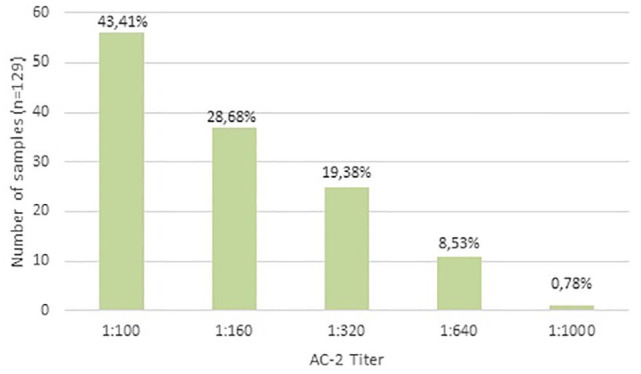
The anti-DFS70 antibodies were confirmed by ELISA test in 21.29% of samples. Compared with anti-DFS70 negative samples we observed 23% lower concentration of LPH ( = .038) and 11% lower concentration of UA ( = .005). TOS was 20% lower ( = .014). The activity of SOD was up to 5% higher ( = .037). The Pearson correlation showed weak negative correlation for LPH, UA, and TOS and a weak positive correlation for SOD activity.
In samples positive for the anti-DFS70 antibody a decreased level of oxidative stress was observed, especially in the case of samples with a high antibody titer. Anti-DFS70 antibodies can be considered as an indirect marker of reduced oxidative stress or a marker indicating the recent intensification of antioxidant processes.
抗DFS70自身抗体是临床上最常被广泛描述但临床意义不明的物质之一,在健康个体中经常检测到。目前尚不清楚DFS70自身抗体是具有保护作用还是致病作用。怀疑诱导抗DFS70抗体形成的因素之一是氧化应激增加。我们评估了抗DFS70抗体与所选氧化应激标志物的共存情况,并研究了这些抗体是否可被视为氧化应激的间接标志物。
通过脂质和蛋白质的自由基损伤指标,如总氧化剂状态(TOS)、脂质过氧化氢(LPH)、脂褐素(LPS)和丙二醛(MDA)的浓度,测量所有样本中的氧化应激强度。还测量了非酶抗氧化系统的参数,如总抗氧化状态(TAS)和尿酸浓度(UA),以及超氧化物歧化酶(SOD)的活性。根据TOS和TAS值计算氧化应激指数(OSI)。所有样本均采用间接免疫荧光法(IFA)检测,357个样本被选用于直接单特异性抗DFS70酶联免疫吸附测定(ELISA)检测。
ELISA检测在21.29%的样本中证实了抗DFS70抗体的存在。与抗DFS70阴性样本相比,我们观察到LPH浓度降低23%(P = 0.038),UA浓度降低11%(P = 0.005)。TOS降低20%(P = 0.014)。SOD活性高达5%(P = 0.037)。Pearson相关性分析显示,LPH、UA和TOS呈弱负相关,SOD活性呈弱正相关。
在抗DFS70抗体阳性的样本中,观察到氧化应激水平降低,尤其是抗体滴度高的样本。抗DFS70抗体可被视为氧化应激降低的间接标志物或表明近期抗氧化过程增强的标志物。