Rickenbach Chiara, Gericke Christoph
Institute for Regenerative Medicine, University of Zurich, Schlieren, Switzerland.
Front Neurosci. 2022 Jan 20;15:806260. doi: 10.3389/fnins.2021.806260. eCollection 2021.
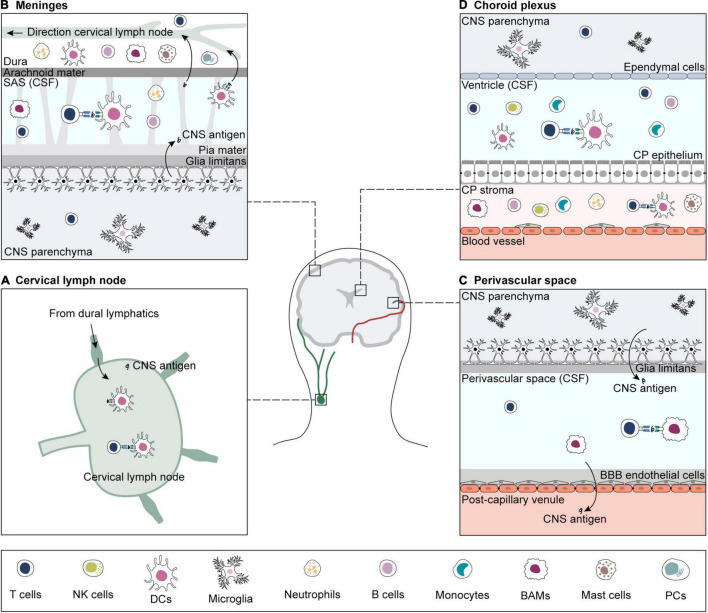
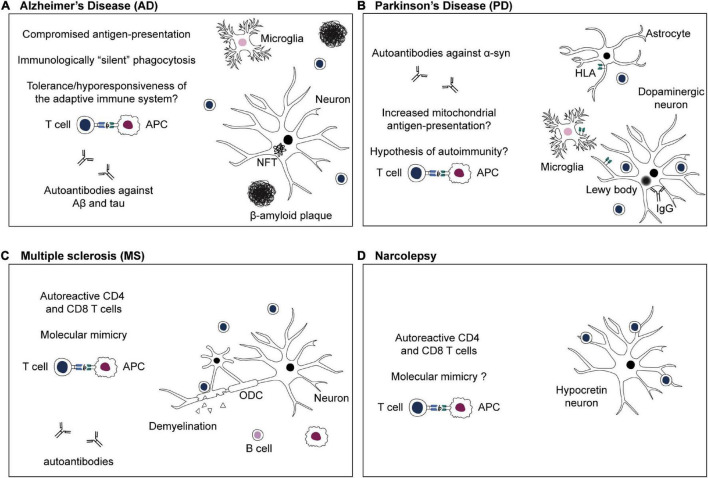
The field of neuroimmunology endorses the involvement of the adaptive immune system in central nervous system (CNS) health, disease, and aging. While immune cell trafficking into the CNS is highly regulated, small numbers of antigen-experienced lymphocytes can still enter the cerebrospinal fluid (CSF)-filled compartments for regular immune surveillance under homeostatic conditions. Meningeal lymphatics facilitate drainage of brain-derived antigens from the CSF to deep cervical lymph nodes to prime potential adaptive immune responses. During aging and CNS disorders, brain barriers and meningeal lymphatic functions are impaired, and immune cell trafficking and antigen efflux are altered. In this context, alterations in the immune cell repertoire of blood and CSF and T and B cells primed against CNS-derived autoantigens have been observed in various CNS disorders. However, for many diseases, a causal relationship between observed immune responses and neuropathological findings is lacking. Here, we review recent discoveries about the association between the adaptive immune system and CNS disorders such as autoimmune neuroinflammatory and neurodegenerative diseases. We focus on the current challenges in identifying specific T cell epitopes in CNS diseases and discuss the potential implications for future diagnostic and treatment options.
神经免疫学领域认可适应性免疫系统在中枢神经系统(CNS)健康、疾病及衰老过程中的作用。虽然免疫细胞向中枢神经系统的迁移受到高度调控,但在稳态条件下,少量经历过抗原刺激的淋巴细胞仍可进入充满脑脊液(CSF)的腔室进行常规免疫监测。脑膜淋巴管有助于将脑源性抗原从脑脊液引流至颈深淋巴结,以启动潜在的适应性免疫反应。在衰老和中枢神经系统疾病期间,脑屏障和脑膜淋巴功能受损,免疫细胞迁移和抗原流出发生改变。在此背景下,在各种中枢神经系统疾病中已观察到血液和脑脊液中免疫细胞库以及针对中枢神经系统衍生自身抗原的T细胞和B细胞的改变。然而,对于许多疾病而言,所观察到的免疫反应与神经病理学发现之间缺乏因果关系。在此,我们综述了关于适应性免疫系统与中枢神经系统疾病(如自身免疫性神经炎症和神经退行性疾病)之间关联的最新发现。我们关注于识别中枢神经系统疾病中特定T细胞表位的当前挑战,并讨论其对未来诊断和治疗选择的潜在影响。