Jin Shanyue, Li Yannan, Xiao Shufeng
College of Business, Gachon University, Seongnam, South Korea.
Graduate School of Technology Management, Kyung Hee University, Yongin, South Korea.
Front Psychol. 2022 Jan 20;12:803681. doi: 10.3389/fpsyg.2021.803681. eCollection 2021.
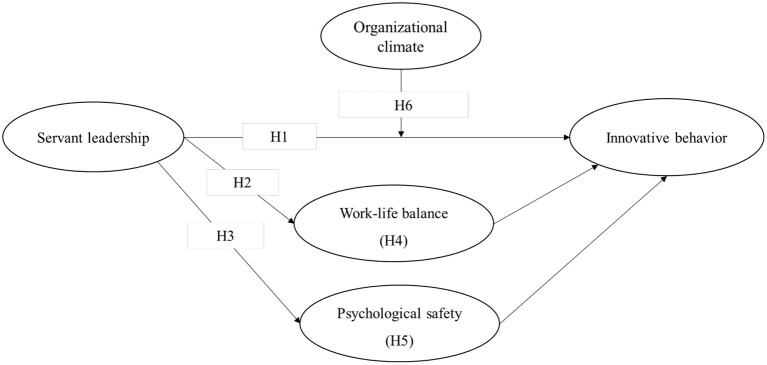
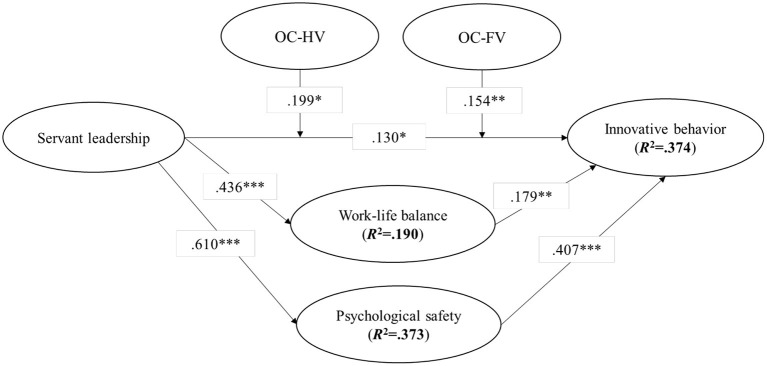
The coronavirus disease 2019 (COVID-19) pandemic has severely damaged the global industrial supply chain and accelerated the digital transformation of the global economy. In such rapidly changing environments, multinational corporations (MNCs) should encourage employees to be more innovative in various fields than ever before. With the onset of the COVID-19 pandemic, employees have become psychologically anxious, their working conditions have deteriorated, and they are in danger of losing their jobs. In this study, we aim to address the question of whether servant leadership facilitates the innovative behavior of employees working in emerging-market MNCs when servant leadership is adopted within the firms. In addition, we explore the mediating roles of work-life balance and psychological stability perceived by employees, and the moderating role of organizational climate in the relationship between servant leadership and MNC employees' innovative behavior. In doing so, we collected data from a sample of 307 Chinese employees who are employed by five different Chinese MNCs from the Internet, information technology, electronics, and e-commerce industries. Based on a sample of survey data collected from employees of Chinese MNCs, we empirically test these ideas by specifically examining how servant leadership may shape the innovation behavior of employees in these MNCs. The results suggest that servant leadership positively influences employees' innovative behavior, and that the contribution of servant leadership to employees' innovative behavior is mediated by work-life balance and psychological stability as well as moderated by the degree of organizational climate. Moreover, the different organizational climates of these MNC employees are also expected to significantly shape the relationship between servant leadership and employees' innovative behavior. This study enriches our understanding of the importance of servant leadership in driving the innovative behaviors of employees in emerging-market MNCs and provides new insights into the mechanisms through which emerging-market MNCs can motivate their employees to be more innovative in their jobs. Thus, this study contributes to the research on human resource management by offering important implications vis-à-vis how MNCs manage their employees more effectively in addressing and responding to the dramatically changing global landscape in the post COVID-19 era.
2019年冠状病毒病(COVID-19)大流行严重破坏了全球工业供应链,并加速了全球经济的数字化转型。在如此迅速变化的环境中,跨国公司(MNCs)应鼓励员工在各个领域比以往任何时候都更具创新性。随着COVID-19大流行的爆发,员工在心理上变得焦虑,工作条件恶化,并且面临失业风险。在本研究中,我们旨在解决当企业采用仆人式领导时,仆人式领导是否有助于新兴市场跨国公司员工的创新行为这一问题。此外,我们探讨员工所感知的工作与生活平衡和心理稳定性的中介作用,以及组织氛围在仆人式领导与跨国公司员工创新行为之间关系中的调节作用。为此,我们从互联网、信息技术、电子和电子商务行业的五家不同中国跨国公司雇佣的307名中国员工样本中收集了数据。基于从中国跨国公司员工收集的调查数据样本,我们通过具体考察仆人式领导如何塑造这些跨国公司员工的创新行为来实证检验这些观点。结果表明,仆人式领导对员工的创新行为有积极影响,并且仆人式领导对员工创新行为的贡献通过工作与生活平衡和心理稳定性来中介,同时受到组织氛围程度的调节。此外,这些跨国公司员工不同的组织氛围也预计会显著塑造仆人式领导与员工创新行为之间的关系。本研究丰富了我们对仆人式领导在推动新兴市场跨国公司员工创新行为方面重要性的理解,并为新兴市场跨国公司激励员工在工作中更具创新性的机制提供了新见解。因此,本研究通过就跨国公司如何更有效地管理员工以应对和适应COVID-19后时代急剧变化的全球格局提供重要启示,为人力资源管理研究做出了贡献。