Sun Wanxiao, Qing Qiting, Cheng Xu, Chen Jing, Yu Ningning, Zhu Liyuan, Zhao Mei
Department of Basic Nursing, School of Nursing, Anhui Medical University, Hefei, Anhui 230032, P.R. China.
Exp Ther Med. 2022 Mar;23(3):206. doi: 10.3892/etm.2022.11129. Epub 2022 Jan 7.
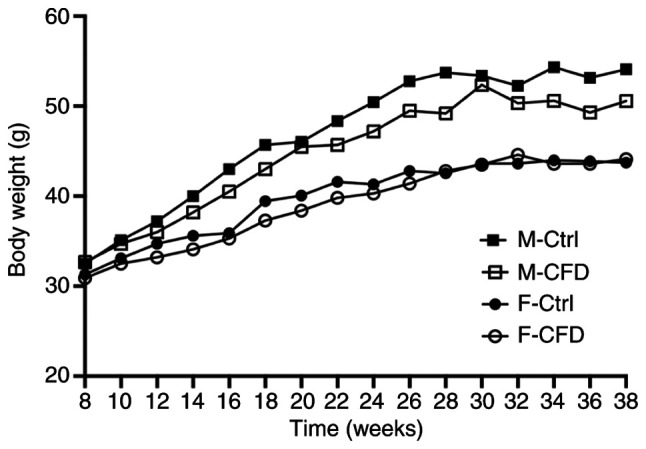
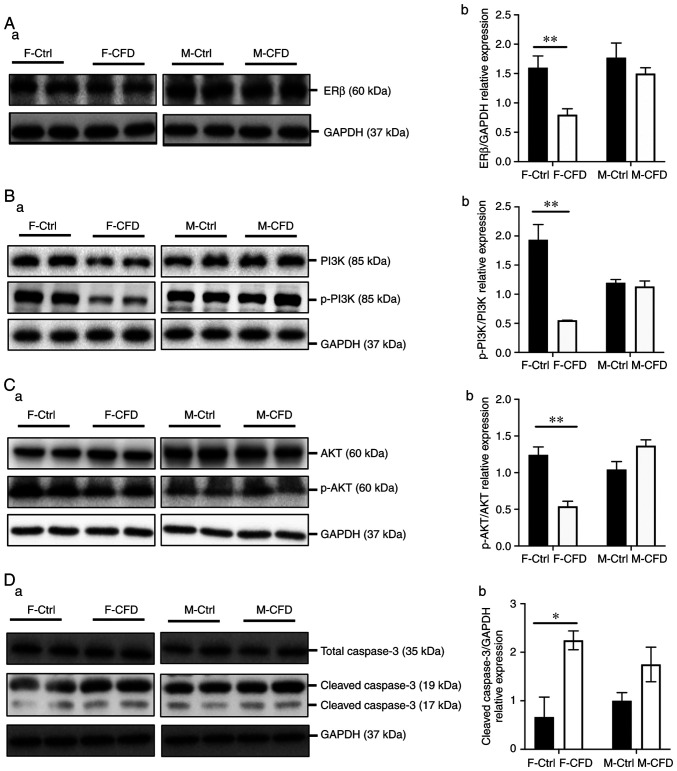
Although previous studies have reported that serum folate levels are negatively associated with depression in women but not men, it remains unclear whether folate deficiency can directly lead to depression and whether sex difference serves a role in this condition, since the potential mechanism remains elusive. Therefore, the present study aimed to investigate whether folate deficiency results in differences in parameters associated with depression between males and females. CD-1 mice received either a standard control diet or a folate-deficient diet from 10 to 38 weeks of age, following which behavioral assays, such as an open field test, sucrose preference test and forced swim test were performed throughout week 38. Serum and cerebral cortex samples were subsequently collected for assessment. Serum folate, homocysteine, estradiol (E2) and testosterone levels were measured using chemiluminescence, enzymatic cycling assay and electrochemiluminescence immunoassays. The cerebral cortex was used for western blot analysis, to detect the expression levels of estrogen receptor β (ERβ), PI3K/AKT pathway and caspase-3. The results revealed that compared with those in female mice that received standard control diet, female mice that received folate-deficient diet exhibited lower E2 concentrations, lower sucrose preferences (as determined through the sucrose preference test), longer durations of immobility (as determined in the forced swim test) and less time spent in the central areas of the open field test. Western blotting demonstrated that the expression levels of ERβ and the phosphorylation levels of PI3K and AKT were decreased, whilst the expression levels of cleaved caspase-3 were increased, in the cerebral cortex of female mice that received folate-deficient diet. However, no differences in E2 concentration, behavioral assay parameters or protein levels of ERβ, phosphorylated (p-)PI3K, p-AKT and cleaved caspase-3 could be observed in male mice regardless of whether they received standard control or folate-deficient diets. Collectively, these results revealed that folate deficiency only led to depression-like behavior in female mice. This may be associated with reduced E2 levels, which may inhibit the PI3K/AKT pathway and upregulate the expression of cleaved caspase-3 to promote neuronal apoptosis.
尽管先前的研究报告称,血清叶酸水平与女性而非男性的抑郁症呈负相关,但叶酸缺乏是否能直接导致抑郁症以及性别差异在这种情况下是否起作用仍不清楚,因为潜在机制仍然难以捉摸。因此,本研究旨在调查叶酸缺乏是否会导致雄性和雌性小鼠在与抑郁症相关的参数上存在差异。CD-1小鼠从10周龄到38周龄接受标准对照饮食或叶酸缺乏饮食,之后在第38周进行了一系列行为测试,如旷场试验、蔗糖偏好试验和强迫游泳试验。随后收集血清和大脑皮层样本进行评估。使用化学发光法、酶循环法和电化学发光免疫分析法测量血清叶酸、同型半胱氨酸、雌二醇(E2)和睾酮水平。大脑皮层用于蛋白质印迹分析,以检测雌激素受体β(ERβ)、PI3K/AKT通路和caspase-3的表达水平。结果显示,与接受标准对照饮食的雌性小鼠相比,接受叶酸缺乏饮食的雌性小鼠E2浓度较低、蔗糖偏好较低(通过蔗糖偏好试验测定)、不动时间较长(在强迫游泳试验中测定)以及在旷场试验中央区域花费的时间较少。蛋白质印迹分析表明,接受叶酸缺乏饮食的雌性小鼠大脑皮层中ERβ的表达水平以及PI3K和AKT的磷酸化水平降低,而裂解的caspase-3的表达水平升高。然而,无论雄性小鼠接受标准对照饮食还是叶酸缺乏饮食,均未观察到E2浓度、行为测试参数或ERβ、磷酸化(p-)PI3K、p-AKT和裂解的caspase-3蛋白水平存在差异。总体而言,这些结果表明叶酸缺乏仅导致雌性小鼠出现类似抑郁的行为。这可能与E2水平降低有关,E2水平降低可能会抑制PI3K/AKT通路并上调裂解的caspase-3的表达以促进神经元凋亡。