Harbison Aoife M, Fogarty Carl A, Phung Toan K, Satheesan Akash, Schulz Benjamin L, Fadda Elisa
Department of Chemistry and Hamilton Institute, Maynooth University Maynooth Kildare Ireland
School of Chemistry and Molecular Biosciences, The University of Queensland St Lucia QLD Australia.
Chem Sci. 2021 Nov 25;13(2):386-395. doi: 10.1039/d1sc04832e. eCollection 2022 Jan 5.
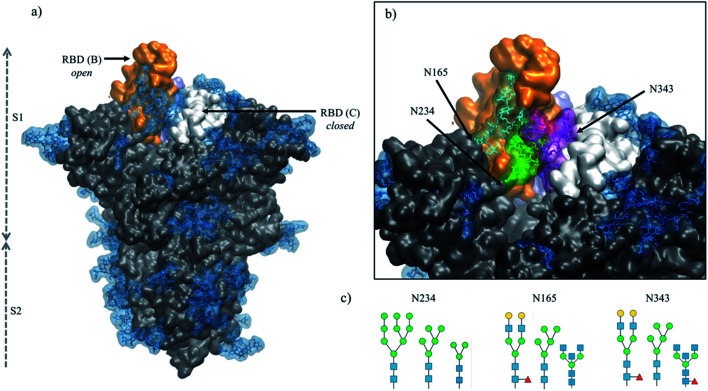
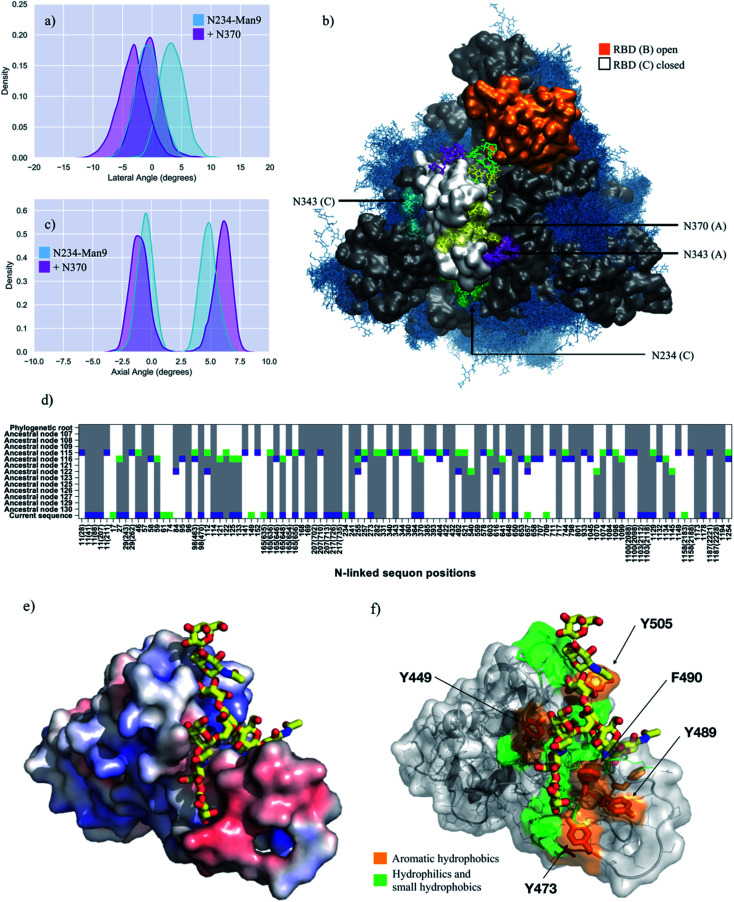
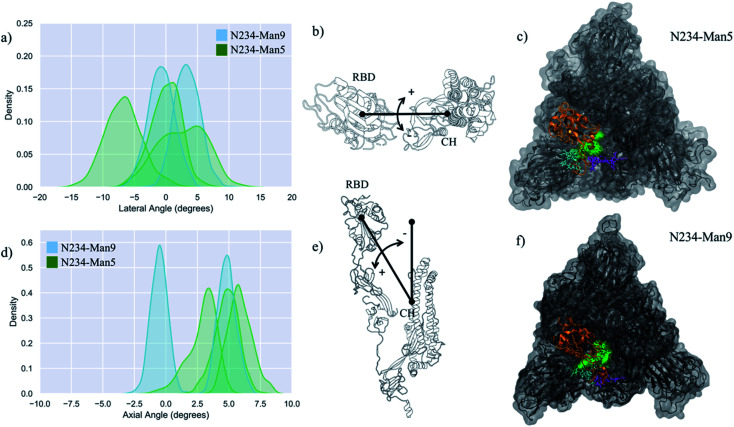
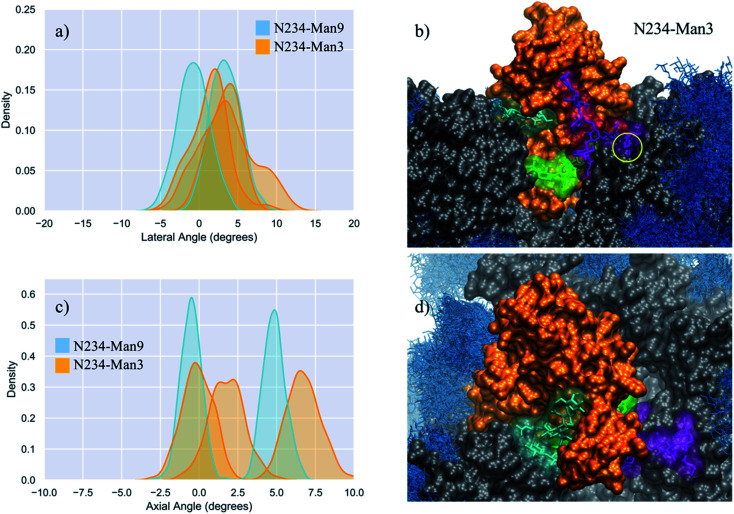
The dense glycan shield is an essential feature of the SARS-CoV-2 spike (S) architecture, key to immune evasion and to the activation of the prefusion conformation. Recent studies indicate that the occupancy and structures of the SARS-CoV-2 S glycans depend not only on the nature of the host cell, but also on the structural stability of the trimer; a point that raises important questions about the relative competence of different glycoforms. Moreover, the functional role of the glycan shield in the SARS-CoV-2 pathogenesis suggests that the evolution of the sites of glycosylation is potentially intertwined with the evolution of the protein sequence to affect optimal activity. Our results from multi-microsecond molecular dynamics simulations indicate that the type of glycosylation at N234, N165 and N343 greatly affects the stability of the receptor binding domain (RBD) open conformation, and thus its exposure and accessibility. Furthermore, our results suggest that the loss of glycosylation at N370, a newly acquired modification in the SARS-CoV-2 S glycan shield's topology, may have contributed to increase the SARS-CoV-2 infectivity as we find that -glycosylation at N370 stabilizes the closed RBD conformation by binding a specific cleft on the RBD surface. We discuss how the absence of the N370 glycan in the SARS-CoV-2 S frees the RBD glycan binding cleft, which becomes available to bind cell-surface glycans, and potentially increases host cell surface localization.
致密聚糖屏蔽是严重急性呼吸综合征冠状病毒2(SARS-CoV-2)刺突(S)蛋白结构的一个基本特征,是免疫逃逸和预融合构象激活的关键。最近的研究表明,SARS-CoV-2 S聚糖的占据情况和结构不仅取决于宿主细胞的性质,还取决于三聚体的结构稳定性;这一点引发了关于不同糖型相对活性的重要问题。此外,聚糖屏蔽在SARS-CoV-2发病机制中的功能作用表明,糖基化位点的进化可能与蛋白质序列的进化相互交织,以影响最佳活性。我们通过多微秒分子动力学模拟得到的结果表明,N234、N165和N343位点的糖基化类型极大地影响受体结合域(RBD)开放构象的稳定性,进而影响其暴露程度和可及性。此外,我们的结果表明,N370位点糖基化的缺失——这是SARS-CoV-2 S聚糖屏蔽拓扑结构中一个新获得的修饰——可能导致了SARS-CoV-2感染性的增加,因为我们发现N370位点的糖基化通过结合RBD表面的一个特定裂隙来稳定RBD的封闭构象。我们讨论了SARS-CoV-2 S蛋白中N370聚糖的缺失如何使RBD聚糖结合裂隙得以释放,从而能够结合细胞表面聚糖,并可能增加在宿主细胞表面的定位。