Molecular and Cellular Modeling Group, Heidelberg Institute for Theoretical Studies (HITS), Heidelberg 69118, Germany.
Heidelberg University, Heidelberg 69117, Germany.
Proc Natl Acad Sci U S A. 2024 Oct 22;121(43):e2404892121. doi: 10.1073/pnas.2404892121. Epub 2024 Oct 14.
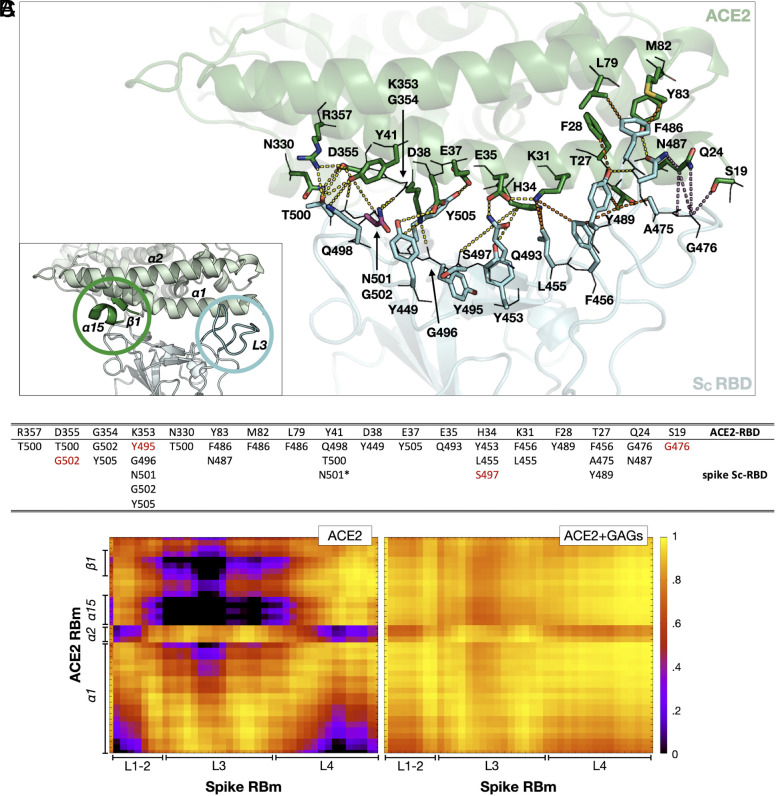
Although it is well established that the SARS-CoV-2 spike glycoprotein binds to the host cell ACE2 receptor to initiate infection, far less is known about the tissue tropism and host cell susceptibility to the virus. Differential expression across different cell types of heparan sulfate (HS) proteoglycans, with variably sulfated glycosaminoglycans (GAGs), and their synergistic interactions with host and viral N-glycans may contribute to tissue tropism and host cell susceptibility. Nevertheless, their contribution remains unclear since HS and N-glycans evade experimental characterization. We, therefore, carried out microsecond-long all-atom molecular dynamics simulations, followed by random acceleration molecular dynamics simulations, of the fully glycosylated spike:ACE2 complex with and without highly sulfated GAG chains bound. By considering the model GAGs as surrogates for the highly sulfated HS expressed in lung cells, we identified key cell entry mechanisms of spike SARS-CoV-2. We find that HS promotes structural and energetic stabilization of the active conformation of the spike receptor-binding domain (RBD) and reorientation of ACE2 toward the N-terminal domain in the same spike subunit as the RBD. Spike and ACE2 N-glycans exert synergistic effects, promoting better packing, strengthening the protein:protein interaction, and prolonging the residence time of the complex. ACE2 and HS binding trigger rearrangement of the S2' functional protease cleavage site through allosteric interdomain communication. These results thus show that HS has a multifaceted role in facilitating SARS-CoV-2 infection, and they provide a mechanistic basis for the development of GAG derivatives with anti-SARS-CoV-2 potential.
虽然 SARS-CoV-2 的刺突糖蛋白与宿主细胞 ACE2 受体结合以启动感染已得到充分证实,但对于病毒的组织嗜性和宿主细胞易感性知之甚少。不同细胞类型中肝素硫酸(HS)蛋白聚糖的差异表达,具有不同硫酸化的糖胺聚糖(GAG),以及它们与宿主和病毒 N-聚糖的协同相互作用,可能有助于组织嗜性和宿主细胞易感性。然而,由于 HS 和 N-聚糖逃避了实验表征,它们的贡献仍然不清楚。因此,我们对全长糖基化的刺突:ACE2 复合物进行了微秒级别的全原子分子动力学模拟,随后进行了随机加速分子动力学模拟,其中结合了和未结合高度硫酸化的 GAG 链。通过将模型 GAG 视为在肺细胞中表达的高度硫酸化 HS 的替代物,我们确定了刺突 SARS-CoV-2 的关键细胞进入机制。我们发现 HS 促进了刺突受体结合域(RBD)的活性构象的结构和能量稳定性,并使 ACE2 重新定向到 RBD 所在的同一刺突亚基的 N 端结构域。刺突和 ACE2 N-聚糖发挥协同作用,促进更好的包装,增强蛋白质:蛋白质相互作用,并延长复合物的停留时间。ACE2 和 HS 的结合通过变构的域间通讯触发 S2' 功能性蛋白酶切割位点的重排。这些结果表明 HS 在促进 SARS-CoV-2 感染方面具有多方面的作用,并为开发具有抗 SARS-CoV-2 潜力的 GAG 衍生物提供了机制基础。