Yepiskoposyan Hasmik, Peitsch Manuel C, Talikka Marja
PMI R&D, Philip Morris Products S.A., Quai Jeanrenaud 5, 2000 Neuchâtel, Switzerland.
Int J Inflam. 2022 Jan 27;2022:4071472. doi: 10.1155/2022/4071472. eCollection 2022.
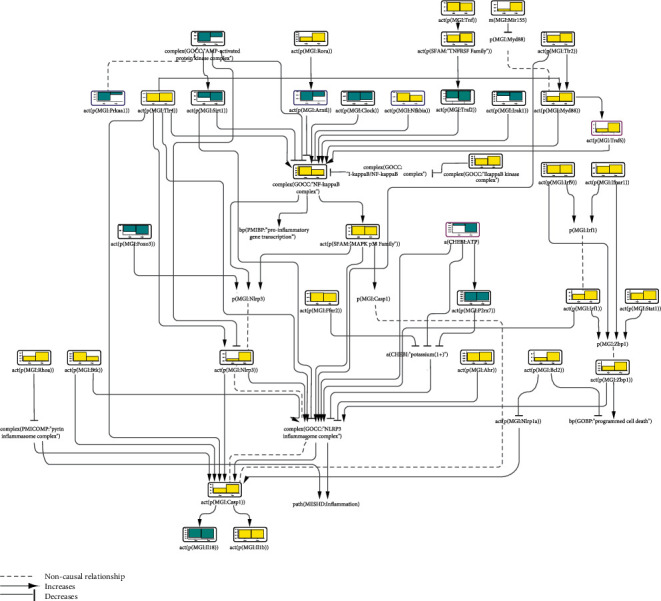
Virtually any stressor that alters the cellular homeostatic state may result in an inflammatory response. As a critical component of innate immunity, inflammasomes play a prominent role in the inflammatory response. The information on inflammasome biology is rapidly growing, thus creating the need for structuring it into a model that can help visualize and enhance the understanding of underlying biological processes. Causal biological network (CBN) models provide predictive power for novel disease mechanisms and treatment outcomes. We assembled the available literature information on inflammasome activation into the CBN model and scored it with publicly available transcriptomic datasets that address viral infection of the lungs, osteo- and rheumatoid arthritis, psoriasis, and aging. The scoring inferred pathway activation leading to NLRP3 inflammasome activation in these diverse conditions, demonstrating that the CBN model provides a platform for interpreting transcriptomic data in the context of inflammasome activation.
几乎任何改变细胞稳态状态的应激源都可能导致炎症反应。作为固有免疫的关键组成部分,炎性小体在炎症反应中发挥着重要作用。关于炎性小体生物学的信息正在迅速增长,因此需要将其构建成一个模型,以帮助可视化并增强对潜在生物学过程的理解。因果生物网络(CBN)模型为新的疾病机制和治疗结果提供了预测能力。我们将关于炎性小体激活的现有文献信息整合到CBN模型中,并用公开可用的转录组数据集对其进行评分,这些数据集涉及肺部病毒感染、骨关节炎和类风湿关节炎、银屑病以及衰老。评分推断出在这些不同情况下导致NLRP3炎性小体激活的途径激活,表明CBN模型为在炎性小体激活的背景下解释转录组数据提供了一个平台。