Iqbal Naseer, Khan Ibrahim, Ali Asghar, Qurashi Ahsanullhaq
Department of Chemistry, College of Science, University of Hafr Al Batin, PO. Box 1803, Hafr Al Batin 31991, Saudi Arabia.
Center of Research Excellence in Nanotechnology, King Fahd University of Petroleum and Minerals, Dhahran 31261, Saudi Arabia.
J Adv Res. 2021 Aug 13;36:15-26. doi: 10.1016/j.jare.2021.08.006. eCollection 2022 Feb.
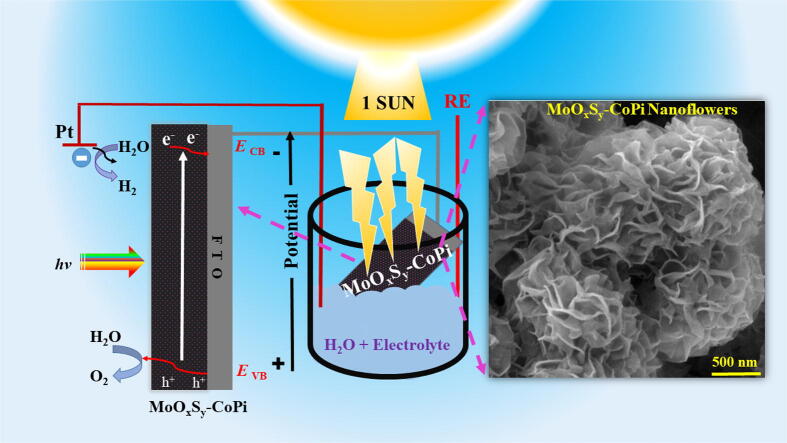
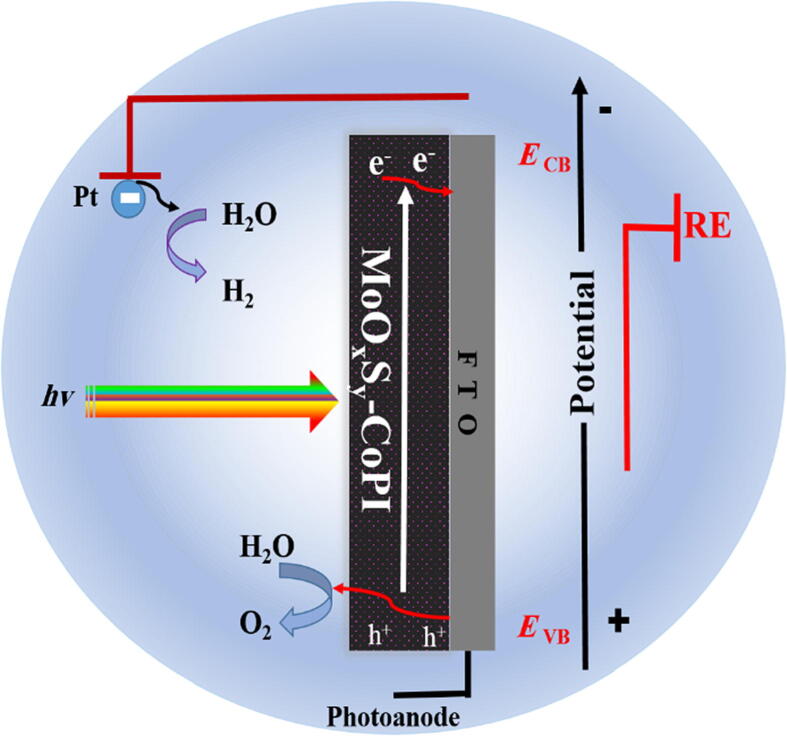
Hydrogen is considered as a clean alternative green energy future fuel. Since the Honda-Fujishima effect for photoelectrochemical water splitting is known, there has been a substantial boost in this field. Numerous photocatalysts based on metals, semiconductors, and organic-inorganic hybrid-systems have been proposed. Several factors limit their efficiency, e.g., a stable PEC-WS setup, absorbing visible light, well-aligned band energy for charge transfer, electrons and holes, and their separation to avoid recombination and limited water redox reactions. Metallic doping and impregnation of stable and efficient co-catalysts such as Pt, Ag, and Au showed enhanced PEC-WS. We used Cobalt-based co-catalyst with molybdenum oxysulfide photocatalyst for effectual solar-driven water splitting.
To develop photocatalysts for efficient PEC processes capable of absorbing sufficient visible light, good band energy for effective charge transfer, inexpensive, significant solar-to-chemical energy conversion efficiencies. Above all, it is developing such PEC-WS systems that will be commercially viable for renewable energy resources.
We prepared Molybdenum oxysulphide-cobalt phosphate photocatalyst for PEC-WS through a facile hydrothermal route using ammonium heptamolybdate, thiourea, and metallic Cobalt precursors.
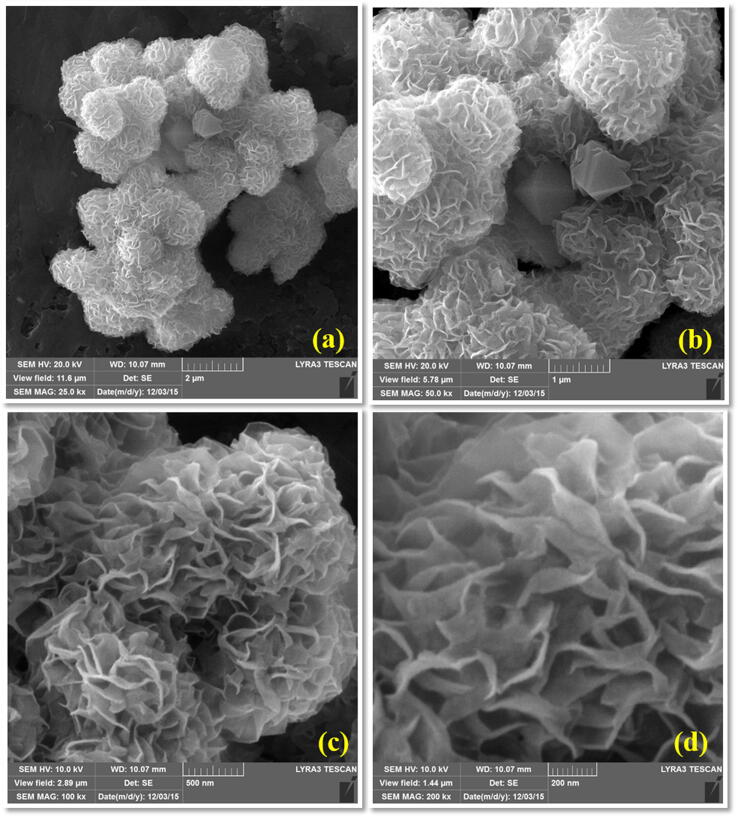
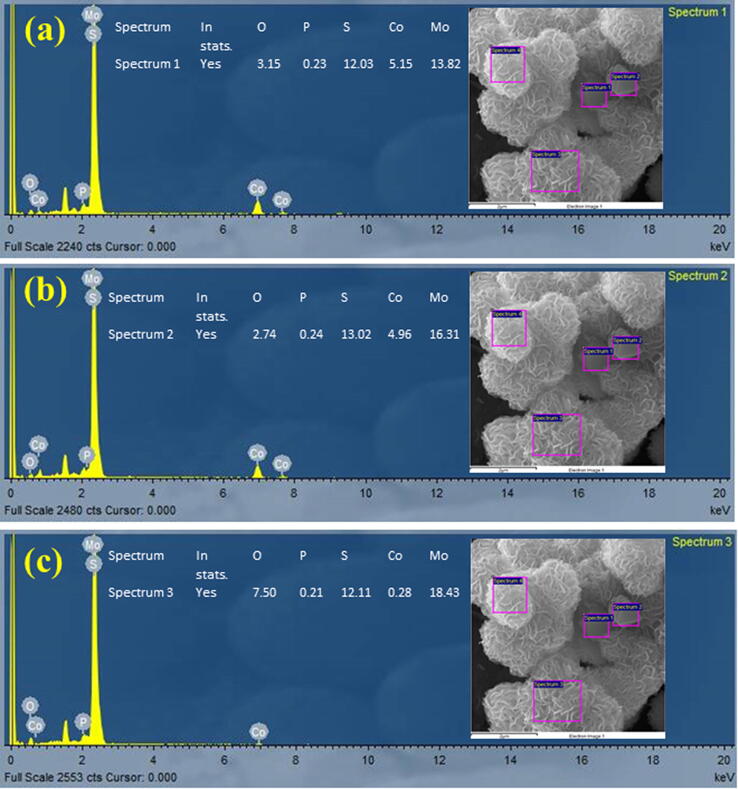
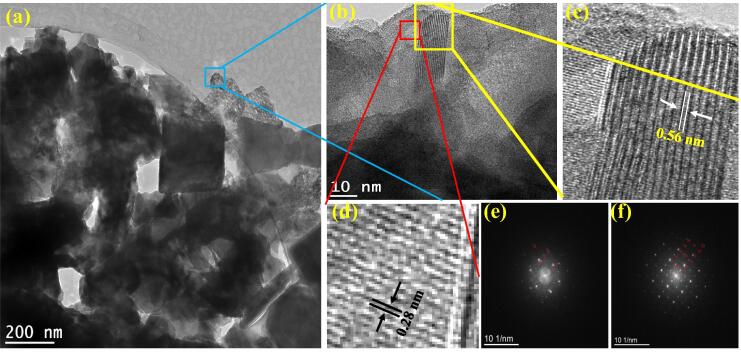
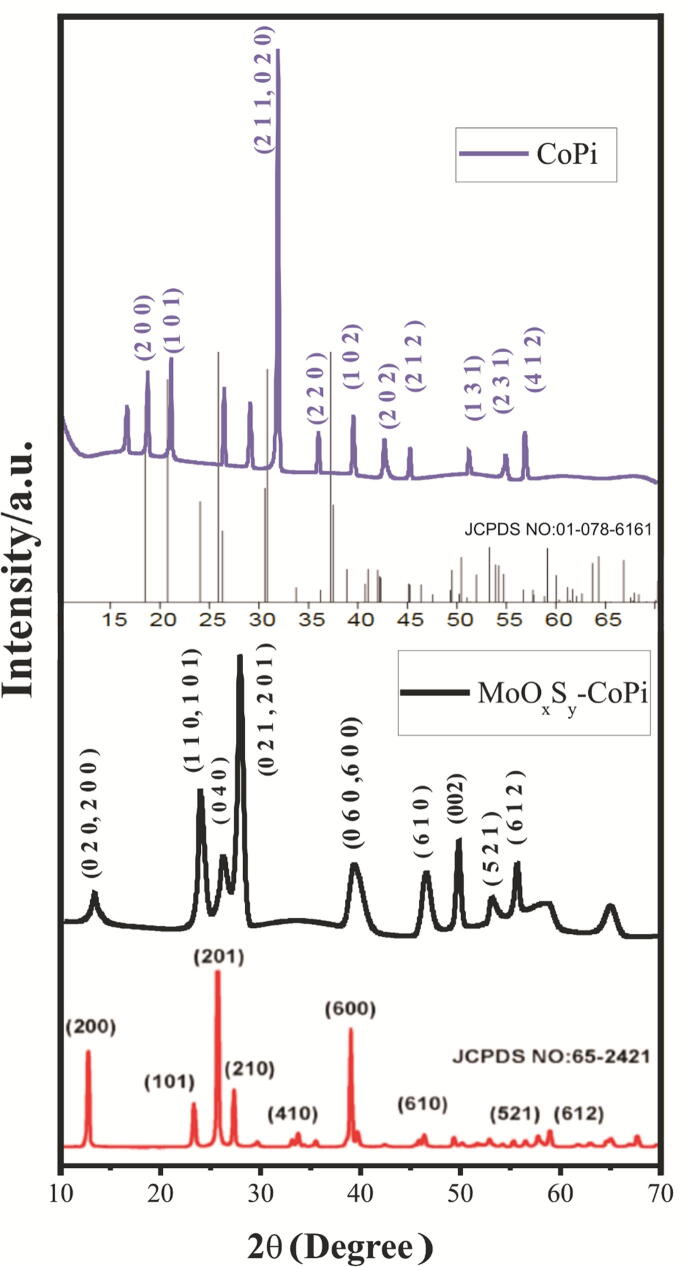
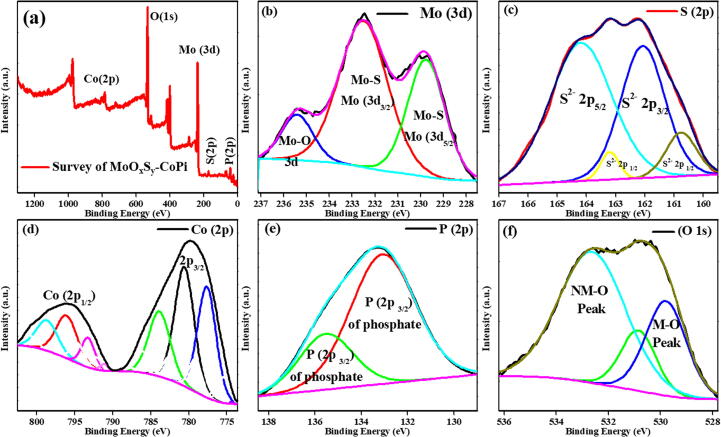
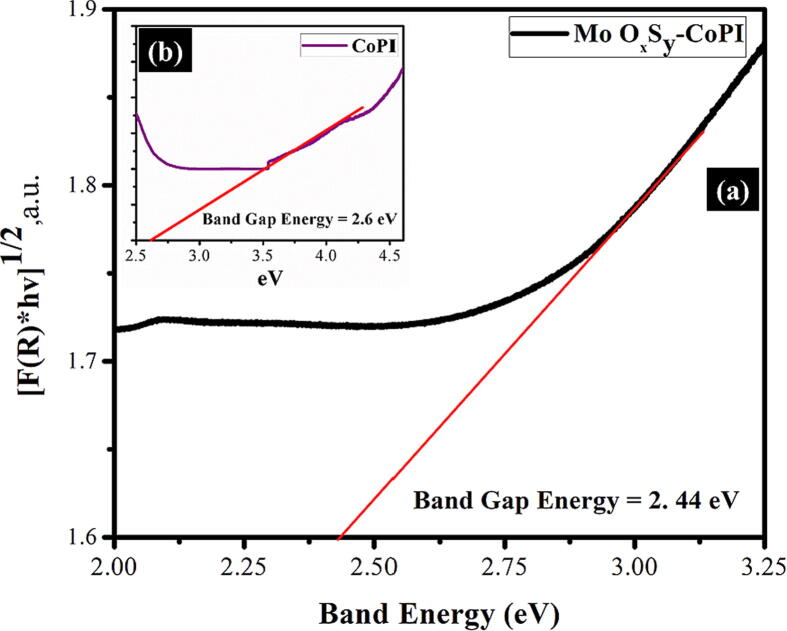
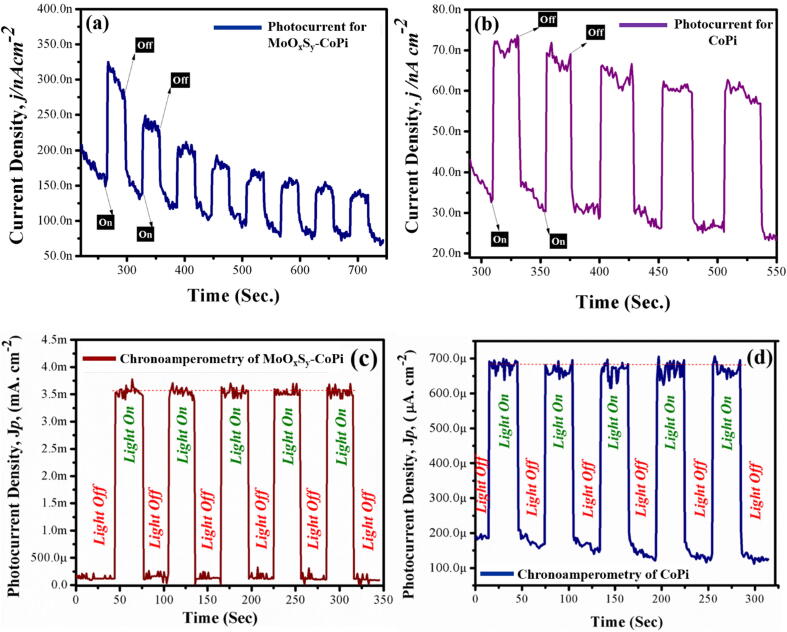
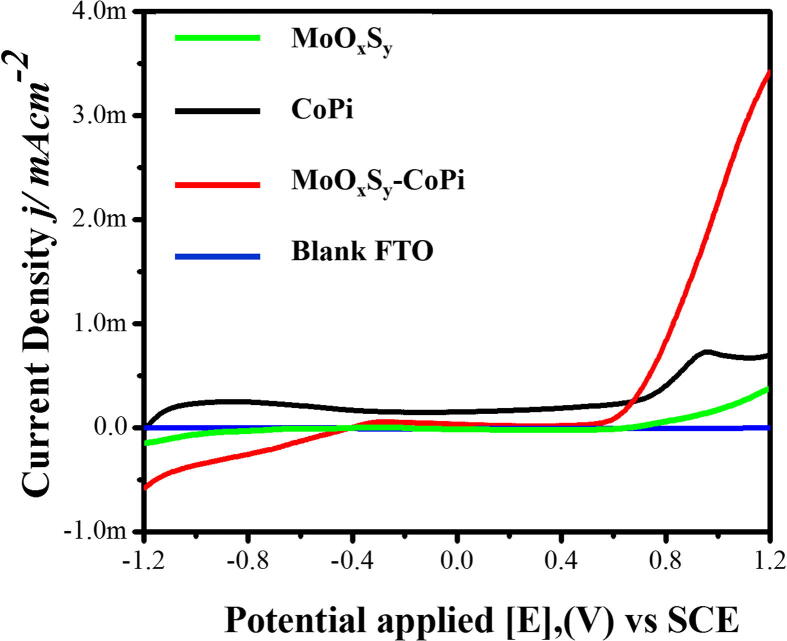
An effectual photocatalyst is produced for solar-driven water splitting. The conformal morphology of MoOS-CoPi nanoflowers is a significant feature, as observed under FE-SEM and HR-TEM. XRD confirmed the degree of purity and orthorhombic crystal structure of MoOS-CoPi. EDX and XPS identify the elemental compositions and corresponding oxidation states of each atom. A 2.44 eV band-gap energy is calculated for MoOS-CoPi from the diffused reflectance spectrum. Photo- Electrochemical Studies (PEC) under 1-SUN solar irradiation revealed 7-8 folds enhanced photocurrent (∼ 3.5 mA/cm2) generated from MoOS-CoPi/FTO in comparison to Co-PI/FTO (∼ 0.5 mA/cm2) and MoOS-/FTO respectively, within 0.5 M NaSO electrolyte (@pH=7) and standard three electrodes electrochemical cell.
Our results showed MoOS-CoPi as promising photocatalyst material for improved solar-driven photoelectrochemical water splitting system.
氢气被视为未来清洁的替代绿色能源燃料。自从本田-藤岛效应被用于光电化学水分解以来,该领域得到了极大的推动。已经提出了许多基于金属、半导体和有机-无机混合体系的光催化剂。有几个因素限制了它们的效率,例如稳定的光电化学水分解装置、吸收可见光、电荷转移的能带排列良好、电子和空穴以及它们的分离以避免复合以及有限的水氧化还原反应。金属掺杂和负载稳定且高效的助催化剂(如铂、银和金)显示出增强的光电化学水分解性能。我们使用基于钴的助催化剂与氧硫化钼光催化剂实现高效的太阳能驱动水分解。
开发用于高效光电化学过程的光催化剂,该光催化剂能够吸收足够的可见光、具有良好的能带以实现有效的电荷转移、价格低廉、具有显著的太阳能到化学能的转换效率。最重要的是,开发这样的光电化学水分解系统,使其在可再生能源方面具有商业可行性。
我们通过简便的水热法,使用七钼酸铵、硫脲和金属钴前驱体制备了用于光电化学水分解的氧硫化钼-磷酸钴光催化剂。
制备出了用于太阳能驱动水分解的有效光催化剂。在场发射扫描电子显微镜(FE-SEM)和高分辨率透射电子显微镜(HR-TEM)下观察到,氧硫化钼-磷酸钴纳米花的共形形态是一个显著特征。X射线衍射(XRD)证实了氧硫化钼-磷酸钴的纯度和正交晶体结构。能量散射X射线光谱(EDX)和X射线光电子能谱(XPS)确定了各原子的元素组成和相应的氧化态。根据漫反射光谱计算出氧硫化钼-磷酸钴的带隙能量为2.44电子伏特。在1个太阳光照下的光电化学研究(PEC)表明,在0.5M硫酸钠电解液(pH = 7)和标准三电极电化学池中,与磷酸钴/氟掺杂氧化锡(Co-PI/FTO)(约0.5毫安/平方厘米)和氧硫化钼/氟掺杂氧化锡(MoOS-/FTO)相比,氧硫化钼-磷酸钴/氟掺杂氧化锡(MoOS-CoPi/FTO)产生的光电流增强了7 - 8倍(约3.5毫安/平方厘米)。
我们的结果表明,氧硫化钼-磷酸钴是用于改进太阳能驱动光电化学水分解系统的有前景的光催化剂材料。