Zhou Jing, Li Jianqiang, Zhang Jingao, Geng Bo, Chen Yao, Zhou Xiaobin
Department of Epidemiology and Health Statistics, Qingdao University, Qingdao, Shandong, China.
Editorial Office of Journal of Precision Medicine, Qingdao University, Qingdao, Shandong, China.
PeerJ. 2022 Jan 25;10:e12837. doi: 10.7717/peerj.12837. eCollection 2022.
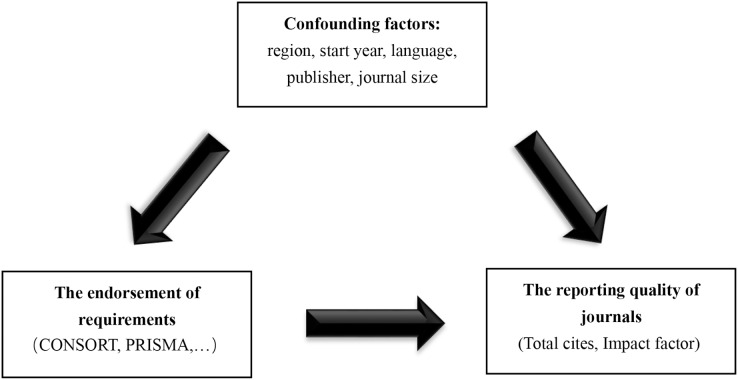
A journal's impact factor (IF) and total citations are often used as indicators of its publication quality. Furthermore, journals that require authors to abide by reporting guidelines or conduct trial registration generally have a higher quality of reporting. In this study, we sought to explore the potential associations between the enforcement of reporting guidelines or trial registration and a surgical journal's IF or total citations in order to find new approaches and ideas to improve journal publication quality.
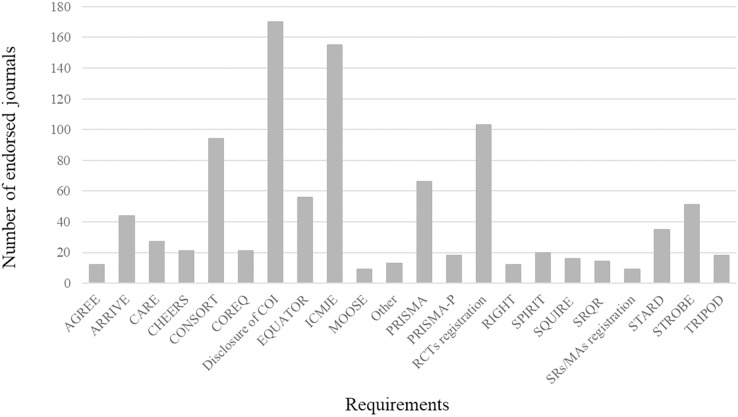
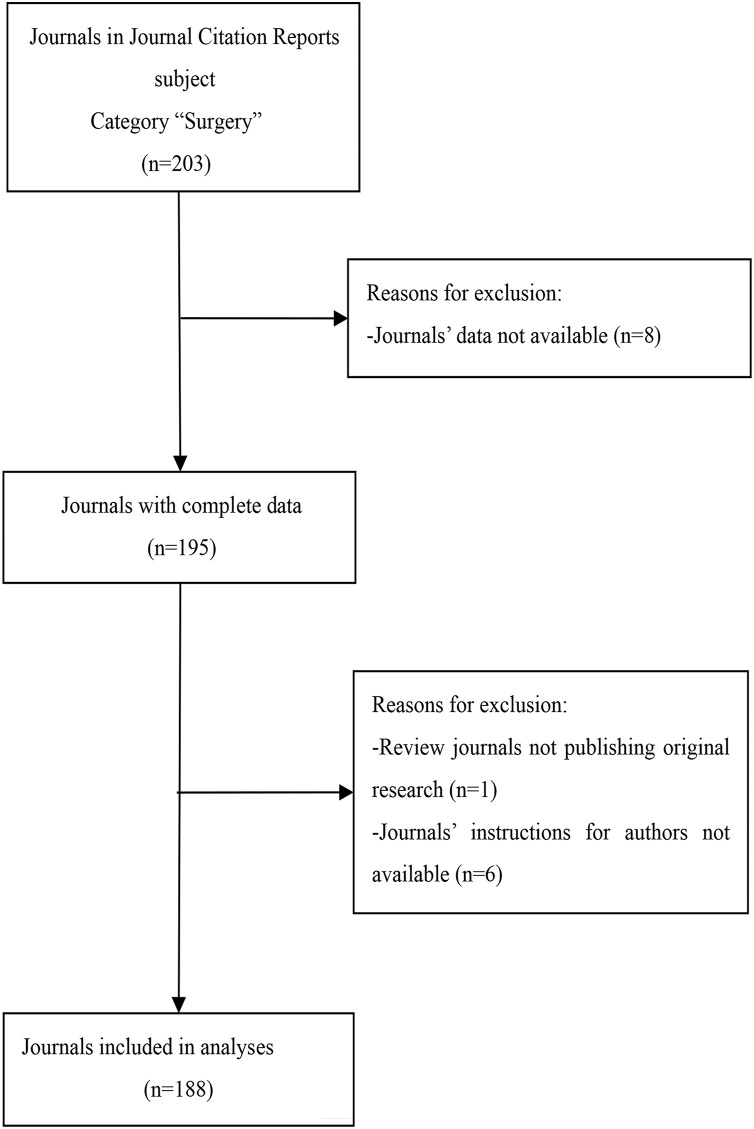
We examined surgical journals from the 2018 Journal Citation Report's Expanded Scientific Citation Index to quantify the use of reporting guidelines or study registration. We reviewed the "instructions for authors" from each journal and used multivariable linear regression analysis to determine which guidelines were associated with the journal IF and total citations. The dependent variable was the logarithm base 10 of the IF in 2018 or the logarithm base 10 of total citations in 2018 (the results were presented as geometric means, specifically the ratio of the "endorsed group" results to "not endorsed group" results). The independent variable was one of the requirements (endorsed and not endorsed). Models adjust for the publication region, language, start year, publisher and journal size (only used to adjust total citations).
We included 188 surgical journals in our study. The results of multivariable linear regression analysis showed that journal IF was associated ( < 0.01) with the following requirements: randomized controlled trial (RCT) registration (geometric means ratio (GR) = 1.422, 95% CI [1.197-1.694]), Consolidated Standards of Reporting Trials (CONSORT) statement (1.318, [1.104-1.578]), Preferred Reporting Items for Systematic Reviews Meta-Analyses (PRISMA) statement (1.390, [1.148-1.683]), Strengthening the Reporting of Observational Studies in Epidemiology (STROBE) statement (1.556, [1.262-1.919]), Standards for Reporting Diagnostic Accuracy (STARD) statement (1.585, [1.216-2.070]), and Meta-analysis of Observational Studies in Epidemiology (MOOSE) statement (2.113, [1.422-3.133]). We found associations between the endorsement of RCT registration (GR = 1.652, 95% CI [1.268-2.153]), CONSORT (1.570, [1.199-2.061]), PRISMA (1.698, [1.271-2.270]), STROBE (2.023, [1.476-2.773]), STARD (2.173, [1.452-3.243]), and MOOSE statements (2.249, [1.219-4.150]) and the number of total citations.
The presence of reporting guidelines and trial registration was associated with higher IF or more total citations in surgical journals. If more surgical journals incorporate these policies into their submission requirements, this may improve publication quality, thus increasing their IF and total citations.
期刊的影响因子(IF)和总被引频次常被用作其出版质量的指标。此外,要求作者遵守报告指南或进行试验注册的期刊,其报告质量通常更高。在本研究中,我们试图探讨报告指南的执行或试验注册与外科期刊的IF或总被引频次之间的潜在关联,以便找到提高期刊出版质量的新方法和思路。
我们检查了2018年《期刊引证报告》扩展科学引文索引中的外科期刊,以量化报告指南的使用或研究注册情况。我们查阅了每本期刊的“作者须知”,并使用多变量线性回归分析来确定哪些指南与期刊IF和总被引频次相关。因变量是2018年IF的常用对数或2018年总被引频次的常用对数(结果以几何平均数表示,具体为“认可组”结果与“未认可组”结果的比值)。自变量是其中一项要求(认可和未认可)。模型对出版地区、语言、创刊年份、出版商和期刊规模进行了调整(仅用于调整总被引频次)。
我们的研究纳入了188本外科期刊。多变量线性回归分析结果显示,期刊IF与以下要求相关(<0.01):随机对照试验(RCT)注册(几何平均数比值(GR)=1.422,95%置信区间[1.197 - 1.694])、《报告试验的统一标准》(CONSORT)声明(1.318,[1.104 - 1.578])、《系统评价和荟萃分析优先报告条目》(PRISMA)声明(1.390,[1.148 - 1.683])、《加强流行病学观察性研究报告》(STROBE)声明(1.556,[1.262 - 1.919])、《诊断准确性报告标准》(STARD)声明(1.585,[1.216 - 2.070])以及《流行病学观察性研究的荟萃分析》(MOOSE)声明(2.113,[1.422 - 3.133])。我们发现RCT注册(GR = 1.652,95%置信区间[1.268 - 2.153])、CONSORT(1.570,[1.199 - 2.061])、PRISMA(1.698,[