Makhout Sanae, Vermeiren Eline, Van De Maele Karolien, Bruyndonckx Luc, De Winter Benedicte Y, Van Hoorenbeeck Kim, Verhulst Stijn L, Van Eyck Annelies
Laboratory of Experimental Medicine and Pediatrics and Member of the Infla-Med Centre of Excellence, University of Antwerp, Antwerp, Belgium.
Department of Pediatrics, Antwerp University Hospital, Edegem, Belgium.
Front Med (Lausanne). 2022 Jan 20;8:835515. doi: 10.3389/fmed.2021.835515. eCollection 2021.
Childhood obesity has increased worldwide, becoming a significant public health concern. Brain-derived neurotrophic factor (BDNF) plays an important role in the central regulation of food intake and body weight, but little is known regarding its role in childhood obesity. Next to obesity, BDNF has been linked to obstructive sleep apnea (OSA) and endothelial dysfunction, two obesity-related comorbidities. The aim of this study is to investigate how BDNF, OSA and endothelial dysfunction interact in children with obesity and to determine the effect of weight loss on serum BDNF levels.
Children and adolescents with obesity aged 8-18 years who were enrolled in a multidisciplinary obesity treatment (MOT) in a tertiary hospital, were prospectively included. Several examinations were conducted during this MOT; at baseline, after 6 months and after 12 months, including the assessment of endothelial function, body composition measurements and a polysomnography. BDNF levels were measured on a serum sample by means of ELISA.
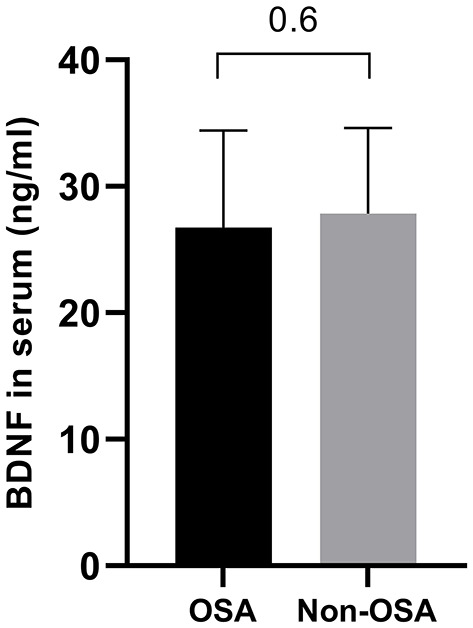
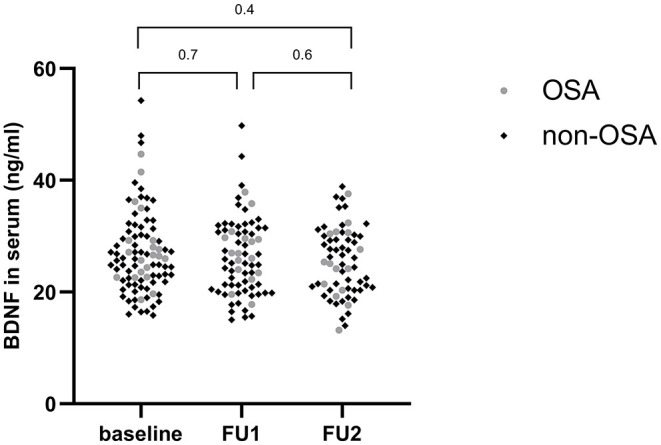
A total of 103 patients with obesity was included, of which 20 had OSA (19.4%). BDNF levels were comparable in children with obesity and OSA and children with obesity but without OSA (26.75 vs. 27.87 ng/ml, = 0.6). No correlations were found between BDNF and sleep-related variables or between BDNF and endothelial function parameters nor between BDNF and adiposity measures. To investigate if the interaction between OSA and endothelial dysfunction had an influence on BDNF levels, a general linear model was used. This model revealed that a diagnosis of OSA, as well as the interaction between OSA and maximal endothelial dilatation, contributed significantly ( = 0.03, = 0.04, respectively) to BDNF levels. After 1 year of weight loss therapy, BDNF levels did not change (26.18 vs. 25.46 ng/ml, = 0.7) in our population.
BDNF concentrations were comparable in children with obesity, both with and without OSA, indicating that BDNF levels are not affected by OSA. However, we did find an interaction effect of OSA and endothelial function on BDNF levels.
儿童肥胖在全球范围内呈上升趋势,已成为一个重大的公共卫生问题。脑源性神经营养因子(BDNF)在食物摄入和体重的中枢调节中起重要作用,但关于其在儿童肥胖中的作用知之甚少。除肥胖外,BDNF还与阻塞性睡眠呼吸暂停(OSA)和内皮功能障碍有关,这两种都是与肥胖相关的合并症。本研究的目的是调查BDNF、OSA和内皮功能障碍在肥胖儿童中如何相互作用,并确定体重减轻对血清BDNF水平的影响。
前瞻性纳入在一家三级医院参加多学科肥胖治疗(MOT)的8至18岁肥胖儿童和青少年。在该MOT期间进行了多项检查;在基线、6个月后和12个月后,包括内皮功能评估、身体成分测量和多导睡眠图检查。通过ELISA法检测血清样本中的BDNF水平。
共纳入103例肥胖患者,其中20例患有OSA(19.4%)。肥胖合并OSA的儿童和肥胖但无OSA的儿童的BDNF水平相当(26.75对27.87 ng/ml,P = 0.6)。在BDNF与睡眠相关变量之间、BDNF与内皮功能参数之间以及BDNF与肥胖测量指标之间未发现相关性。为了研究OSA与内皮功能障碍之间的相互作用是否对BDNF水平有影响,使用了一般线性模型。该模型显示,OSA诊断以及OSA与最大内皮扩张之间的相互作用对BDNF水平有显著贡献(分别为P = 0.03,P = 0.04)。在我们的研究人群中,经过1年的减肥治疗后,BDNF水平没有变化(26.18对25.46 ng/ml,P = 0.7)。
肥胖儿童中,无论有无OSA,BDNF浓度相当,表明BDNF水平不受OSA影响。然而,我们确实发现OSA与内皮功能对BDNF水平有相互作用效应。