Smiljanić Milutin, Bele Marjan, Moriau Léonard Jean, Vélez Santa John Fredy, Menart Svit, Šala Martin, Hrnjić Armin, Jovanovič Primož, Ruiz-Zepeda Francisco, Gaberšček Miran, Hodnik Nejc
Department of Materials Chemistry, National Institute of Chemistry, Hajdrihova 19, 1000 Ljubljana, Slovenia.
Laboratory for Atomic Physics, Institute for Nuclear Sciences Vinča, University of Belgrade, Mike Alasa 12-14, 11001 Belgrade, Serbia.
ACS Omega. 2022 Jan 19;7(4):3540-3548. doi: 10.1021/acsomega.1c06028. eCollection 2022 Feb 1.
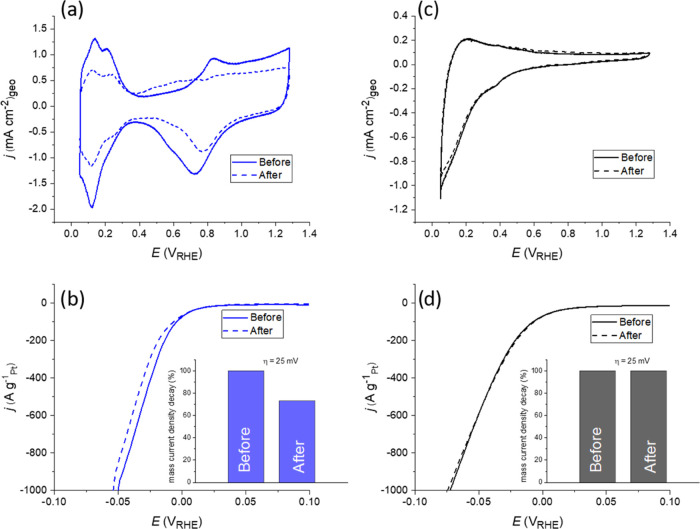
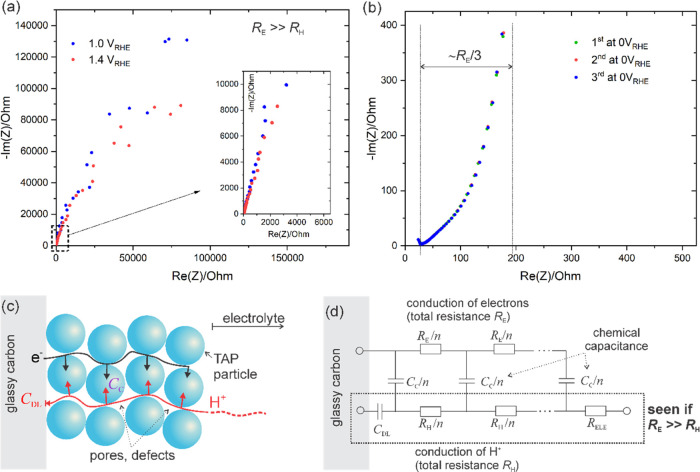
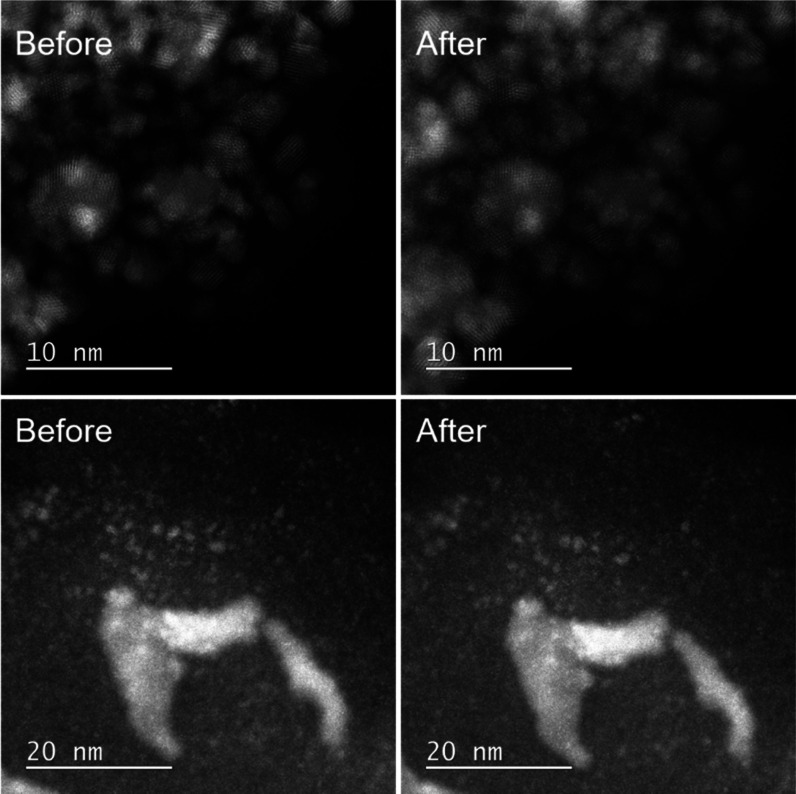
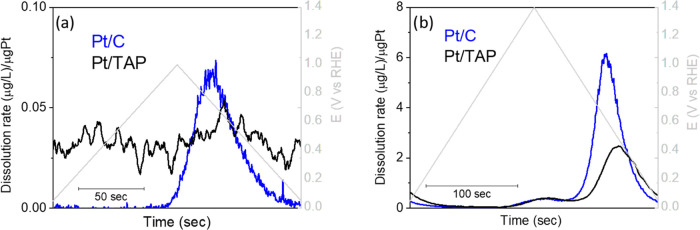
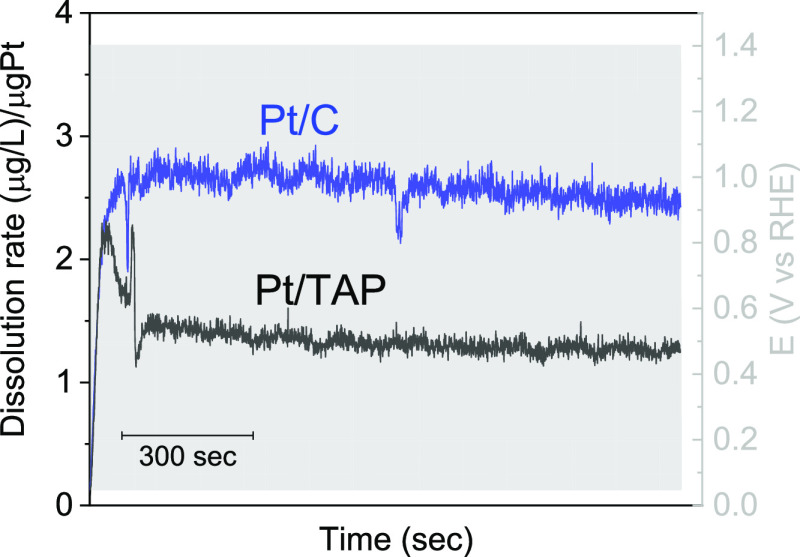
Degradation of carbon-supported Pt nanocatalysts in fuel cells and electrolyzers hinders widespread commercialization of these green technologies. Transition between oxidized and reduced states of Pt during fast potential spikes triggers significant Pt dissolution. Therefore, designing Pt-based catalysts able to withstand such conditions is of critical importance. We report here on a strategy to suppress Pt dissolution by using an organic matrix tris(aza)pentacene (TAP) as an alternative support material for Pt. The major benefit of TAP is its potential-dependent conductivity in aqueous media, which was directly evidenced by electrochemical impedance spectroscopy. At potentials below ∼0.45 V, TAP is protonated and its conductivity is improved, which enables supported Pt to run hydrogen reactions. At potentials corresponding to Pt oxidation/reduction (>∼0.45 V), TAP is deprotonated and its conductivity is restricted. Tunable conductivity of TAP enhanced the durability of the Pt/TAP with respect to Pt/C when these two materials were subjected to the same degradation protocol (0.1 M HClO electrolyte, 3000 voltammetric scans, 1 V/s, 0.05-1.4 V). The exceptional stability of Pt/TAP composite on a nanoscale level was confirmed by identical location TEM imaging before and after the used degradation protocol. Suppression of transient Pt dissolution from Pt/TAP with respect to the Pt/C benchmark was directly measured in a setup consisting of an electrochemical flow cell connected to inductively coupled plasma-mass spectrometry.
燃料电池和电解槽中碳载铂纳米催化剂的降解阻碍了这些绿色技术的广泛商业化。在快速电位尖峰期间,铂在氧化态和还原态之间的转变会引发大量铂的溶解。因此,设计能够承受此类条件的铂基催化剂至关重要。我们在此报告一种策略,即使用有机基质三(氮杂)并五苯(TAP)作为铂的替代载体材料来抑制铂的溶解。TAP的主要优点是其在水性介质中与电位相关的导电性,这通过电化学阻抗谱直接得到证明。在低于约0.45 V的电位下,TAP被质子化,其导电性得到改善,这使得负载的铂能够进行氢反应。在对应于铂氧化/还原的电位(>约0.45 V)下,TAP去质子化,其导电性受到限制。当这两种材料经历相同的降解程序(0.1 M高氯酸电解质,3000次伏安扫描,1 V/s,0.05 - 1.4 V)时,TAP的可调导电性提高了Pt/TAP相对于Pt/C的耐久性。在使用的降解程序前后,通过相同位置的透射电子显微镜成像证实了Pt/TAP复合材料在纳米尺度上的卓越稳定性。在由连接到电感耦合等离子体质谱仪的电化学流通池组成的装置中,直接测量了Pt/TAP相对于Pt/C基准的瞬态铂溶解的抑制情况。