Lord S J, Bahlmann K, O'Connell D L, Kiely B E, Daniels B, Pearson S A, Beith J, Bulsara M K, Houssami N
The School of Medicine, University of Notre Dame Australia, Darlinghurst, Australia.
The National Health and Medical Research Council (NHMRC) Clinical Trials Centre, The University of Sydney, Camperdown, Australia.
EClinicalMedicine. 2022 Jan 29;44:101282. doi: 10.1016/j.eclinm.2022.101282. eCollection 2022 Feb.
Advances in breast cancer (BC) care have reduced mortality, but their impact on survival once diagnosed with metastasis is less well described. This systematic review aimed to describe population-level survival since 1995 for metastatic BC (dnMBC) and recurrent MBC (rMBC).
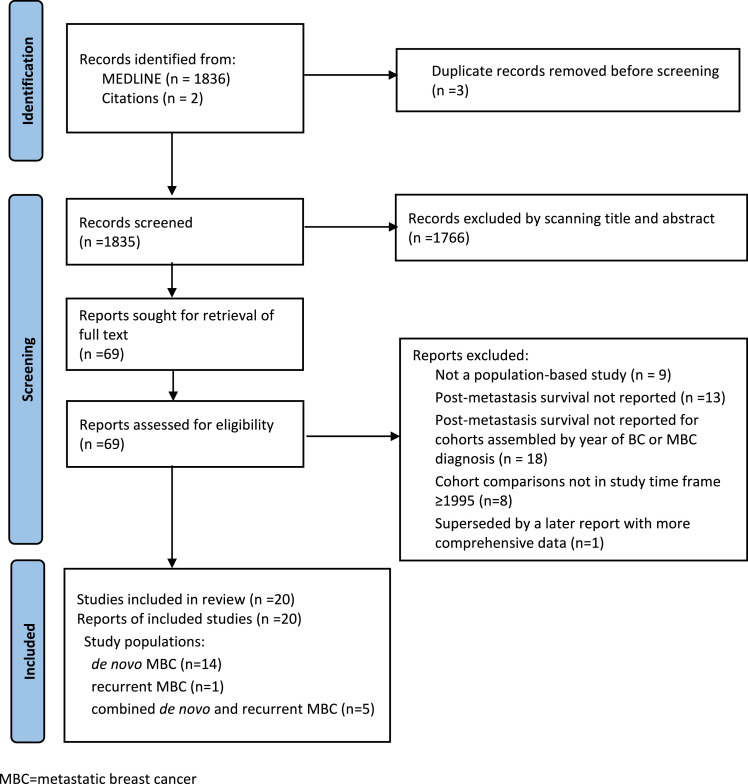
We searched MEDLINE 01/01/1995-12/04/2021 to identify population-based cohort studies of MBC reporting overall (OS) or BC-specific survival (BCSS) over time. We appraised risk-of-bias and summarised survival descriptively for MBC diagnoses in 5-year periods from 1995 until 2014; and for age, hormone receptor and HER2 subgroups.
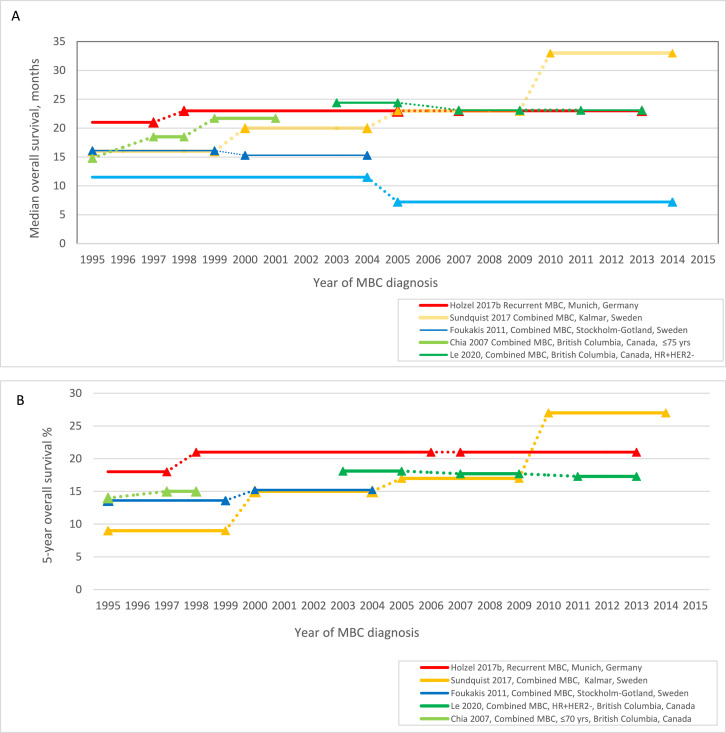
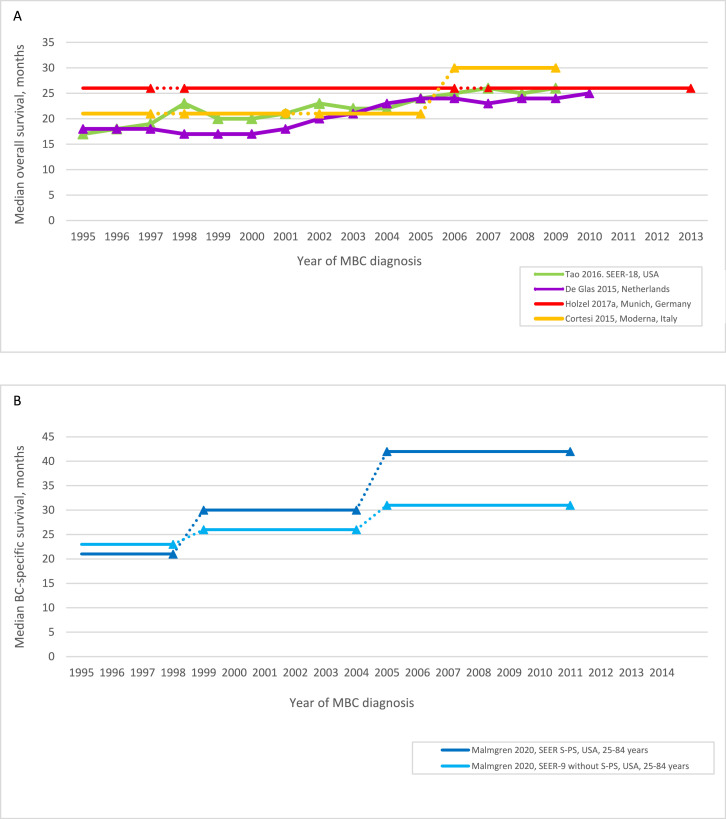
We identified 20 eligible studies (14 dnMBC, 1 rMBC, 5 combined). Potential sources of bias in these studies were confounding and shorter follow-up for the latest diagnosis period.For dnMBC, 13 of 14 studies reported improved OS or BCSS since 1995. In 2005-2009, the median OS was 26 months (range 24-30), a median gain of 6 months since 1995-1999 (range 0-9, 4 studies). Median 5-year OS was 23% in 2005-2009, a median gain of 7% since 1995-1999 (range -2 to 14%, 4 studies). For women ≥70 years, the median and 5-year OS was unchanged (1 study) with no to modest difference in relative survival (range: -1·9% ( = 0.71) to +2·1% ( = 0.045), 3 studies). For rMBC, one study reported no change in survival between 1998 and 2006 and 2007-2013 (median OS 23 months). For combined MBC, 76-89% had rMBC. Three of four studies observed no change in median OS after 2000. Of these, one study reported median OS improved for women ≤60 years (1995-1999 19·1; 2000-2004 22·3 months) but not >60 years (12·7, 11·6 months).
Population-level improvements in OS for dnMBC have not been consistently observed in rMBC cohorts nor older women. These findings have implications for counselling patients about prognosis, planning cancer services and trial stratification.
SL was funded in part by a National Health and Medical Research Council (NHMRC) Project Grant ID: 1125433. NH was funded by the NBCF Chair in Breast Cancer Prevention grant (EC-21-001) and a NHMRC Investigator (Leader) grant (194410). BD and SAP were funded in part by the NHMRC Centre of Research Excellence in Medicines Intelligence (1196900).
乳腺癌(BC)护理方面的进展降低了死亡率,但对一旦诊断为转移性乳腺癌后的生存影响描述较少。本系统评价旨在描述自1995年以来转移性乳腺癌(dnMBC)和复发性转移性乳腺癌(rMBC)的人群水平生存率。
我们检索了1995年1月1日至2021年4月12日的MEDLINE,以确定基于人群的队列研究,这些研究报告了MBC随时间的总生存期(OS)或乳腺癌特异性生存期(BCSS)。我们评估了偏倚风险,并按描述性方法总结了1995年至2014年期间每5年MBC诊断的生存率;以及按年龄、激素受体和HER2亚组进行总结。
我们确定了20项符合条件的研究(14项dnMBC,1项rMBC,5项合并研究)。这些研究中潜在的偏倚来源包括混杂因素以及最新诊断期的随访时间较短。对于dnMBC,14项研究中的13项报告自1995年以来OS或BCSS有所改善。在2005 - 2009年,中位OS为26个月(范围24 - 30个月),自1995 - 1999年以来中位增加了6个月(范围0 - 9个月,4项研究)。2005 - 2009年的5年中位OS为23%,自1995 - 1999年以来中位增加了7%(范围 - 2%至14%,4项研究)。对于70岁及以上的女性,中位和5年OS没有变化(1项研究),相对生存率无至适度差异(范围: - 1.9%(P = 0.71)至 + 2.1%(P = 0.045),3项研究)。对于rMBC,一项研究报告1998年至2006年以及2007 - 2013年期间生存率没有变化(中位OS 23个月)。对于合并的MBC,76 - 89%为rMBC。四项研究中的三项观察到2000年后中位OS没有变化。其中,一项研究报告年龄≤60岁的女性中位OS有所改善(1995 - 1999年为19.1个月;2000 - 2004年为22.3个月),但年龄>60岁的女性没有改善(分别为12.7个月、11.6个月)。
rMBC队列和老年女性中未一致观察到dnMBC人群水平的OS改善。这些发现对为患者提供预后咨询、规划癌症服务和试验分层具有启示意义。
SL部分由澳大利亚国家卫生与医学研究委员会(NHMRC)项目资助,项目编号:1125433。NH由乳腺癌预防领域的NBCF主席资助(EC - 21 - 001)以及NHMRC研究员(负责人)资助(194410)。BD和SAP部分由NHMRC药物情报卓越研究中心资助(1196900)。