Department of Bolton Clarke, Bolton Clarke Research Institute, Victoria, Australia.
Department is School of Psychology and Public Health, Centre for Health Communication and Participation, La Trobe University, Bundoora, Victoria, Australia.
J Eval Clin Pract. 2022 Jun;28(3):421-435. doi: 10.1111/jep.13660. Epub 2022 Feb 6.
RATIONALE, AIMS AND OBJECTIVES: The field of implementation science is critical for embedding research evidence into healthcare practice, benefiting individuals, organizations, governments, and the broader community. Implementation science is messy and complex, underpinned by many theories and frameworks. Efficacious interventions for older people with multiple comorbidities exist, yet many lack effectiveness evaluation relevant to pragmatic implementation within aged care practice. This article outlines the conceptualization and development of an Implementation Framework for Aged Care (IFAC), fit-for-purpose for an aged care organization, Bolton Clarke, intent on embedding evidence into practice.
A four-stage process was adopted to (1) explore context and relevant literature to conceptualize the IFAC; (2) identify key elements for a draft IFAC; (3) expand elements and refine the draft in consultation with experts and (4) apply the IFAC to three existing projects, identifying key learnings. A checklist to operationalize the IFAC was then developed.
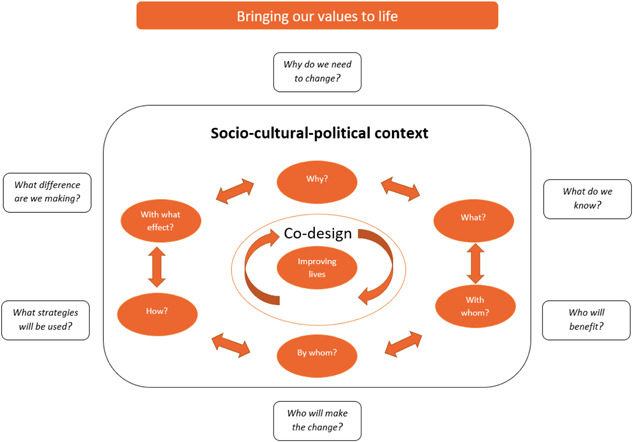
The IFAC is grounded in codesign principles and encapsulated by the implementation context, from a social, cultural and political perspective. The IFAC addresses the questions of (1) why do we need to change?; (2) what do we know?; (3) who will benefit?; (4) who will make the change?; (5) what strategies will be used?; and (6) what difference are we making? Three pilot projects: early adoption of a Wellness and Reablement approach; a care worker and virtual physiotherapist-led program to prevent falls; and a therapeutic horticulture program for residential communities, highlight learnings of applying the IFAC in practice.
This fit-for-purpose IFAC was developed for a proactive and responsive aged care provider. The simplicity of the six-question IFAC is underpinned by substantial theoretical perspectives for its elements and their connections. This complexity is then consolidated into an 18-question checklist to operationalize the IFAC, necessary to advance the translation of evidence into clinical practice.
背景、目的和目标:实施科学领域对于将研究证据嵌入医疗保健实践中至关重要,使个人、组织、政府和更广泛的社区受益。实施科学复杂且混乱,由许多理论和框架支撑。针对患有多种合并症的老年人,已经有了有效的干预措施,但其中许多措施在老龄化护理实践中缺乏与实际实施相关的有效性评估。本文概述了适合 Bolton Clarke 这样的老年护理机构的老年护理实施框架(IFAC)的概念化和开发,该机构致力于将证据融入实践。
采用四阶段流程来(1)探索背景和相关文献,以概念化 IFAC;(2)确定草案 IFAC 的关键要素;(3)与专家协商扩展要素并完善草案;(4)将 IFAC 应用于三个现有项目,确定关键学习点。然后开发了一个操作 IFAC 的清单。
IFAC 基于共同设计原则,并从社会、文化和政治角度封装实施背景。IFAC 回答了以下问题:(1)为什么我们需要改变?;(2)我们知道什么?;(3)谁将受益?;(4)谁将进行变革?;(5)将使用哪些策略?;(6)我们正在取得什么成果?。三个试点项目:早期采用健康和康复方法;护理人员和虚拟物理治疗师主导的预防跌倒计划;以及针对住宅社区的治疗性园艺计划,突出了在实践中应用 IFAC 的学习点。
这个为积极主动和响应迅速的老年护理提供商量身定制的 IFAC。简单的六问 IFAC 由其要素及其连接的实质性理论观点支撑。然后,将这种复杂性整合到一个 18 问的清单中,以操作 IFAC,这对于将证据转化为临床实践是必要的。