Department of Global Public Health and Primary Care, University of Bergen, Norway.
Bergen Addiction Research, Department of Addiction Medicine, Haukeland University Hospital, Bergen, Norway.
PLoS Med. 2022 Feb 8;19(2):e1003889. doi: 10.1371/journal.pmed.1003889. eCollection 2022 Feb.
Interpreting and utilizing the findings of nutritional research can be challenging to clinicians, policy makers, and even researchers. To make better decisions about diet, innovative methods that integrate best evidence are needed. We have developed a decision support model that predicts how dietary choices affect life expectancy (LE).
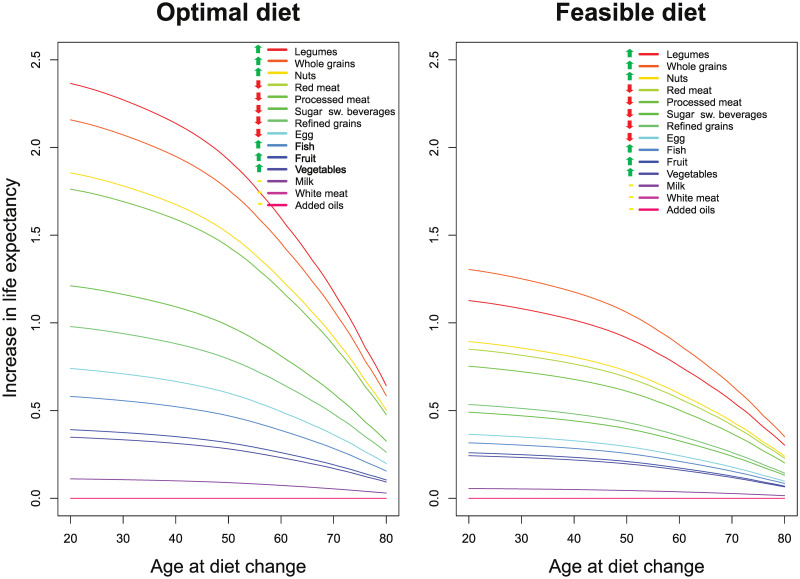
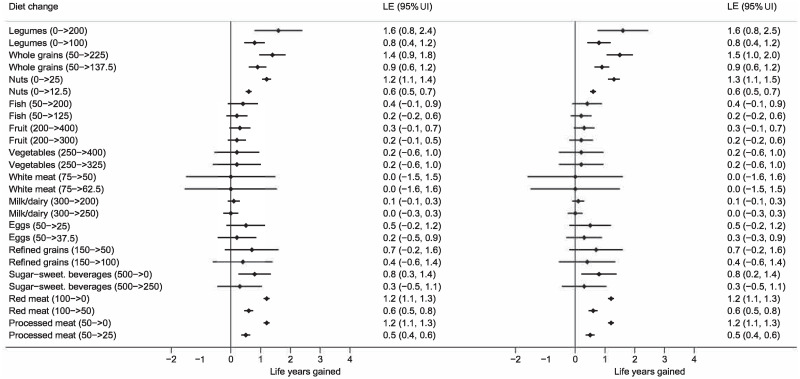
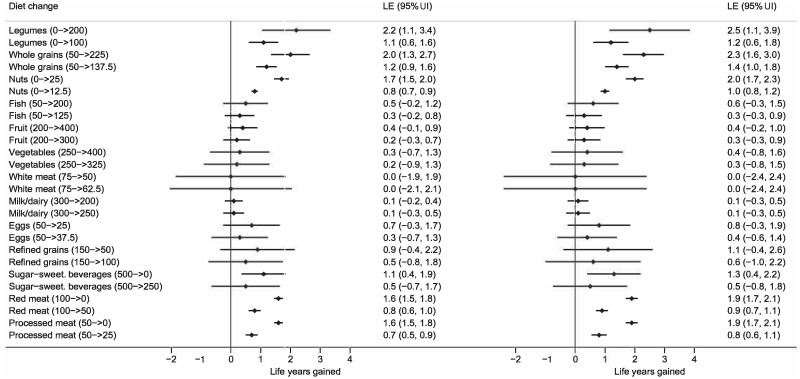
Based on meta-analyses and data from the Global Burden of Disease study (2019), we used life table methodology to estimate how LE changes with sustained changes in the intake of fruits, vegetables, whole grains, refined grains, nuts, legumes, fish, eggs, milk/dairy, red meat, processed meat, and sugar-sweetened beverages. We present estimates (with 95% uncertainty intervals [95% UIs]) for an optimized diet and a feasibility approach diet. An optimal diet had substantially higher intake than a typical diet of whole grains, legumes, fish, fruits, vegetables, and included a handful of nuts, while reducing red and processed meats, sugar-sweetened beverages, and refined grains. A feasibility approach diet was a midpoint between an optimal and a typical Western diet. A sustained change from a typical Western diet to the optimal diet from age 20 years would increase LE by more than a decade for women from the United States (10.7 [95% UI 8.4 to 12.3] years) and men (13.0 [95% UI 9.4 to 14.3] years). The largest gains would be made by eating more legumes (females: 2.2 [95% UI 1.1 to 3.4]; males: 2.5 [95% UI 1.1 to 3.9]), whole grains (females: 2.0 [95% UI 1.3 to 2.7]; males: 2.3 [95% UI 1.6 to 3.0]), and nuts (females: 1.7 [95% UI 1.5 to 2.0]; males: 2.0 [95% UI 1.7 to 2.3]), and less red meat (females: 1.6 [95% UI 1.5 to 1.8]; males: 1.9 [95% UI 1.7 to 2.1]) and processed meat (females: 1.6 [95% UI 1.5 to 1.8]; males: 1.9 [95% UI 1.7 to 2.1]). Changing from a typical diet to the optimized diet at age 60 years would increase LE by 8.0 (95% UI 6.2 to 9.3) years for women and 8.8 (95% UI 6.8 to 10.0) years for men, and 80-year-olds would gain 3.4 years (95% UI females: 2.6 to 3.8/males: 2.7 to 3.9). Change from typical to feasibility approach diet would increase LE by 6.2 (95% UI 3.5 to 8.1) years for 20-year-old women from the United States and 7.3 (95% UI 4.7 to 9.5) years for men. Using NutriGrade, the overall quality of evidence was assessed as moderate. The methodology provides population estimates under given assumptions and is not meant as individualized forecasting, with study limitations that include uncertainty for time to achieve full effects, the effect of eggs, white meat, and oils, individual variation in protective and risk factors, uncertainties for future development of medical treatments; and changes in lifestyle.
A sustained dietary change may give substantial health gains for people of all ages both for optimized and feasible changes. Gains are predicted to be larger the earlier the dietary changes are initiated in life. The Food4HealthyLife calculator that we provide online could be useful for clinicians, policy makers, and laypeople to understand the health impact of dietary choices.
对于临床医生、政策制定者甚至研究人员来说,解释和利用营养研究结果可能具有挑战性。为了更好地做出有关饮食的决策,需要创新的方法来整合最佳证据。我们已经开发出一种决策支持模型,该模型可以预测饮食选择如何影响预期寿命 (LE)。
基于荟萃分析和全球疾病负担研究的数据(2019 年),我们使用生命表方法来估计随着水果、蔬菜、全谷物、精制谷物、坚果、豆类、鱼类、鸡蛋、牛奶/乳制品、红肉、加工肉和含糖饮料的摄入量持续变化,LE 如何变化。我们提供了优化饮食和可行性方法饮食的估计值(带有 95%置信区间 [95%UI])。优化饮食的摄入量大大高于全谷物、豆类、鱼类、水果、蔬菜的典型饮食,同时减少了红肉和加工肉类、含糖饮料和精制谷物的摄入量。可行性方法饮食是优化和典型西方饮食之间的中点。从 20 岁开始,从典型的西方饮食转变为最佳饮食,将使美国女性的 LE 增加 10 年以上(女性 10.7 [95%UI 8.4 至 12.3] 年),男性增加 13 年(男性 9.4 至 14.3 年)。最大的收益将通过食用更多的豆类(女性:2.2 [95%UI 1.1 至 3.4];男性:2.5 [95%UI 1.1 至 3.9])、全谷物(女性:2.0 [95%UI 1.3 至 2.7];男性:2.3 [95%UI 1.6 至 3.0])和坚果(女性:1.7 [95%UI 1.5 至 2.0];男性:2.0 [95%UI 1.7 至 2.3]),以及减少红肉(女性:1.6 [95%UI 1.5 至 1.8];男性:1.9 [95%UI 1.7 至 2.1])和加工肉(女性:1.6 [95%UI 1.5 至 1.8];男性:1.9 [95%UI 1.7 至 2.1])来实现。从典型饮食转变为 60 岁时的优化饮食,将使美国女性的 LE 增加 8.0 年(95%UI 6.2 至 9.3 年),男性增加 8.8 年(95%UI 6.8 至 10.0 年),80 岁的人将获得 3.4 年(95%UI 女性:2.6 至 3.8/男性:2.7 至 3.9)。从典型饮食转变为可行性方法饮食将使美国 20 岁女性的 LE 增加 6.2 年(95%UI 3.5 至 8.1 年),男性增加 7.3 年(95%UI 4.7 至 9.5 年)。使用 NutriGrade 评估了证据的总体质量,认为是中等水平。该方法根据给定的假设提供人口估计,不作为个体化预测,研究存在的局限性包括达到完全效果的时间不确定、鸡蛋、白色肉类和油脂的效果、保护和危险因素的个体差异、医疗治疗未来发展的不确定性;以及生活方式的变化。
对于各个年龄段的人来说,持续的饮食变化可能会带来可观的健康收益,无论是优化饮食还是可行的饮食变化。预计早期开始饮食变化,收益会更大。我们在线提供的 Food4HealthyLife 计算器可以帮助临床医生、政策制定者和普通大众了解饮食选择对健康的影响。