Translational Health Research Institute (THRI), Western Sydney University, Campbelltown campus, Penrith, NSW, 2751, Australia.
School of Public Health, College of Medicine and Health Sciences, Hawassa University, Hawassa, Ethiopia.
BMC Infect Dis. 2022 Feb 8;22(1):134. doi: 10.1186/s12879-022-07119-6.
Antiretroviral therapy for pregnant women infected with HIV has evolved significantly over time, from single dosage antiretroviral and zidovudine alone to lifelong combination of antiretroviral therapy, but the effect of the intervention on population-level child HIV infection has not been well studied in sub-Saharan Africa. Therefore, this study aimed to establish the trend and effect of ART coverage during pregnancy on mother-to-child HIV transmission in sub-Saharan Africa from 2010 to 2019.
Country-level longitudinal ecological study design was used. Forty-one sub-Saharan Africa countries were included using publicly available data from the United Nations Programme on HIV/AIDS, World Health Organization, and World Bank. We created a panel dataset of 410 observations for this study from the years 2010-2019. Linear fixed effects dummy variable regression models were conducted to measure the effect of ART coverage during pregnancy on MTCT rate. Regression coefficients with their 95% confidence intervals (CIs) were estimated for each variable from the fixed effects model.
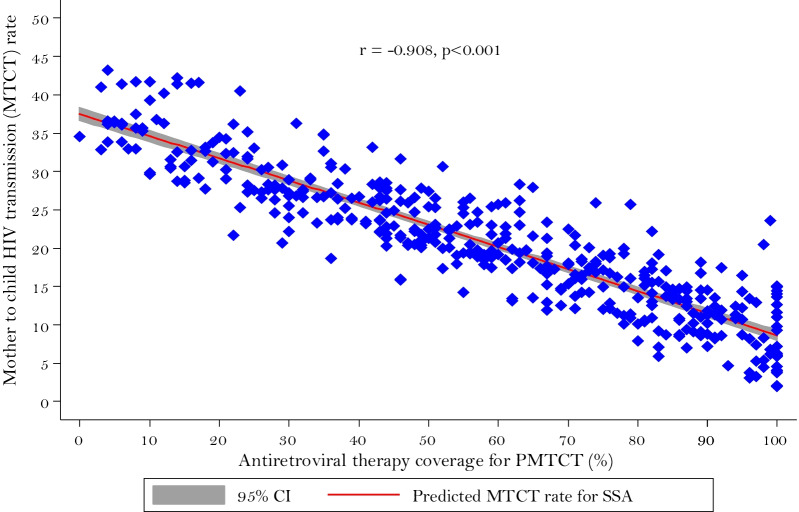
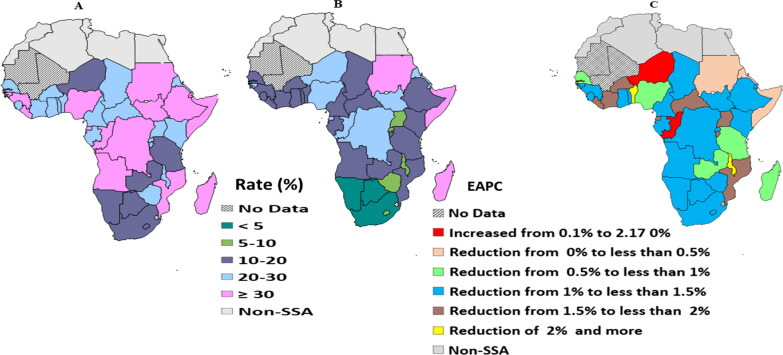
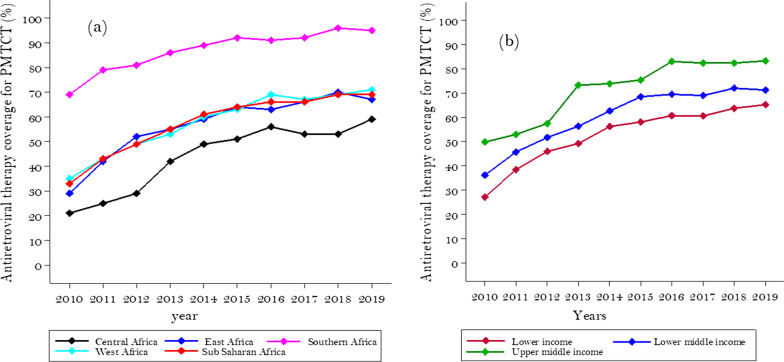
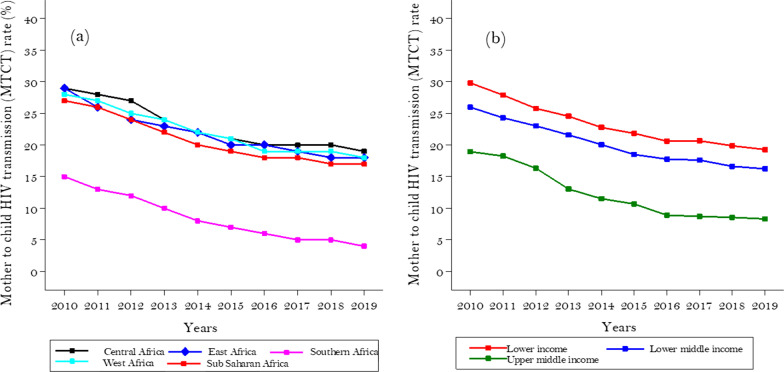
ART coverage during pregnancy increased from 32.98 to 69.46% between 2010 and 2019. Over the same period, the rate of HIV transmission from mother to child reduced from 27.18 to 16.90% in sub-Saharan Africa. A subgroup analysis found that in southern Africa and upper-middle-income groups, higher ART coverage, and lower MTCT rates were recorded. The fixed-effects model result showed that ART coverage during pregnancy (β = - 0.18, 95% CI - 0.19-- 0.16) (p < 0.001) and log-transformed HIV incidence-to-prevalence ratio (β = 5.41, 95% CI 2.18-8.65) (p < 0.001) were significantly associated with mother-to-child HIV transmission rate.
ART coverage for HIV positive pregnant women and HIV incidence-to-prevalence ratio were significantly associated with MTCT rate in sub-Saharan Africa. Based on these findings we suggest countries scale up ART coverage by implementing varieties of proven strategies and control the HIV epidemic to achieve the global target of eliminating MTCT of HIV in the region.
抗逆转录病毒疗法(ART)在感染 HIV 的孕妇中的应用已经随着时间的推移发生了重大变化,从单一剂量抗逆转录病毒药物和齐多夫定治疗,发展到终生联合抗逆转录病毒治疗,但该干预措施对撒哈拉以南非洲地区的人群水平母婴 HIV 感染的影响尚未得到充分研究。因此,本研究旨在确定 2010 年至 2019 年期间撒哈拉以南非洲地区妊娠期间接受抗逆转录病毒治疗的覆盖情况对母婴 HIV 传播的趋势和影响。
采用国家层面的纵向生态研究设计。本研究使用了联合国艾滋病规划署、世界卫生组织和世界银行提供的公开数据,共纳入 41 个撒哈拉以南非洲国家。我们从 2010 年至 2019 年创建了一个面板数据集,共 410 个观测值。采用线性固定效应虚拟变量回归模型来衡量妊娠期间接受抗逆转录病毒治疗的覆盖情况对母婴传播率的影响。从固定效应模型中估计每个变量的回归系数及其 95%置信区间(CI)。
2010 年至 2019 年期间,妊娠期间接受抗逆转录病毒治疗的比例从 32.98%上升到 69.46%。同期,撒哈拉以南非洲地区母婴 HIV 传播率从 27.18%下降到 16.90%。亚组分析发现,在南部非洲和中高收入国家,更高的抗逆转录病毒治疗覆盖率和更低的母婴传播率得到了记录。固定效应模型结果表明,妊娠期间接受抗逆转录病毒治疗(β=-0.18,95%CI-0.19-0.16)(p<0.001)和 HIV 发病率与流行率比值的对数转换(β=5.41,95%CI2.18-8.65)(p<0.001)与母婴 HIV 传播率显著相关。
撒哈拉以南非洲地区,HIV 阳性孕妇接受抗逆转录病毒治疗的覆盖率和 HIV 发病率与流行率比值与母婴 HIV 传播率显著相关。基于这些发现,我们建议各国通过实施各种经过验证的策略来扩大抗逆转录病毒治疗的覆盖率,并控制 HIV 流行,以实现该地区消除母婴 HIV 传播的全球目标。