Department of Cardiology, First Affiliated Hospital of Nanjing Medical University, Nanjing, China.
Department of Geriatrics, Sir Run Run Hospital of Nanjing Medical University, Nanjing, China.
Bioengineered. 2022 Feb;13(2):3826-3839. doi: 10.1080/21655979.2021.2017564.
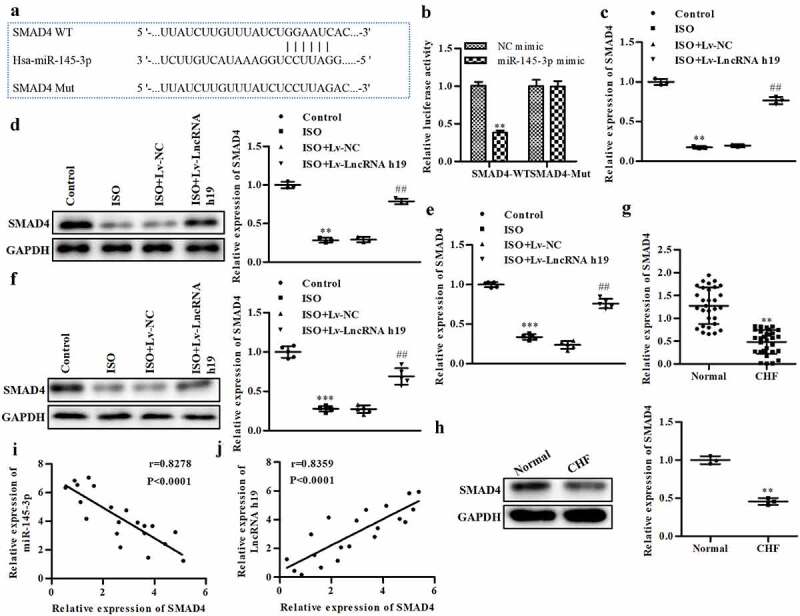
Sustained cardiac hypertrophy (CH) contributes to many heart diseases. Long noncoding RNAs (lncRNAs) collectively play critical roles in cardiovascular diseases (CVDs). However, the roles of lncRNA H19 in CH are still unclear. A CH model was constructed utilizing isoproterenol (ISO). We demonstrated H19 could participate in regulating ISO-induced CH development both and . The online databases DIANA and TargetScan were used to predict the targets of H19 and MicroRNA-145-3p (miR-145-3p), respectively. Luciferase reporter assay was used to verify the downstream targets. The results showed that H19 was decreased under ISO stimulation. The H19 overexpression resulted in significant decrease in mouse heart size and weight, left ventricular systolic dysfunction, left ventricular posterior wall thickness and cardiac hypertrophic growth, while promoted the increase of left ventricular ejection fraction and left ventricle fraction shortening. H19 also inhibited protein expression levels of CH markers, such as atrial natriuretic peptide (ANP), brain natriuretic peptide (BNP), and MYH7. Luciferase assays results showed that miR-145-3p was a target of H19 and SMAD4 was a target of miR-145-3p. We found that H19 regulated SMAD4 by sponging miR-145-3p. Knockout of miR-145-3p or overexpression of SMAD4 facilitated H19-induced decreases in ANP, BNP, and MYH7. Collectively, our findings have indicated that the H19/miR-145-3p/SMAD4 axis should be a negative regulator involved in CH progression.
持续的心脏肥大(CH)是许多心脏病的病因。长链非编码 RNA(lncRNA)在心血管疾病(CVD)中发挥着关键作用。然而,lncRNA H19 在 CH 中的作用仍不清楚。我们利用异丙肾上腺素(ISO)构建了 CH 模型。结果表明,H19 可以参与调节 ISO 诱导的 CH 发展。在线数据库 DIANA 和 TargetScan 分别用于预测 H19 和 MicroRNA-145-3p(miR-145-3p)的靶标。荧光素酶报告基因实验用于验证下游靶标。结果显示,ISO 刺激下 H19 表达减少。H19 过表达导致小鼠心脏大小和重量、左心室收缩功能、左心室后壁厚度和心脏肥大生长显著减少,而左心室射血分数和左心室缩短分数增加。H19 还抑制了 CH 标志物如心房利钠肽(ANP)、脑利钠肽(BNP)和 MYH7 的蛋白表达水平。荧光素酶实验结果表明,miR-145-3p 是 H19 的靶标,SMAD4 是 miR-145-3p 的靶标。我们发现 H19 通过海绵吸附 miR-145-3p 来调节 SMAD4。敲除 miR-145-3p 或过表达 SMAD4 促进了 H19 诱导的 ANP、BNP 和 MYH7 减少。总之,我们的研究结果表明,H19/miR-145-3p/SMAD4 轴可能是参与 CH 进展的负调控因子。