Department of Epidemiology, School of Public Health, University of São Paulo, Av. Dr. Arnaldo, 715, São Paulo, SP, CEP 01246-904, Brazil.
Mycology Unit of Adolfo Lutz Institute, Public Health Reference Laboratory, Secretary of Health, Av. Dr.Arnaldo, 351, São Paulo, SP, CEP 05411-000, Brazil.
BMC Infect Dis. 2022 Feb 9;22(1):138. doi: 10.1186/s12879-022-07118-7.
Cryptococcal meningitis causes high mortality in immunocompromised and immunocompetent patients. The objective of this study was to identify early predictors of clinical outcome, available at the first days of hospitalization, in patients with cryptococcal meningitis in a tertiary center in Brazil.
Ninety-six cases of cryptococcal meningitis with clinical, epidemiological and laboratory data, and identification and antifungal susceptibility of the strains were analyzed. Quantitative CSF yeast counts were performed by direct microscopic exam with a Fuchs-Rosenthal cell counting chamber using an institutional protocol. Univariable and multiple analyses using logistic regression were performed to identify predictors, available at the beginning of hospitalization, of in-hospital mortality. Moreover, we performed a secondary analysis for a composite outcome defined by hospital mortality and intensive care unit transfer.
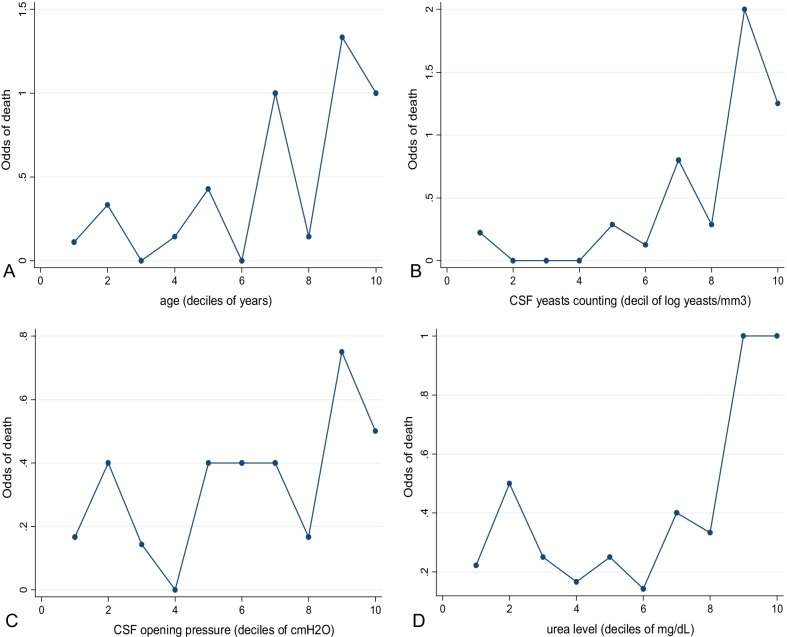
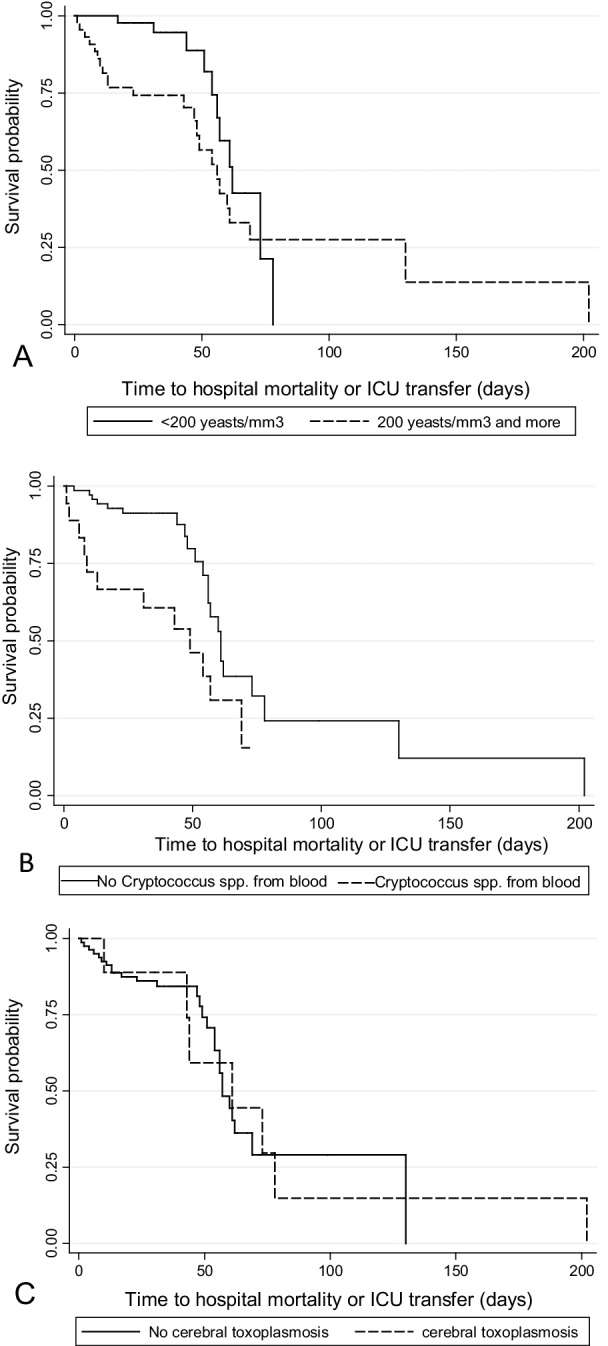
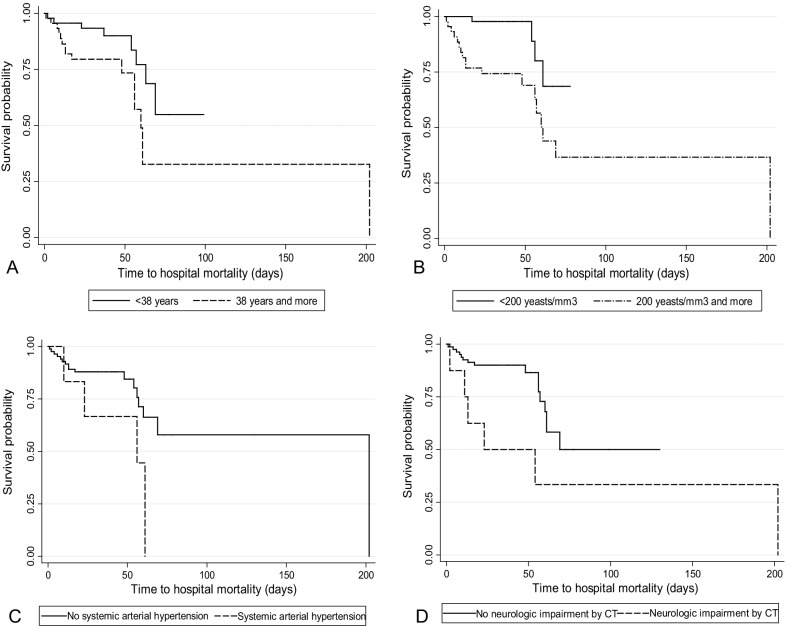
The species and the antifungal susceptibility were not associated with the outcomes evaluated. The variables significantly associated with the mortality were age (OR = 1.08, 95% CI 1.02-1.15), the cerebrospinal fluid (CSF) yeasts count (OR = 1.65, 95% CI 1.20-2.27), systemic arterial hypertension (OR = 22.63, 95% CI 1.64-312.91) and neurological impairment identified by computed tomography (OR = 41.73, 95% CI 3.10-561.65). At the secondary analysis, CSF yeast count was also associated with the composite outcome, in addition to the culture of Cryptococcus spp. from bloodstream and cerebral toxoplasmosis. The associations were consistent with survival models evaluated.
Age and CSF yeast count were independently associated with in-hospital mortality of patients with cryptococcal meningitis but Cryptococcus species identification and antifungal susceptibility were not associated with the outcomes. Quantitative CSF yeast counts used in this study can be evaluated and implemented in other low and middle-income settings.
隐球菌性脑膜炎可导致免疫功能低下和免疫功能正常的患者死亡率升高。本研究的目的是在巴西的一家三级中心,确定在住院的最初几天内可用于预测隐球菌性脑膜炎患者临床结局的早期预测因素。
分析了 96 例隐球菌性脑膜炎患者的临床、流行病学和实验室数据,以及菌株的鉴定和抗真菌药敏性。使用机构方案,通过直接显微镜检查使用福克思-罗森塔尔细胞计数室对定量 CSF 酵母计数。使用逻辑回归进行单变量和多变量分析,以确定在住院期间死亡率的预测因素,这些因素可在住院的最初几天获得。此外,我们还进行了次要分析,以确定定义为住院死亡率和重症监护病房转科的复合结局。
物种和抗真菌药敏性与评估的结局无关。与死亡率显著相关的变量为年龄(OR=1.08,95%CI 1.02-1.15)、CSF 酵母计数(OR=1.65,95%CI 1.20-2.27)、全身性动脉高血压(OR=22.63,95%CI 1.64-312.91)和计算机断层扫描(CT)确定的神经功能障碍(OR=41.73,95%CI 3.10-561.65)。在次要分析中,CSF 酵母计数与复合结局相关,此外还与血流中分离出的隐球菌和脑部弓形体病有关。这些关联与评估的生存模型一致。
年龄和 CSF 酵母计数与隐球菌性脑膜炎患者的住院死亡率独立相关,但隐球菌种类的鉴定和抗真菌药敏性与结局无关。本研究中使用的定量 CSF 酵母计数可以在其他中低收入环境中进行评估和实施。