Department of Electrical and Computer Engineering, Texas A&M University, College Station, TX, USA.
Department of Medicine, Baylor College of Medicine, Houston, TX, 77030, USA.
Sci Rep. 2022 Feb 9;12(1):2211. doi: 10.1038/s41598-022-06230-7.
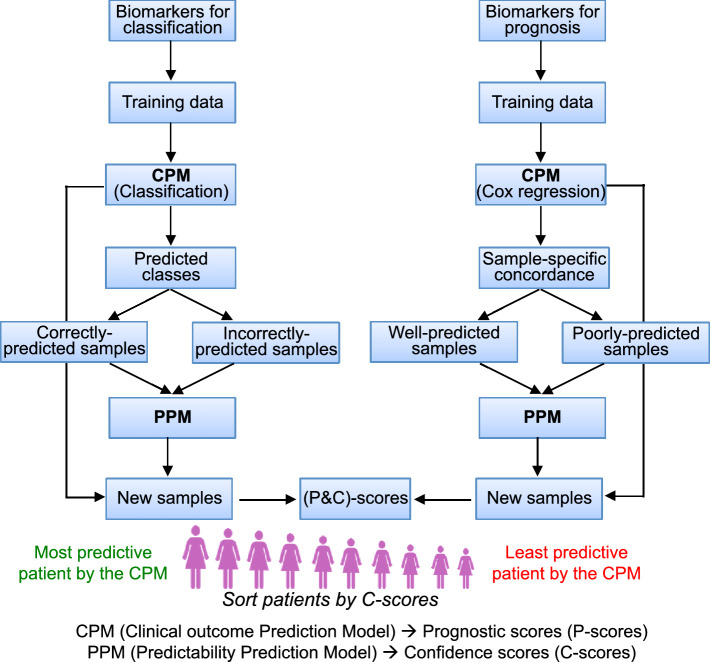
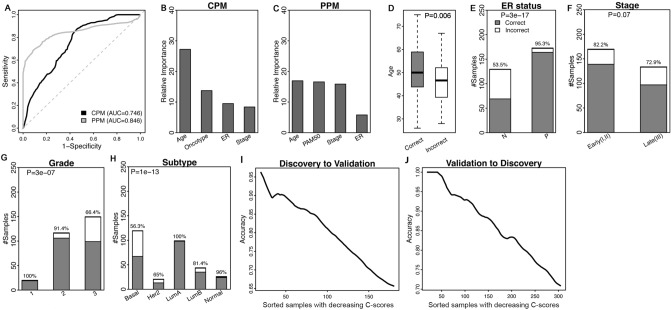
To improve cancer precision medicine, prognostic and predictive biomarkers are critically needed to aid physicians in deciding treatment strategies in a personalized fashion. Due to the heterogeneous nature of cancer, most biomarkers are expected to be valid only in a subset of patients. Furthermore, there is no current approach to determine the applicability of biomarkers. In this study, we propose a framework to improve the clinical application of biomarkers. As part of this framework, we develop a clinical outcome prediction model (CPM) and a predictability prediction model (PPM) for each biomarker and use these models to calculate a prognostic score (P-score) and a confidence score (C-score) for each patient. Each biomarker's P-score indicates its association with patient clinical outcomes, while each C-score reflects the biomarker applicability of the biomarker's CPM to a patient and therefore the confidence of the clinical prediction. We assessed the effectiveness of this framework by applying it to three biomarkers, Oncotype DX, MammaPrint, and an E2F4 signature, which have been used for predicting patient response, pathologic complete response versus residual disease to neoadjuvant chemotherapy (a classification problem), and recurrence-free survival (a Cox regression problem) in breast cancer, respectively. In both applications, our analyses indicated patients with higher C scores were more likely to be correctly predicted by the biomarkers, indicating the effectiveness of our framework. This framework provides a useful approach to develop and apply biomarkers in the context of cancer precision medicine.
为了提高癌症精准医学水平,迫切需要预后和预测生物标志物来帮助医生以个性化的方式制定治疗策略。由于癌症的异质性,大多数生物标志物预计仅在一部分患者中有效。此外,目前还没有确定生物标志物适用性的方法。在本研究中,我们提出了一个改进生物标志物临床应用的框架。作为该框架的一部分,我们为每个生物标志物开发了一个临床结果预测模型(CPM)和一个可预测性预测模型(PPM),并使用这些模型为每个患者计算预后评分(P-score)和置信评分(C-score)。每个生物标志物的 P-score 表示其与患者临床结果的关联,而每个 C-score 反映了生物标志物的 CPM 对患者的适用性,因此反映了临床预测的置信度。我们通过将该框架应用于三种生物标志物,即 Oncotype DX、MammaPrint 和 E2F4 标志物,来评估该框架的有效性,这些生物标志物分别用于预测患者对新辅助化疗的反应、病理完全缓解与残留疾病(分类问题)以及无复发生存(Cox 回归问题),以评估该框架的有效性。在这两种应用中,我们的分析表明,C 分数较高的患者更有可能被生物标志物正确预测,这表明了我们框架的有效性。该框架为在癌症精准医学背景下开发和应用生物标志物提供了一种有用的方法。