Department of Health Sciences, Osaka University Graduate School of Medicine, Osaka, Japan.
Faculty of Health Science, Morinomiya University of Medical Sciences, Osaka, Japan.
Geriatr Gerontol Int. 2022 Apr;22(4):286-291. doi: 10.1111/ggi.14355. Epub 2022 Feb 10.
The aim of this study was to clarify the association between dietary protein intake and decline in the estimated glomerular filtration rate (eGFR) among Japanese older adults.
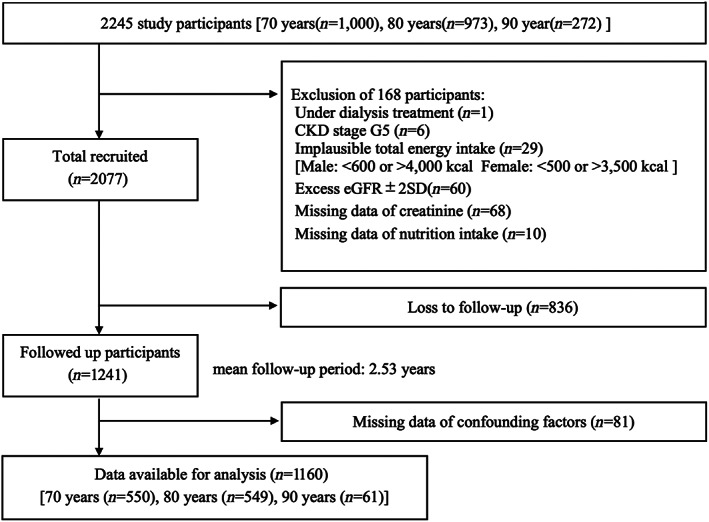
We used the data of the Septuagenarians, Octogenarians and Nonagenarians Investigation with Centenarians (SONIC) study, an ongoing narrow-age range cohort study: 69-71 years, 79-81 years and 89-91 years. The outcome variable, change in eGFR, was estimated from serum creatinine measured at the baseline and 3-year follow up, and the exposure variable, protein intake, was calculated using the brief-type self-administered diet history questionnaire at the baseline. Associations between eGFR change and protein intake were determined by multiple linear regression analysis.
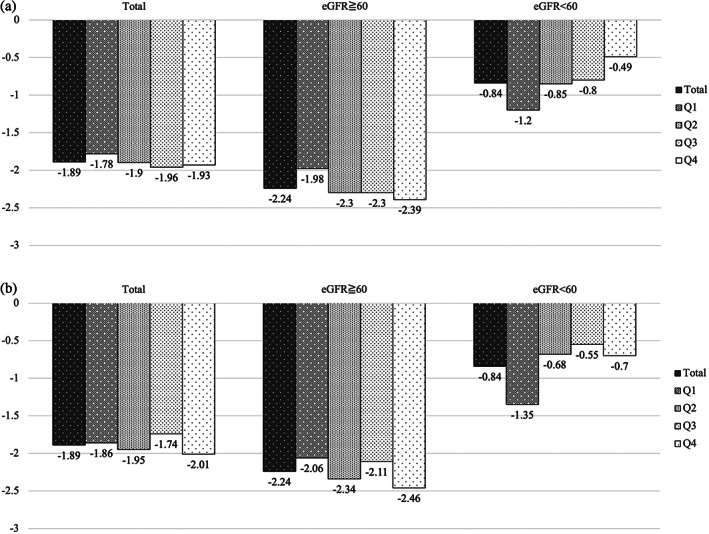
The mean eGFR change per year was -1.89 mL/min/1.73 m . The mean protein intake was 1.50 g/kg/day. The results of this study showed that there was no significant association between protein or animal protein intake and change in eGFR per year in the entire population of participants, including the very elderly, but there was a significant positive association in those whose renal function fell into chronic kidney disease stage G3 or G4.
Protein intake among community-dwelling older adults was not associated with lower eGFR, and for older chronic kidney disease patients, protein and animal protein intakes were more beneficial in maintaining eGFR. The results provide evidence that protein intake should not be restricted for older patients with chronic kidney disease, including the very elderly. Geriatr Gerontol Int 2022; 22: 286-291.
本研究旨在阐明日本老年人膳食蛋白质摄入量与估算肾小球滤过率(eGFR)下降之间的关系。
我们使用了正在进行的窄年龄范围队列研究——“九十岁及以上人群研究”(SONIC)的数据,该研究包括 69-71 岁、79-81 岁和 89-91 岁三个年龄段。结局变量 eGFR 的变化是通过基线和 3 年随访时测量的血清肌酐值估算得到的,而暴露变量蛋白质摄入量则是通过基线时的简短型自我管理饮食史问卷计算得到的。通过多元线性回归分析确定 eGFR 变化与蛋白质摄入量之间的关系。
每年 eGFR 的平均变化为-1.89mL/min/1.73m。蛋白质的平均摄入量为 1.50g/kg/天。研究结果表明,在包括非常老年人在内的所有参与者中,蛋白质或动物蛋白摄入量与每年 eGFR 的变化之间没有显著关联,但在肾功能下降到慢性肾脏病 3 或 4 期的人群中,这种关联呈显著正相关。
社区居住的老年人的蛋白质摄入量与较低的 eGFR 无关,对于老年慢性肾脏病患者,摄入蛋白质和动物蛋白更有利于维持 eGFR。这些结果为证据表明,对于包括非常老年人在内的慢性肾脏病老年患者,不应限制蛋白质摄入。老年医学与老年病学国际杂志 2022;22:286-291。