Gomel Nir, Shemesh Nadav, Sorkin Nir, Levinger Nadav, Levinger Shmuel, Hirsch Ami, Achiron Asaf, Levinger Eliya
Department of Ophthalmology, Tel Aviv Medical Center and Sackler Faculty of Medicine, Tel Aviv University, 6423906, Tel Aviv, Israel.
The Faculty of Medicine, The Hebrew University of Jerusalem, Jerusalem, Israel.
Ophthalmol Ther. 2024 Dec;13(12):3049-3057. doi: 10.1007/s40123-024-01040-8. Epub 2024 Oct 3.
The study aimed to compare postoperative pain between alcohol-assisted and transepithelial photorefractive keratectomy in patients who received the novel analgesic preoperative nepafenac treatment 2 days preoperatively and 3 days postoperatively. Pain, stinging, tearing, light sensitivity, and stress levels were evaluated.
The study included a retrospective analysis of 55 patients divided into two groups: bilateral alcohol-assisted photorefractive keratectomy (aa-PRK) and transepithelial photorefractive keratectomy (transepithelial-PRK). Nepafenac was administered for pain control for all patients, with patients receiving four drops for 2 days before the surgery and 3 days postoperatively per clinical instructions. Patients completed questionnaires on the day of the surgery and for the first 5 days postoperatively. Statistical analysis was performed using XLSTAT (version 2023.1.2). t-Test was used to analyze and compare pain and symptom levels and Fisher's exact test for categorical data. p-Values less than 0.05 were considered statistically significant.
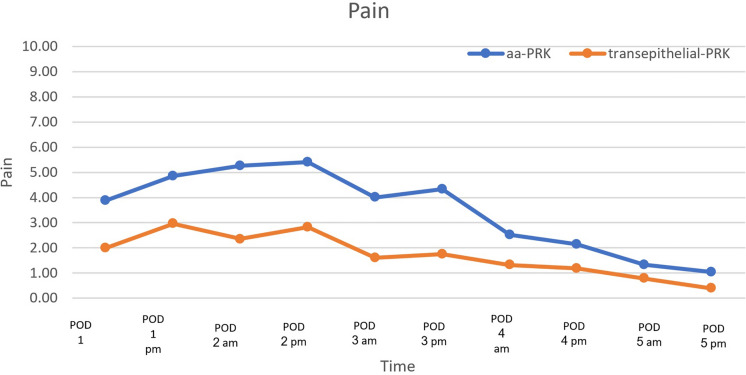
The study examined 55 patients (49% female) with a mean age of 25.11 ± 6.81 years who had undergone bilateral surface refractive surgery to correct myopic errors. The mean baseline standard error (SE) was -3.16 ± 2.20 D. Among these patients, 27 patients underwent aa-PRK and 28 patients underwent transepithelial-PRK. Higher levels of pain were significant in the aa-PRK group (p = 0.003). However, there was no significant difference between the groups in the average levels of stinging, tearing, or light sensation. Additionally, stress levels decreased over time in both groups, with levels becoming almost equal after 5 days, and there was no significant difference in the average stress levels between the two groups.
The study found that patients who underwent the transepithelial-PRK procedure had significantly lower pain levels compared with those who underwent aa-PRK after being treated with nepafenac per protocol. However, there was no significant difference between the two groups in terms of stinging, tearing, light sensation, and stress levels.
本研究旨在比较接受新型镇痛药物萘非那酮术前2天及术后3天治疗的患者,在酒精辅助准分子上皮下角膜磨镶术(aa-PRK)和经上皮准分子角膜切削术(trans-PRK)后的术后疼痛情况。对疼痛、刺痛、流泪、畏光和应激水平进行了评估。
本研究对55例患者进行回顾性分析,分为两组:双侧酒精辅助准分子上皮下角膜磨镶术(aa-PRK)组和经上皮准分子角膜切削术(trans-PRK)组。所有患者均使用萘非那酮控制疼痛,根据临床指示,患者在手术前2天和术后3天每天滴4次。患者在手术当天及术后前5天完成问卷。使用XLSTAT(2023.1.2版)进行统计分析。采用t检验分析和比较疼痛及症状水平,分类数据采用Fisher精确检验。p值小于0.05被认为具有统计学意义。
本研究共纳入55例患者(49%为女性),平均年龄25.11±6.81岁,均接受双侧表面屈光手术以矫正近视。平均基线标准误(SE)为-3.16±2.20D。其中,27例患者接受aa-PRK,28例患者接受trans-PRK。aa-PRK组的疼痛水平更高(p = 0.003)。然而,两组在刺痛、流泪或畏光的平均水平上无显著差异。此外,两组的应激水平均随时间下降,5天后水平几乎相等,两组的平均应激水平无显著差异。
研究发现,按照方案使用萘非那酮治疗后,接受trans-PRK手术的患者疼痛水平明显低于接受aa-PRK手术的患者。然而,两组在刺痛、流泪、畏光和应激水平方面无显著差异。