The Rheumatism Research Center, Catholic Research Institute of Medical Science, College of Medicine, The Catholic University of Korea, 222, Banpo-daero, Seocho-gu, Seoul, 06591, Republic of Korea.
Lab of Translational ImmunoMedicine, Catholic Research Institute of Medical Science, College of Medicine, College of Medicine, The Catholic University of Korea, Seoul, Republic of Korea.
J Transl Med. 2022 Feb 11;20(1):85. doi: 10.1186/s12967-022-03267-0.
Rheumatoid arthritis (RA) is a progressive systemic autoimmune disease that is characterized by infiltration of inflammatory cells into the hyperplastic synovial tissue, resulting in subsequent destruction of adjacent articular cartilage and bone. Methotrexate (MTX), the first conventional disease-modifying antirheumatic drug (DMARD), could alleviate articular damage in RA and is implicated in humoral and cellular immune responses. However, MTX has several side effects, so efficient delivery of low-dose MTX is important.
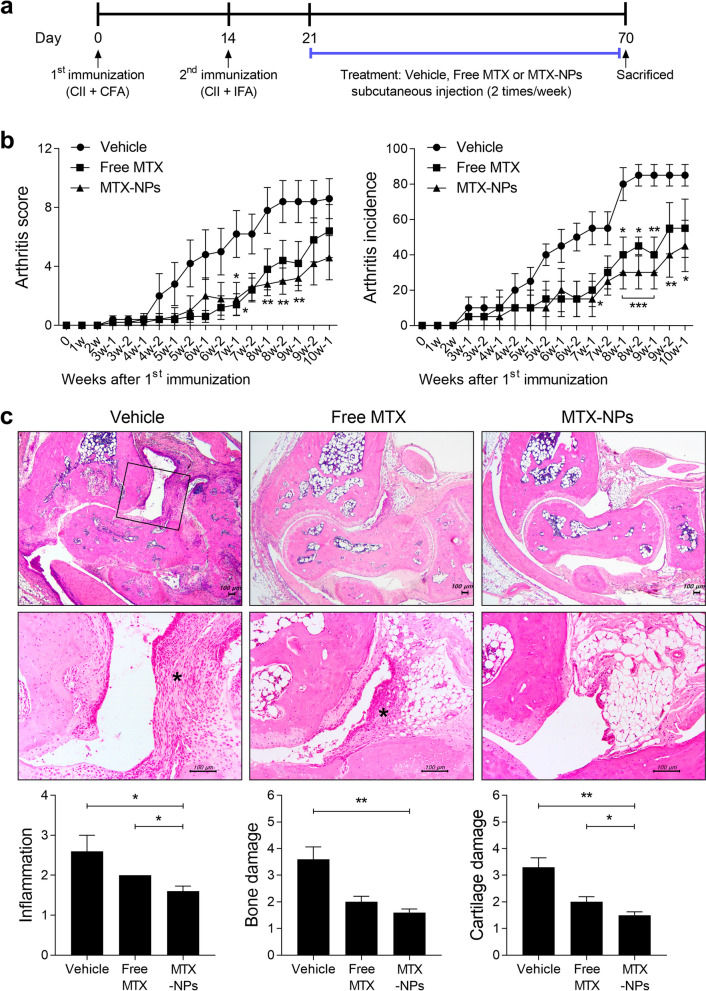
To investigate the efficacy of MTX-loaded nanoparticles (MTX-NPs) against experimental model of RA, free MTX or MTX-NPs were administered as subcutaneous route to mice with collagen-induced arthritis (CIA) at 3 weeks after CII immunization. The levels of inflammatory factors in tissues were determined by immunohistochemistry, confocal microscopy, real-time PCR, and flow cytometry.
MTX-NPs ameliorated arthritic severity and joint destruction in collagen-induced arthritis (CIA) mice compared to free MTX-treated CIA mice. The levels of inflammatory cytokines, including interleukin (IL)-1β, tumor necrosis factor-α, and vascular endothelial growth factor, were reduced in MTX-NPs-treated mice. Number of CD4 + IL-17 + cells decreased whereas the number of CD4 + CD25 + Foxp3 + cells increased in spleens from MTX- NPs-treated CIA mice compared to MTX-treated CIA mice. The frequency of CD19 + CD25 + Foxp3 + regulatory B cells increased in ex vivo splenocytes from MTX-loaded NPs-treated CIA mice compared to MTX-treated CIA mice.
The results suggest that MTX-loaded NPs have therapeutic potential for RA.
类风湿关节炎(RA)是一种进行性系统性自身免疫性疾病,其特征是炎症细胞浸润增生的滑膜组织,进而导致相邻关节软骨和骨的破坏。甲氨蝶呤(MTX)是首个传统的疾病修饰抗风湿药物(DMARD),可缓解 RA 中的关节损伤,并参与体液和细胞免疫反应。然而,MTX 有几种副作用,因此有效递送至低剂量 MTX 很重要。
为了研究载甲氨蝶呤纳米粒(MTX-NPs)对实验性 RA 模型的疗效,在 CII 免疫后 3 周,通过皮下途径向胶原诱导关节炎(CIA)小鼠给予游离 MTX 或 MTX-NPs。通过免疫组织化学、共聚焦显微镜、实时 PCR 和流式细胞术测定组织中炎症因子的水平。
与游离 MTX 治疗的 CIA 小鼠相比,MTX-NPs 改善了 CIA 小鼠的关节炎严重程度和关节破坏。MTX-NPs 治疗的小鼠中,包括白细胞介素(IL)-1β、肿瘤坏死因子-α 和血管内皮生长因子在内的炎症细胞因子水平降低。与游离 MTX 治疗的 CIA 小鼠相比,MTX-NPs 治疗的 CIA 小鼠脾脏中 CD4+IL-17+细胞的数量减少,而 CD4+CD25+Foxp3+细胞的数量增加。与游离 MTX 治疗的 CIA 小鼠相比,载 MTX-NPs 治疗的 CIA 小鼠的脾细胞中 CD19+CD25+Foxp3+调节性 B 细胞的频率增加。
结果表明,载 MTX-NPs 对 RA 具有治疗潜力。