• 文献检索
  • 文档翻译
  • 深度研究
  • 学术资讯
  • Suppr Zotero 插件Zotero 插件
  • 邀请有礼
  • 套餐&价格
  • 历史记录
应用&插件
Suppr Zotero 插件Zotero 插件浏览器插件Mac 客户端Windows 客户端微信小程序
定价
高级版会员购买积分包购买API积分包
服务
文献检索文档翻译深度研究API 文档MCP 服务
关于我们
关于 Suppr公司介绍联系我们用户协议隐私条款
关注我们

Suppr 超能文献

核心技术专利:CN118964589B侵权必究
粤ICP备2023148730 号-1Suppr @ 2026

文献检索

告别复杂PubMed语法,用中文像聊天一样搜索,搜遍4000万医学文献。AI智能推荐,让科研检索更轻松。

立即免费搜索

文件翻译

保留排版,准确专业,支持PDF/Word/PPT等文件格式,支持 12+语言互译。

免费翻译文档

深度研究

AI帮你快速写综述,25分钟生成高质量综述,智能提取关键信息,辅助科研写作。

立即免费体验

鸟类捕食者会根据信号的可靠性来品尝拒绝模拟猎物。

Avian predators taste reject mimetic prey in relation to their signal reliability.

机构信息

Guangxi Key Laboratory of Forest Ecology and Conservation, College of Forestry, Guangxi University, Nanning, Guangxi, People's Republic of China.

Department of Health and Environmental Sciences, Xi'an Jiaotong-Liverpool University, Suzhou, Jiangsu, People's Republic of China.

出版信息

Sci Rep. 2022 Feb 11;12(1):2334. doi: 10.1038/s41598-022-05600-5.

DOI:10.1038/s41598-022-05600-5
PMID:35149707
原文链接:https://pmc.ncbi.nlm.nih.gov/articles/PMC8837650/
Abstract

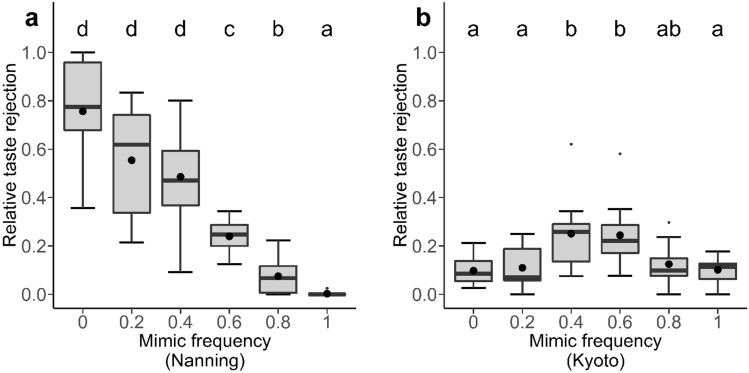
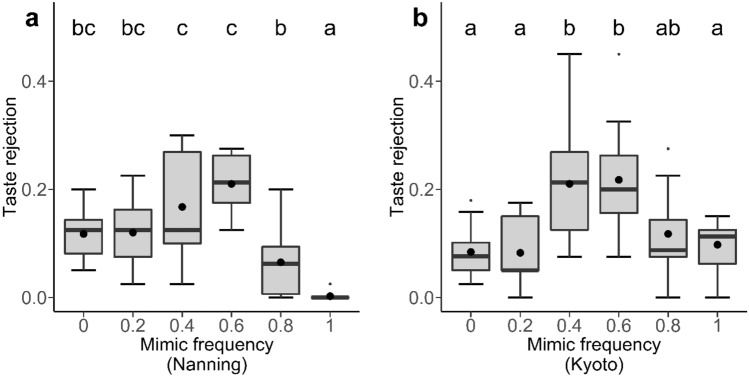
Aposematic organisms defend themselves through various means to increase their unprofitability to predators which they advertise with conspicuous warning signals. Predators learn to avoid aposematic prey through associative learning that leads to lower predation. However, when these visual signals become unreliable (e.g., through automimicry or Batesian mimicry), predators may switch from using visual signals to taste sampling prey to choose among them. In this experiment, we tested this possibility in a field experiment where we released a total of 4800 mealworm prey in two clusters consisting of either: (i) undefended prey (injected with water) and (ii) model-mimics (injected with either quinine sulphate [models] or water [mimics]). Prey were deployed at 12 sites, with the mimic frequency of the model-mimics ranging between 0 and 1 (at 0.2 intervals). We found that taste rejection peaked at moderate mimic frequencies (0.4 and 0.6), supporting the idea that taste sampling and rejection of prey is related to signal reliability and predator uncertainty. This is the first time that taste-rejection has been shown to be related to the reliability of prey signals in a mimetic prey system.

摘要

警戒生物通过各种方式来保护自己,使其对捕食者来说无利可图,它们会用明显的警告信号来宣传自己。捕食者通过联想学习来避免警戒性猎物,从而降低捕食率。然而,当这些视觉信号变得不可靠时(例如,通过自动拟态或贝氏拟态),捕食者可能会从使用视觉信号转变为品尝猎物来选择猎物。在这个实验中,我们在一个野外实验中测试了这种可能性,我们总共在两个集群中释放了 4800 只黄粉虫猎物,集群 1 由未受防御的猎物(注射水)组成,集群 2 由模型模拟物(注射硫酸奎宁[模型]或水[模拟物])组成。猎物被部署在 12 个地点,模型模拟物的模拟频率在 0 到 1 之间(以 0.2 的间隔变化)。我们发现,味觉排斥在中等模拟频率(0.4 和 0.6)时达到峰值,这支持了这样一种观点,即对猎物的味觉采样和排斥与信号可靠性和捕食者的不确定性有关。这是第一次在模仿猎物系统中证明味觉排斥与猎物信号的可靠性有关。
https://cdn.ncbi.nlm.nih.gov/pmc/blobs/4be9/8837650/f259808e6d41/41598_2022_5600_Fig3_HTML.jpg
https://cdn.ncbi.nlm.nih.gov/pmc/blobs/4be9/8837650/1acf5808dc1c/41598_2022_5600_Fig1_HTML.jpg
https://cdn.ncbi.nlm.nih.gov/pmc/blobs/4be9/8837650/6d5b2645eb3e/41598_2022_5600_Fig2_HTML.jpg
https://cdn.ncbi.nlm.nih.gov/pmc/blobs/4be9/8837650/f259808e6d41/41598_2022_5600_Fig3_HTML.jpg
https://cdn.ncbi.nlm.nih.gov/pmc/blobs/4be9/8837650/1acf5808dc1c/41598_2022_5600_Fig1_HTML.jpg
https://cdn.ncbi.nlm.nih.gov/pmc/blobs/4be9/8837650/6d5b2645eb3e/41598_2022_5600_Fig2_HTML.jpg
https://cdn.ncbi.nlm.nih.gov/pmc/blobs/4be9/8837650/f259808e6d41/41598_2022_5600_Fig3_HTML.jpg

相似文献

1
Avian predators taste reject mimetic prey in relation to their signal reliability.鸟类捕食者会根据信号的可靠性来品尝拒绝模拟猎物。
Sci Rep. 2022 Feb 11;12(1):2334. doi: 10.1038/s41598-022-05600-5.
2
Body size matters for aposematic prey during predator aversion learning.在捕食者厌恶学习过程中,警戒色猎物的体型很重要。
Behav Processes. 2014 Nov;109 Pt B:173-9. doi: 10.1016/j.beproc.2014.09.026. Epub 2014 Sep 23.
3
Disentangling taste and toxicity in aposematic prey.化险为夷:拟态猎物的味觉与毒性。
Proc Biol Sci. 2012 Dec 19;280(1753):20122588. doi: 10.1098/rspb.2012.2588. Print 2013 Feb 22.
4
Frequency-dependent taste-rejection by avian predation may select for defence chemical polymorphisms in aposematic prey.鸟类捕食导致的频率依赖性味觉排斥可能会促使具有警戒色的猎物在防御性化学物质方面产生多态性。
Biol Lett. 2005 Dec 22;1(4):500-3. doi: 10.1098/rsbl.2005.0359.
5
The benefits of being toxic to deter predators depends on prey body size.对捕食者有毒以进行威慑的益处取决于猎物的体型大小。
Behav Ecol. 2016 Nov-Dec;27(6):1650-1655. doi: 10.1093/beheco/arw086. Epub 2016 Jun 21.
6
Predators' decisions to eat defended prey depend on the size of undefended prey.捕食者决定食用有防御能力的猎物取决于无防御能力猎物的大小。
Anim Behav. 2013 Jun;85(6):1315-1321. doi: 10.1016/j.anbehav.2013.03.021.
7
The Impact of Detoxification Costs and Predation Risk on Foraging: Implications for Mimicry Dynamics.解毒成本和被捕食风险对觅食的影响:对拟态动态的启示
PLoS One. 2017 Jan 3;12(1):e0169043. doi: 10.1371/journal.pone.0169043. eCollection 2017.
8
How can automimicry persist when predators can preferentially consume undefended mimics?当捕食者能够优先捕食无防御能力的拟态者时,自动拟态是如何持续存在的呢?
Proc Biol Sci. 2006 Feb 7;273(1584):373-8. doi: 10.1098/rspb.2005.3238.
9
Conditions for the spread of conspicuous warning signals: a numerical model with novel insights.显著警告信号的传播条件:一个具有新颖见解的数值模型
Evolution. 2006 Nov;60(11):2246-56.
10
Better the devil you know: avian predators find variation in prey toxicity aversive.宁要熟悉的魔鬼:鸟类捕食者发现猎物毒性的变化令人厌恶。
Biol Lett. 2014 Nov;10(11):20140533. doi: 10.1098/rsbl.2014.0533.

本文引用的文献

1
ape 5.0: an environment for modern phylogenetics and evolutionary analyses in R.ape 5.0:R 中的现代系统发育学和进化分析环境。
Bioinformatics. 2019 Feb 1;35(3):526-528. doi: 10.1093/bioinformatics/bty633.
2
Too hard to swallow: a secret secondary defence of an aposematic insect.难以下咽:一种警戒色昆虫的隐秘二级防御机制
J Exp Biol. 2018 Jan 25;221(Pt 2):jeb172486. doi: 10.1242/jeb.172486.
3
SURVIVAL OF DISTASTEFUL INSECTS AFTER BEING ATTACKED BY NAIVE BIRDS: A REAPPRAISAL OF THE THEORY OF APOSEMATIC COLORATION EVOLVING THROUGH INDIVIDUAL SELECTION.
被未接触过的鸟类攻击后难吃昆虫的存活:对通过个体选择进化的警戒色理论的重新评估
Evolution. 1982 Sep;36(5):998-1002. doi: 10.1111/j.1558-5646.1982.tb05468.x.
4
BUTTERFLY PALATABILITY AND MIMICRY: EXPERIMENTS WITH AMEIVA LIZARDS.蝴蝶的适口性与拟态:对美洲蜥属蜥蜴的实验
Evolution. 1976 Mar;30(1):73-81. doi: 10.1111/j.1558-5646.1976.tb00882.x.
5
Higher survival of an aposematic than of a cryptic form of a distasteful bug.具有警戒色的难吃虫子比具有保护色的虫子有更高的存活率。
Oecologia. 1985 Oct;67(3):411-415. doi: 10.1007/BF00384948.
6
Are aposematic signals honest? A review.警戒信号是诚实的吗?一篇综述。
J Evol Biol. 2015 Sep;28(9):1583-99. doi: 10.1111/jeb.12676. Epub 2015 Jul 4.
7
Better the devil you know: avian predators find variation in prey toxicity aversive.宁要熟悉的魔鬼:鸟类捕食者发现猎物毒性的变化令人厌恶。
Biol Lett. 2014 Nov;10(11):20140533. doi: 10.1098/rsbl.2014.0533.
8
Antagonistic evolution in an aposematic predator-prey signaling system.警戒色捕食者 - 猎物信号系统中的拮抗进化。
Evolution. 2014 Oct;68(10):2996-3007. doi: 10.1111/evo.12498. Epub 2014 Sep 17.
9
Changes in predator community structure shifts the efficacy of two warning signals in Arctiid moths.捕食者群落结构的变化改变了灯蛾科蛾类两种警戒信号的效果。
J Anim Ecol. 2014 May;83(3):598-605. doi: 10.1111/1365-2656.12169. Epub 2014 Jan 24.
10
Ambient temperature influences birds' decisions to eat toxic prey.环境温度会影响鸟类捕食有毒猎物的决策。
Anim Behav. 2013 Oct;86(4):733-740. doi: 10.1016/j.anbehav.2013.07.007.