Department of Thoracic Surgery, the First Affiliated Hospital of Kunming Medical University, Kunming, China.
Geneseeq Research Institute, Nanjing Geneseeq Technology Inc., Nanjing, China.
Thorac Cancer. 2022 Apr;13(7):947-955. doi: 10.1111/1759-7714.14329. Epub 2022 Feb 11.
Emerging evidence has underscored infiltrating immune cells in the tumor microenvironment (TME) of non-small cell lung cancer (NSCLC). Owing to screening programs, the prevalence of early-stage NSCLC is growing, but its high recurrence risk and poor survival impose an increasing demand for further understanding the TME.
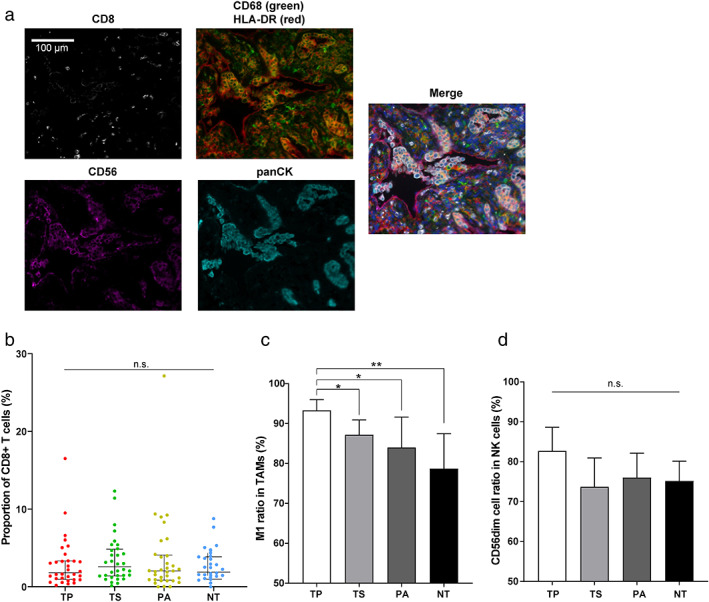
Tissue and plasma samples from 33 resectable stage IA NSCLC patients were collected from the surgery and subject to histological and genomic analyses. The distribution of CD8+ T cells, tumor-associated macrophages (TAMs, M1 polarization and M2 polarization), and natural killer (NK) cells (CD56dim and CD56bright) was analyzed. The impact of clinical characteristics and immunotherapy-related biomarkers on immune cell infiltration were also investigated.
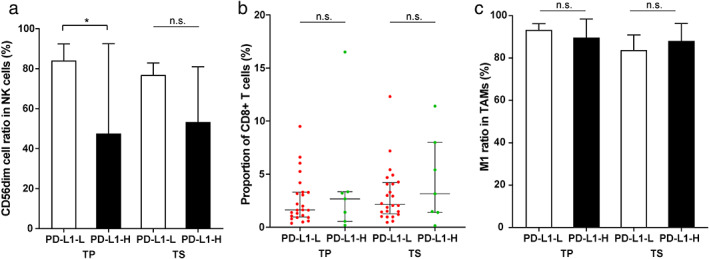
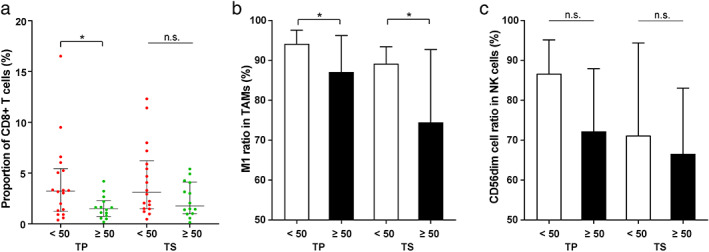
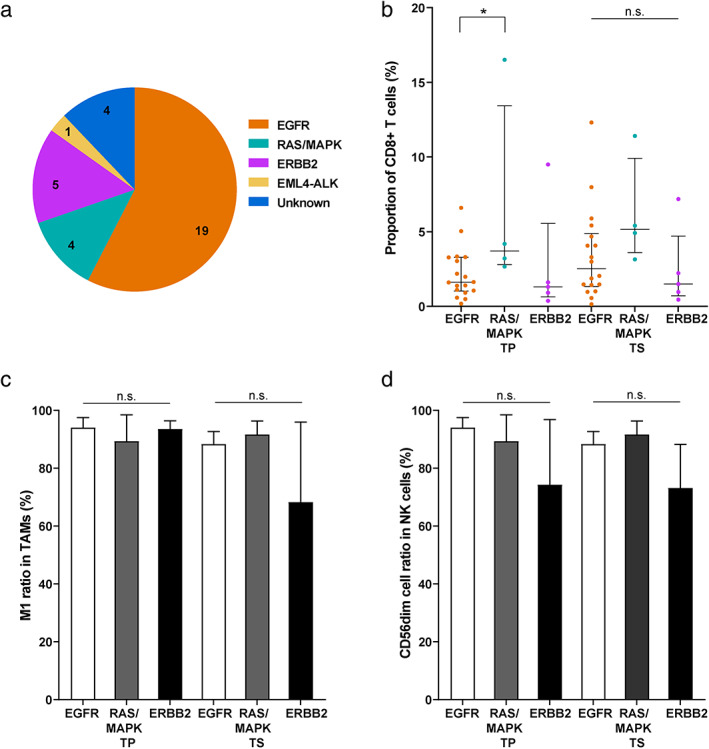
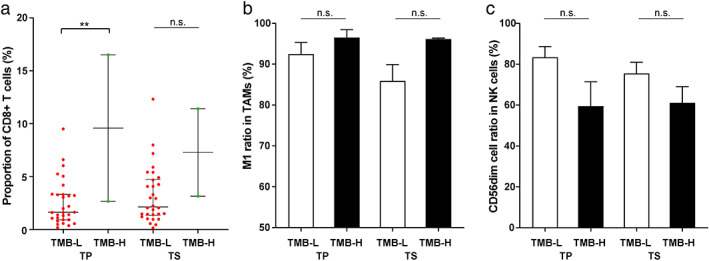
Using multiplex immunohistochemistry (mIHC), we found a significantly higher M1 polarization proportion of total TAMs in tumor parenchyma than in other tissues, while other immune cells remained stable. Patients under 50 showed higher infiltrating CD8+ T cell density and M1 ratio in tumor tissues. Tumors carrying RAS-MAPK mutations were associated with significantly increased infiltration of CD8+ T cells. We also identified significantly higher infiltration of CD8+ T cells and enrichment of CD56bright NK cells in high tumor mutation burden (TMB) and high programmed cell death ligand 1 (PD-L1) samples, respectively.
Our study highlighted the heterogeneity and dynamics of infiltrating immune cells in stage IA NSCLC TME, featured by M1 TAM enrichment in tumor parenchyma. Age, driver mutation type, TMB, and PD-L1 level were found to associate with immune cell infiltration in the TME, shedding light on immunotherapy development.
越来越多的证据强调了非小细胞肺癌(NSCLC)肿瘤微环境(TME)中浸润的免疫细胞。由于筛查计划,早期 NSCLC 的患病率正在增加,但它的高复发风险和较差的生存率对进一步了解 TME 提出了越来越高的要求。
从 33 例可切除的 IA 期 NSCLC 患者的手术中收集组织和血浆样本,并进行组织学和基因组分析。分析 CD8+T 细胞、肿瘤相关巨噬细胞(TAMs,M1 极化和 M2 极化)和自然杀伤(NK)细胞(CD56dim 和 CD56bright)的分布。还研究了临床特征和免疫治疗相关生物标志物对免疫细胞浸润的影响。
使用多重免疫组化(mIHC),我们发现肿瘤实质中总 TAMs 的 M1 极化比例明显高于其他组织,而其他免疫细胞保持稳定。50 岁以下的患者在肿瘤组织中显示出更高的浸润性 CD8+T 细胞密度和 M1 比值。携带 RAS-MAPK 突变的肿瘤与 CD8+T 细胞的浸润显著增加相关。我们还发现,在高肿瘤突变负担(TMB)和高程序性细胞死亡配体 1(PD-L1)样本中,CD8+T 细胞和 CD56bright NK 细胞的浸润明显增加。
我们的研究强调了 IA 期 NSCLC TME 中浸润免疫细胞的异质性和动态性,其特征是肿瘤实质中 M1 TAM 富集。年龄、驱动突变类型、TMB 和 PD-L1 水平与 TME 中的免疫细胞浸润有关,为免疫治疗的发展提供了线索。