Diagnostics and Public Health Department, Infectious Diseases Division, University of Verona, P.le L.A. Scuro 10, Verona 37134, Italy.
Diagnostics and Public Health Department, Infectious Diseases Division, University of Verona, P.le L.A. Scuro 10, Verona 37134, Italy.
J Infect. 2022 Apr;84(4):566-572. doi: 10.1016/j.jinf.2022.02.003. Epub 2022 Feb 10.
Residual symptoms can be detected for several months after COVID-19. To better understand the predictors and impact of symptom persistence we analyzed a prospective cohort of COVID-19 patients.
Patients were followed for 9 months after COVID-19 onset. Duration and predictors of persistence of symptoms, physical health and psychological distress were assessed.
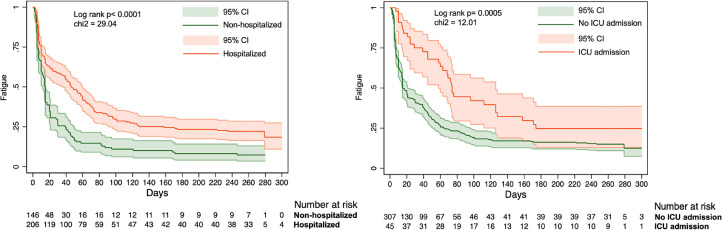
465 patients (54% males, 51% hospitalized) were included; 37% presented with at least 4 symptoms and 42% complained of symptom lasting more than 28 days. At month 9, 20% of patients were still symptomatic, showing mainly fatigue (11%) and breathlessness (8%). Hospitalization and ICU stay vs. non-hospitalized status increased the median duration of fatigue of 8 weeks. Age > 50 years (OR 2.50), ICU stay (OR 2.35), and presentation with 4 or more symptoms (OR 2.04) were independent predictors of persistence of symptoms at month 9. A total of 18% of patients did not return to optimal pre-COVID physical health, while 19% showed psychological distress at month 9. Hospital admission (OR 2.28) and persistence of symptoms at day 28 (OR 2.21) and month 9 (OR 5.16) were independent predictors of suboptimal physical health, while female gender (OR 5.27) and persistence of symptoms at day 28 (OR 2.42) and month 9 (OR 2.48) were risk factors for psychological distress.
Patients with advanced age, ICU stay and multiple symptoms at onset were more likely to suffer from long-term symptoms, which had a negative impact on both physical and mental wellbeing. This study contributes to identify the target populations and Long COVID consequences for planning long-term recovery interventions.
新冠病毒感染后,患者可能会在数月内残留症状。为了更好地了解症状持续存在的预测因素和影响,我们对一组新冠病毒感染患者进行了前瞻性队列研究。
对新冠病毒感染发病后 9 个月的患者进行随访。评估症状持续时间和预测因素、身体健康和心理困扰。
共纳入 465 例患者(54%为男性,51%住院);37%至少存在 4 种症状,42%抱怨症状持续超过 28 天。9 个月时,20%的患者仍有症状,主要表现为疲劳(11%)和呼吸困难(8%)。住院和 ICU 治疗与非住院患者相比,疲劳的中位持续时间增加了 8 周。年龄 > 50 岁(OR 2.50)、入住 ICU(OR 2.35)和出现 4 种及以上症状(OR 2.04)是 9 个月时症状持续存在的独立预测因素。共有 18%的患者未恢复到新冠病毒感染前的最佳身体状况,而 19%的患者在 9 个月时出现心理困扰。住院(OR 2.28)和 28 天(OR 2.21)、9 个月时症状持续存在(OR 5.16)是身体状况欠佳的独立预测因素,而女性(OR 5.27)和 28 天(OR 2.42)、9 个月时症状持续存在(OR 2.48)是心理困扰的危险因素。
年龄较大、入住 ICU 和发病时出现多种症状的患者更有可能长期出现症状,这对身心健康都有负面影响。本研究有助于确定目标人群和新冠病毒感染后长期症状的后果,为规划长期康复干预措施提供依据。