
婴儿补充维生素 B 对神经发育的影响:尼泊尔一项随机安慰剂对照试验的随访。
The effect of infant vitamin B supplementation on neurodevelopment: a follow-up of a randomised placebo-controlled trial in Nepal.
机构信息
Centre for Intervention Science in Maternal and Child Health, Centre for International Health, Department of Global Public Health and Primary Care, University of Bergen, Bergen, Norway.
Department of Child Health, Institute of Medicine, Tribhuvan University, Kathmandu, Nepal.
出版信息
Br J Nutr. 2023 Jan 14;129(1):41-48. doi: 10.1017/S0007114522000071. Epub 2022 Feb 14.
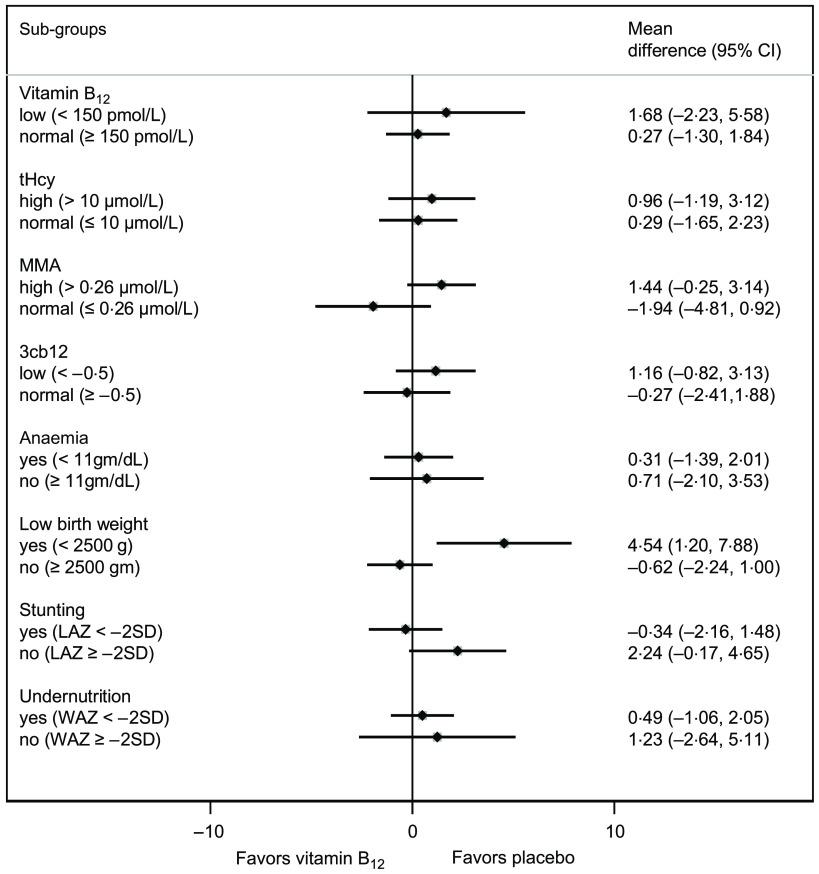
The most critical period for brain development is before a child's second birthday. Standardised tests measuring neurodevelopment are more reliable when administered after this period. Severe vitamin B deficiency affects brain development and function. In a randomised, double-blind, placebo-controlled trial in 600 Nepalese infants (6-11 months at enrolment), we found no effect of 2 µg vitamin B daily for a year on neurodevelopment. The primary objective of the current study was to measure the effect of the intervention on the Wechsler Preschool and Primary Scale of Intelligence (WPPSI-IV) full scale intelligence quotient (FSIQ). We measured the effect on the Bayley Scales of Infant and Toddler Development 3rd edition at age 30-35 months ( 555). At age 42-47 months ( 533), we used the WPPSI-IV and subtests from the Neuropsychological Assessment, 2nd edition (NEPSY-II). We also used the FSIQ to estimate subgroup specific effects. The mean (sd) WPPSI-IV FSIQ in the vitamin B group was 84·4 (8·4) and 85·0 (8·6) in the placebo group (mean difference -0·5 (95 % CI -1·97, 0·94), = 0·48). There were no effect of the vitamin B on any of the other neurodevelopmental outcomes and no beneficial effect in any of the subgroups. In conclusion, providing 2 µg of vitamin B for a year in infants at risk of vitamin B deficiency does not improve preschool cognitive function.
大脑发育的最关键时期是在儿童两岁生日之前。在这个时期之后进行的测量神经发育的标准化测试更可靠。严重的维生素 B 缺乏会影响大脑发育和功能。在一项针对 600 名尼泊尔婴儿(入组时 6-11 个月)的随机、双盲、安慰剂对照试验中,我们发现,每天补充 2 微克维生素 B 持续一年对神经发育没有影响。本研究的主要目的是测量干预对韦氏学前和小学智力量表第四版(WPPSI-IV)全量表智商(FSIQ)的影响。我们在 30-35 个月时(555 名婴儿)测量了贝利婴幼儿发育量表第三版的影响,在 42-47 个月时(533 名婴儿)使用了 WPPSI-IV 和神经心理评估第二版(NEPSY-II)的测试。我们还使用了 FSIQ 来估计亚组特定的影响。维生素 B 组的 WPPSI-IV FSIQ 平均值(标准差)为 84.4(8.4),安慰剂组为 85.0(8.6)(平均差值 -0.5(95%CI-1.97,0.94), = 0.48)。维生素 B 对任何其他神经发育结果均无影响,在任何亚组中均无有益作用。总之,在有维生素 B 缺乏风险的婴儿中提供 2 微克的维生素 B 持续一年并不会改善学龄前认知功能。

 Zotero 插件