Innlandet Hospital Trust, Lillehammer, Norway; Centre for International Health, University of Bergen, Norway.
Innlandet Hospital Trust, Lillehammer, Norway; Department of Psychology, Inland Norway University of Applied Sciences, Lillehammer, Norway.
J Nutr. 2023 Dec;153(12):3543-3554. doi: 10.1016/j.tjnut.2023.10.013. Epub 2023 Oct 18.
Vitamin B12 and folate are essential micronutrients important for normal infant growth and development.
The aims were to describe vitamin B12 and folate status in pregnant females and their infants according to commonly used status cutoffs and examine the associations between maternal status, maternal supplement use, and breastfeeding and infant status.
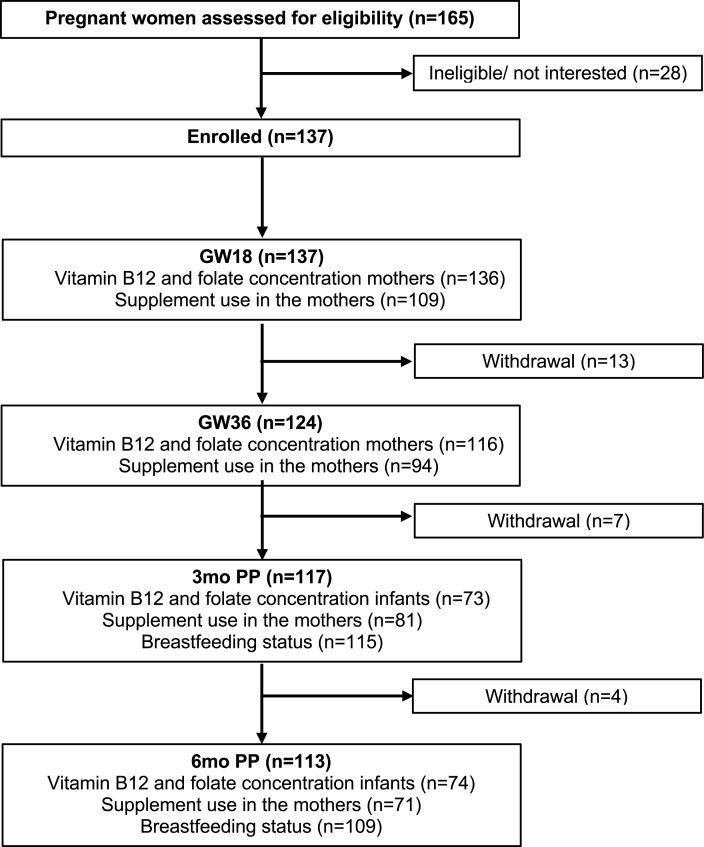
Pregnant females were recruited at 18 wk gestation in Bergen, Norway. Maternal vitamin B12 and folate status were measured at gestational weeks 18 (n = 136) and 36 (n = 116), and infant status was measured at ages 3 (n = 73) and 6 (n = 74) mo.
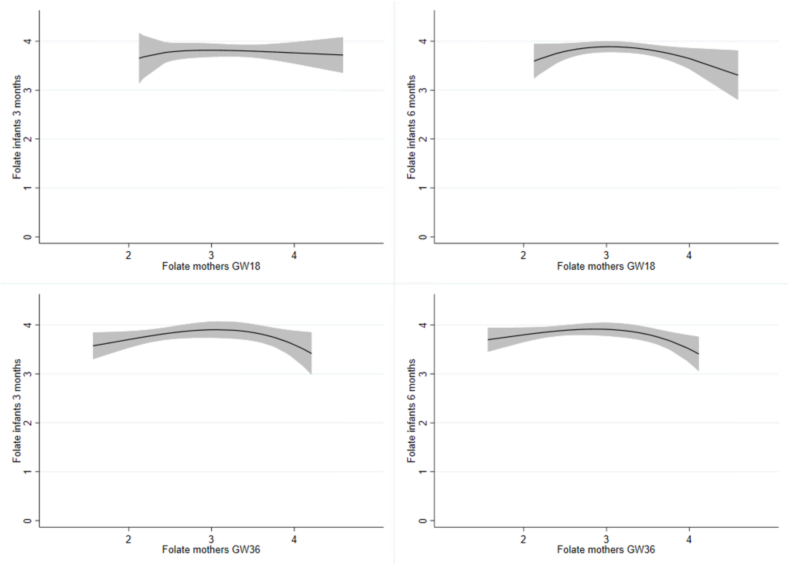
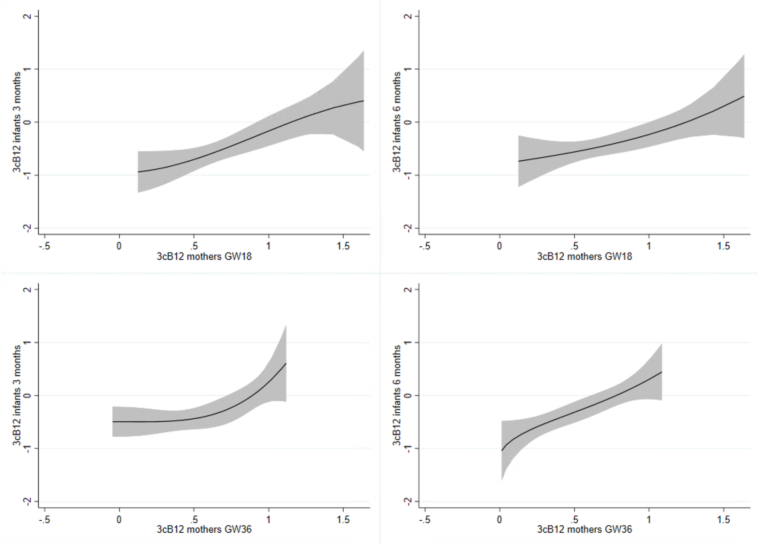
At gestational weeks 18 and 36, respectively, 4.4% and 2.6% of the mothers had plasma cobalamin concentrations <148 pmol/L, 0.7% and 6.9% had methylmalonic acid (MMA) concentrations >0.26 μmol/L, and 3.7% and 30% had folate concentrations <10 nmol/L. None of the females had total homocysteine (t-Hcy) concentrations >13 μmol/L or 3 combined indicator of vitamin B12 (cB12) < -0.5. At 3 and 6 mo, respectively, 4.1% and 5.4% of the infants had cobalamin concentrations <148 pmol/L, 63% and 74% had t-Hcy concentrations >6.5 μmol/L, 59% and 66% had MMA concentrations >0.26 μmol/L, and 47% and 60% had cB12 > -0.5. None of the infants had folate concentrations <10 nmol/L. Several of the vitamin B12 biomarkers in infants were associated with maternal vitamin B12 status during pregnancy. Breastfed infants had lower vitamin B12 status (as indicated by plasma cobalamin, t-Hcy, and cB12) than nonbreastfed infants at both 3 and 6 mo. Use of supplements during pregnancy was associated with better vitamin B12 status among infants at 3 and 6 mo, as indicated by infants' cobalamin and t-Hcy concentrations.
Subclinical vitamin B12 deficiency among infants was common and associated with maternal vitamin B12 status during pregnancy and breastfeeding. Among the mothers, an increase in biochemical folate deficiency was discovered toward the end of gestation. Further studies are needed to investigate clinical consequences. This trial was registered at clinicaltrials.gov as NCT02610959.
维生素 B12 和叶酸是婴儿正常生长发育所必需的微量营养素。
根据常用的状态临界值,描述孕妇及其婴儿的维生素 B12 和叶酸状况,并研究母体状况、母体补充剂使用情况和母乳喂养与婴儿状况之间的关系。
在挪威卑尔根,于妊娠 18 周时招募孕妇。分别在妊娠 18 周(n=136)和 36 周(n=116)时测量母体维生素 B12 和叶酸状况,在婴儿 3 个月(n=73)和 6 个月(n=74)时测量婴儿状况。
分别在妊娠 18 周和 36 周时,有 4.4%和 2.6%的母亲血浆钴胺素浓度<148 pmol/L,有 0.7%和 6.9%的母亲甲基丙二酸(MMA)浓度>0.26 μmol/L,有 3.7%和 30%的母亲叶酸浓度<10 nmol/L。没有女性的总同型半胱氨酸(t-Hcy)浓度>13 μmol/L 或 3 种维生素 B12 综合指标(cB12)< -0.5。分别在婴儿 3 个月和 6 个月时,有 4.1%和 5.4%的婴儿钴胺素浓度<148 pmol/L,有 63%和 74%的婴儿 t-Hcy 浓度>6.5 μmol/L,有 59%和 66%的婴儿 MMA 浓度>0.26 μmol/L,有 47%和 60%的婴儿 cB12> -0.5。没有婴儿的叶酸浓度<10 nmol/L。婴儿的几种维生素 B12 生物标志物与母体在妊娠期间的维生素 B12 状况有关。与非母乳喂养的婴儿相比,母乳喂养的婴儿在 3 个月和 6 个月时的维生素 B12 状况(表现为血浆钴胺素、t-Hcy 和 cB12)更低。妊娠期间使用补充剂与婴儿在 3 个月和 6 个月时的维生素 B12 状况(表现为婴儿的钴胺素和 t-Hcy 浓度)较好有关。
婴儿亚临床维生素 B12 缺乏很常见,与母体在妊娠期间和母乳喂养期间的维生素 B12 状况有关。在母亲中,发现妊娠末期生物化学叶酸缺乏有所增加。需要进一步的研究来调查临床后果。本试验在 clinicaltrials.gov 注册,编号为 NCT02610959。