Martin Anne, Partika Anne, Castle Sherri, Horm Diane, Johnson Anna D
Independent Consultant, 237 West 11th St., 4A, New York, NY 10014.
Department of Psychology, Georgetown University, 303 White-Gravenor Hall, Washington, DC 20057.
Early Child Res Q. 2022;60:237-249. doi: 10.1016/j.ecresq.2022.02.001. Epub 2022 Feb 9.
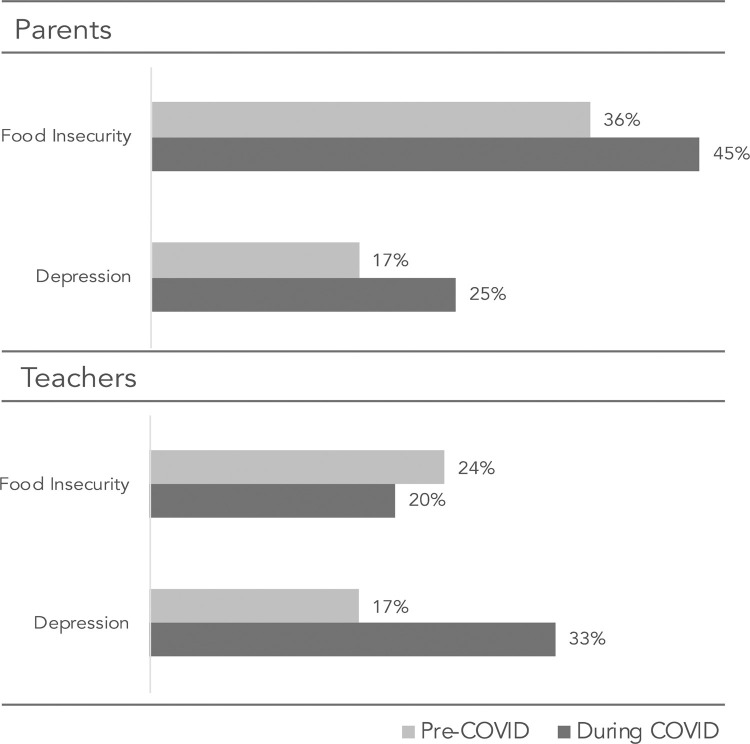
The COVID-19 pandemic has placed unprecedented strains on both parents and teachers, both of whose mental and financial hardships have serious implications for young children's wellbeing. We drew on an existing cohort study of families with low incomes in Tulsa, OK when children were in their Spring of first grade in 2020. We surveyed parents and teachers - children's caregivers on both sides of the screen during distance learning - before and after the COVID-19 pandemic hit and schools were closed. We first compared the proportion of parents and teachers who were depressed and food-insecure before and after the pandemic struck. We then used pre-pandemic characteristics of parents and teachers in separate models to predict their depression and food insecurity during the pandemic. Results showed that rates of depression among both parents and teachers spiked after COVID-19, and food insecurity rates also increased among parents. For both parents and teachers, the strongest predictor of depression during COVID-19 was having experienced depression before the pandemic. Similarly, the strongest predictor of food insecurity during COVID-19 was having experienced food insecurity beforehand. These results point intervention efforts towards identifying the caregivers of children in low-income contexts whose mental and financial wellbeing are likely to be most compromised during this and perhaps future disasters.
新冠疫情给家长和教师都带来了前所未有的压力,他们在精神和经济上的困境都对幼儿的幸福有着严重影响。我们利用了俄克拉荷马州塔尔萨市一项针对低收入家庭的现有队列研究,该研究始于2020年孩子们一年级春季学期。在新冠疫情爆发且学校关闭前后,我们对家长和教师——远程学习期间屏幕两端孩子的照料者——进行了调查。我们首先比较了疫情爆发前后抑郁和粮食不安全的家长及教师的比例。然后,我们在不同模型中使用家长和教师疫情前的特征来预测他们在疫情期间的抑郁和粮食不安全状况。结果显示,新冠疫情后家长和教师的抑郁率均大幅上升,家长中的粮食不安全率也有所增加。对于家长和教师而言,新冠疫情期间抑郁的最强预测因素是在疫情前曾经历过抑郁。同样,新冠疫情期间粮食不安全的最强预测因素是此前曾经历过粮食不安全。这些结果表明,干预措施应致力于识别低收入家庭中孩子的照料者,他们在此次以及未来可能发生的灾难中,其精神和经济状况可能受到最大程度的影响。