Carpenter Lucy J, Chance Rosie J, Sherwen Tomás, Adams Thomas J, Ball Stephen M, Evans Mat J, Hepach Helmke, Hollis Lloyd D J, Hughes Claire, Jickells Timothy D, Mahajan Anoop, Stevens David P, Tinel Liselotte, Wadley Martin R
Wolfson Atmospheric Chemistry Laboratories, Department of Chemistry, University of York, York, UK.
National Centre for Atmospheric Science (NCAS), University of York, York YO10 5DD, UK.
Proc Math Phys Eng Sci. 2021 Mar;477(2247):20200824. doi: 10.1098/rspa.2020.0824. Epub 2021 Mar 3.
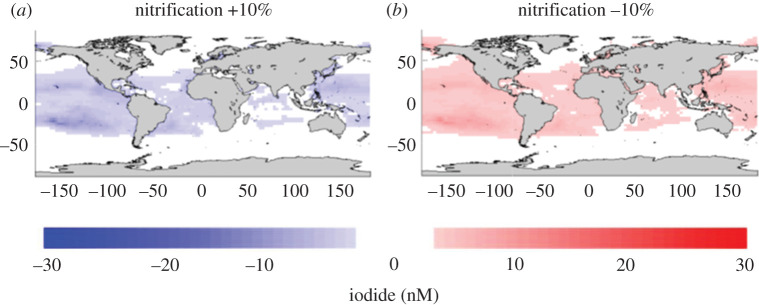
Iodine is a critical trace element involved in many diverse and important processes in the Earth system. The importance of iodine for human health has been known for over a century, with low iodine in the diet being linked to goitre, cretinism and neonatal death. Research over the last few decades has shown that iodine has significant impacts on tropospheric photochemistry, ultimately impacting climate by reducing the radiative forcing of ozone (O) and air quality by reducing extreme O concentrations in polluted regions. Iodine is naturally present in the ocean, predominantly as aqueous iodide and iodate. The rapid reaction of sea-surface iodide with O is believed to be the largest single source of gaseous iodine to the atmosphere. Due to increased anthropogenic O, this release of iodine is believed to have increased dramatically over the twentieth century, by as much as a factor of 3. Uncertainties in the marine iodine distribution and global cycle are, however, major constraints in the effective prediction of how the emissions of iodine and its biogeochemical cycle may change in the future or have changed in the past. Here, we present a synthesis of recent results by our team and others which bring a fresh perspective to understanding the global iodine biogeochemical cycle. In particular, we suggest that future climate-induced oceanographic changes could result in a significant change in aqueous iodide concentrations in the surface ocean, with implications for atmospheric air quality and climate.
碘是一种关键的微量元素,参与地球系统中许多不同且重要的过程。碘对人类健康的重要性在一个多世纪前就已为人所知,饮食中碘含量低与甲状腺肿、克汀病和新生儿死亡有关。过去几十年的研究表明,碘对对流层光化学有重大影响,最终通过降低臭氧(O₃)的辐射强迫影响气候,并通过降低污染地区的极端臭氧浓度影响空气质量。碘天然存在于海洋中,主要以碘化物和碘酸盐的形式存在。海表面碘化物与臭氧的快速反应被认为是大气中气态碘的最大单一来源。由于人为产生的臭氧增加,据信这种碘的释放量在20世纪大幅增加,多达三倍。然而,海洋碘分布和全球循环的不确定性是有效预测碘排放及其生物地球化学循环在未来可能如何变化或过去如何变化的主要制约因素。在此,我们综合了我们团队和其他团队的最新研究成果,为理解全球碘生物地球化学循环带来了新的视角。特别是,我们认为未来由气候引起的海洋学变化可能导致表层海洋中碘化物浓度发生显著变化,从而影响大气空气质量和气候。