van Duuren Luuk A, Ozik Jonathan, Spliet Remy, Collier Nicholson T, Lansdorp-Vogelaar Iris, Meester Reinier G S
Department of Public Health, Erasmus University Medical Center, Rotterdam, Netherlands.
Decision and Infrastructure Sciences, Argonne National Laboratory, Lemont, IL, United States.
Front Physiol. 2022 Jan 26;12:718276. doi: 10.3389/fphys.2021.718276. eCollection 2021.
Fecal immunochemical testing (FIT) is an established method for colorectal cancer (CRC) screening. Measured FIT-concentrations are associated with both present and future risk of CRC, and may be used for personalized screening. However, evaluation of personalized screening is computationally challenging. In this study, a broadly applicable algorithm is presented to efficiently optimize personalized screening policies that prescribe screening intervals and FIT-cutoffs, based on age and FIT-history.
We present a mathematical framework for personalized screening policies and a bi-objective evolutionary algorithm that identifies policies with minimal costs and maximal health benefits. The algorithm is combined with an established microsimulation model (MISCAN-Colon), to accurately estimate the costs and benefits of generated policies, without restrictive Markov assumptions. The performance of the algorithm is demonstrated in three experiments.
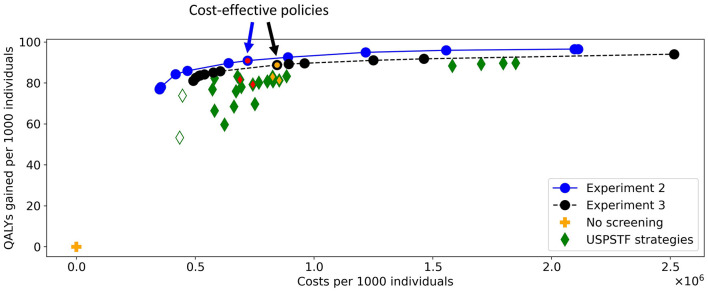
In Experiment 1, a relatively small benchmark problem, the optimal policies were known. The algorithm approached the maximum feasible benefits with a relative difference of 0.007%. Experiment 2 optimized both intervals and cutoffs, Experiment 3 optimized cutoffs only. Optimal policies in both experiments are unknown. Compared to policies recently evaluated for the USPSTF, personalized screening increased health benefits up to 14 and 4.3%, for Experiments 2 and 3, respectively, without adding costs. Generated policies have several features concordant with current screening recommendations.
The method presented in this paper is flexible and capable of optimizing personalized screening policies evaluated with computationally-intensive but established simulation models. It can be used to inform screening policies for CRC or other diseases. For CRC, more debate is needed on what features a policy needs to exhibit to make it suitable for implementation in practice.
粪便免疫化学检测(FIT)是一种既定的结直肠癌(CRC)筛查方法。所测得的FIT浓度与CRC的当前和未来风险均相关,可用于个性化筛查。然而,对个性化筛查进行评估在计算上具有挑战性。在本研究中,我们提出了一种广泛适用的算法,以基于年龄和FIT检测史有效地优化规定筛查间隔和FIT临界值的个性化筛查策略。
我们提出了一个用于个性化筛查策略的数学框架以及一种双目标进化算法,该算法可识别成本最小且健康效益最大的策略。该算法与一个既定的微观模拟模型(MISCAN - 结肠模型)相结合,以在无需严格马尔可夫假设的情况下准确估计所生成策略的成本和效益。该算法的性能在三个实验中得到了验证。
在实验1中,这是一个相对较小的基准问题,最优策略是已知的。该算法接近了最大可行效益,相对差异为0.007%。实验2同时优化了间隔和临界值,实验3仅优化了临界值。这两个实验中的最优策略均未知。与最近为美国预防服务工作组(USPSTF)评估的策略相比,个性化筛查分别使实验2和实验3的健康效益提高了14%和4.3%,且未增加成本。所生成的策略具有一些与当前筛查建议相符的特征。
本文提出的方法具有灵活性,能够优化通过计算密集型但既定的模拟模型评估的个性化筛查策略。它可用于为CRC或其他疾病的筛查策略提供信息。对于CRC而言,对于一项策略需要具备哪些特征才能使其适合在实际中实施,仍需要更多的讨论。