International Clinical Research Center, St. Anne's University Hospital, Brno, Czechia.
Institute of Hematology and Blood Transfusion, Prague, Czechia.
Front Immunol. 2022 Jan 27;13:827250. doi: 10.3389/fimmu.2022.827250. eCollection 2022.
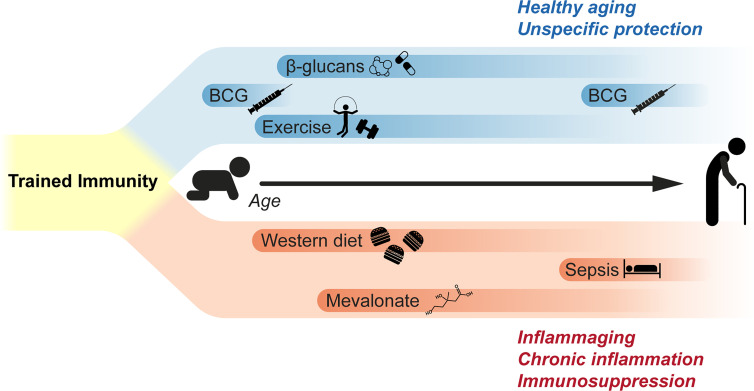
Recent evidence shows that innate immune cells, in addition to B and T cells, can retain immunological memory of their encounters and afford long-term resistance against infections in a process known as 'trained immunity'. However, the duration of the unspecific protection observed is poorly compatible with the average lifespan of innate immune cells, suggesting the involvement of long-lived cells. Accordingly, recent studies demonstrate that hematopoietic stem and progenitor cells (HSPCs) lay at the foundation of trained immunity, retaining immunological memory of infections and giving rise to a "trained" myeloid progeny for a long time. In this review, we discuss the research demonstrating the involvement of HSPCs in the onset of long-lasting trained immunity. We highlight the roles of specific cytokines and Toll-like receptor ligands in influencing HSPC memory phenotypes and the molecular mechanisms underlying trained immunity HSPCs. Finally, we discuss the potential benefits and drawbacks of the long-lasting trained immune responses, and describe the challenges that the field is facing.
最近的证据表明,除了 B 细胞和 T 细胞之外,固有免疫细胞也可以保留其遭遇的免疫记忆,并在一个被称为“训练免疫”的过程中提供对感染的长期抵抗。然而,观察到的非特异性保护的持续时间与固有免疫细胞的平均寿命极不相符,这表明存在长寿细胞的参与。因此,最近的研究表明,造血干细胞和祖细胞(HSPCs)是训练免疫的基础,它们保留了感染的免疫记忆,并在很长一段时间内产生“训练有素”的髓系前体细胞。在这篇综述中,我们讨论了证明 HSPCs 参与长期训练免疫的研究。我们强调了特定细胞因子和 Toll 样受体配体在影响 HSPC 记忆表型以及训练免疫 HSPC 相关的分子机制中的作用。最后,我们讨论了长期训练免疫反应的潜在好处和缺点,并描述了该领域面临的挑战。