Beltrame Anna, Salguero Pedro, Rossi Emanuela, Conesa Ana, Moro Lucia, Bettini Laura Rachele, Rizzi Eleonora, D'Angió Mariella, Deiana Michela, Piubelli Chiara, Rebora Paola, Duranti Silvia, Bonfanti Paolo, Capua Ilaria, Tarazona Sonia, Valsecchi Maria Grazia
Department of Infectious, Tropical Diseases and Microbiology Istituto di Ricovero e Cura a Carattere Scientifico (I.R.C.C.S). Sacro Cuore Don Calabria Hospital, Negrar di Valpolicella, Italy.
Department of Applied Statistics, Operations Research and Quality, Universitat Politècnica de València, Valencia, Spain.
Front Immunol. 2022 Jan 27;13:834851. doi: 10.3389/fimmu.2022.834851. eCollection 2022.
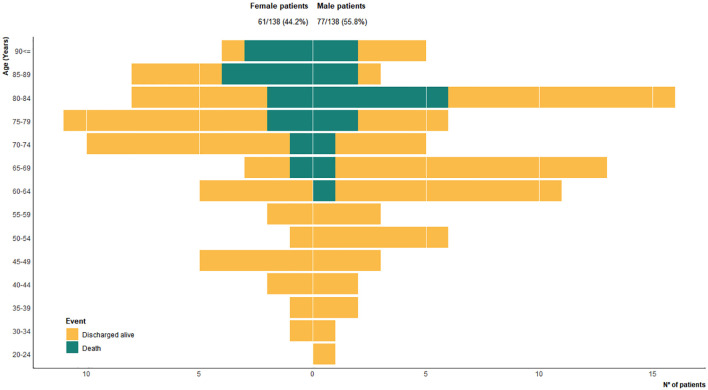
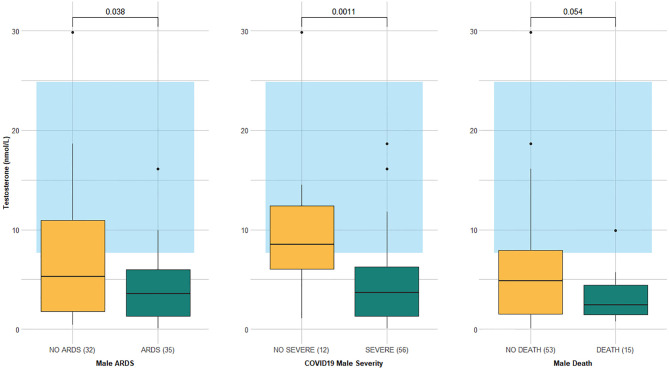
Understanding the cause of sex disparities in COVID-19 outcomes is a major challenge. We investigate sex hormone levels and their association with outcomes in COVID-19 patients, stratified by sex and age. This observational, retrospective, cohort study included 138 patients aged 18 years or older with COVID-19, hospitalized in Italy between February 1 and May 30, 2020. The association between sex hormones (testosterone, estradiol, progesterone, dehydroepiandrosterone) and outcomes (ARDS, severe COVID-19, in-hospital mortality) was explored in 120 patients aged 50 years and over. STROBE checklist was followed. The median age was 73.5 years [IQR 61, 82]; 55.8% were male. In older males, testosterone was lower if ARDS and severe COVID-19 were reported than if not (3.6 5.3 nmol/L, p =0.0378 and 3.7 8.5 nmol/L, p =0.0011, respectively). Deceased males had lower testosterone (2.4 4.8 nmol/L, p =0.0536) and higher estradiol than survivors (40 24 pg/mL, p = 0.0006). Testosterone was negatively associated with ARDS (OR 0.849 [95% CI 0.734, 0.982]), severe COVID-19 (OR 0.691 [95% CI 0.546, 0.874]), and in-hospital mortality (OR 0.742 [95% CI 0.566, 0.972]), regardless of potential confounders, though confirmed only in the regression model on males. Higher estradiol was associated with a higher probability of death (OR 1.051 [95% CI 1.018, 1.084]), confirmed in both sex models. In males, higher testosterone seems to be protective against any considered outcome. Higher estradiol was associated with a higher probability of death in both sexes.
了解新冠疫情结果中性别差异的原因是一项重大挑战。我们对新冠患者的性激素水平及其与结果的关联进行了调查,并按性别和年龄进行了分层。这项观察性、回顾性队列研究纳入了138名18岁及以上的新冠患者,这些患者于2020年2月1日至5月30日期间在意大利住院治疗。我们在120名50岁及以上的患者中探讨了性激素(睾酮、雌二醇、孕酮、脱氢表雄酮)与结果(急性呼吸窘迫综合征、重症新冠、院内死亡)之间的关联。研究遵循了STROBE清单。中位年龄为73.5岁[四分位间距61, 82];55.8%为男性。在老年男性中,报告发生急性呼吸窘迫综合征和重症新冠的患者,其睾酮水平低于未发生者(分别为3.6±5.3nmol/L,p = 0.0378和3.7±8.5nmol/L,p = 0.0011)。死亡男性的睾酮水平较低(2.4±4.8nmol/L,p = 0.0536),雌二醇水平高于幸存者(40±24pg/mL,p = 0.0006)。无论潜在混杂因素如何,睾酮与急性呼吸窘迫综合征(比值比0.849[95%置信区间0.734, 0.982])、重症新冠(比值比0.691[95%置信区间0.546, 0.874])和院内死亡(比值比0.742[95%置信区间0.566, 0.972])呈负相关,不过仅在男性回归模型中得到证实。较高的雌二醇水平与死亡概率较高相关(比值比1.051[95%置信区间1.018, 1.084]),在两个性别模型中均得到证实。在男性中,较高的睾酮似乎对任何所考虑的结果都有保护作用。较高的雌二醇水平与两性的死亡概率较高相关。