Division of Endocrinology, Diabetes and Metabolism, St Louis University School of Medicine, St Louis, Missouri.
Department of Pathology and Immunology, Washington University School of Medicine in St Louis, Missouri.
JAMA Netw Open. 2021 May 3;4(5):e2111398. doi: 10.1001/jamanetworkopen.2021.11398.
Male sex is a risk factor for developing severe COVID-19 illness. It is not known whether sex hormones contribute to this predisposition.
To investigate the association of concentrations of serum testosterone, estradiol, and insulinlike growth factor 1 (IGF-1, concentrations of which are regulated by sex hormone signaling) with COVID-19 severity.
DESIGN, SETTING, AND PARTICIPANTS: This prospective cohort study was conducted using serum samples collected from consecutive patients who presented from March through May 2020 to the Barnes Jewish Hospital in St Louis, Missouri, with COVID-19 (diagnosed using nasopharyngeal swabs).
Testosterone, estradiol, and IGF-1 concentrations were measured at the time of presentation (ie, day 0) and at days 3, 7, 14, and 28 after admission (if the patient remained hospitalized).
Baseline hormone concentrations were compared among patients who had severe COVID-19 vs those with milder COVID-19 illness. RNA sequencing was performed on circulating mononuclear cells to understand the mechanistic association of altered circulating hormone concentrations with cellular signaling pathways.
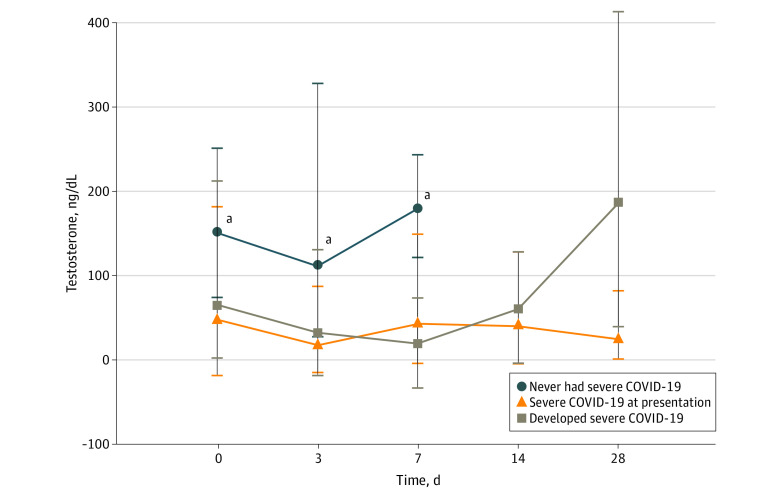
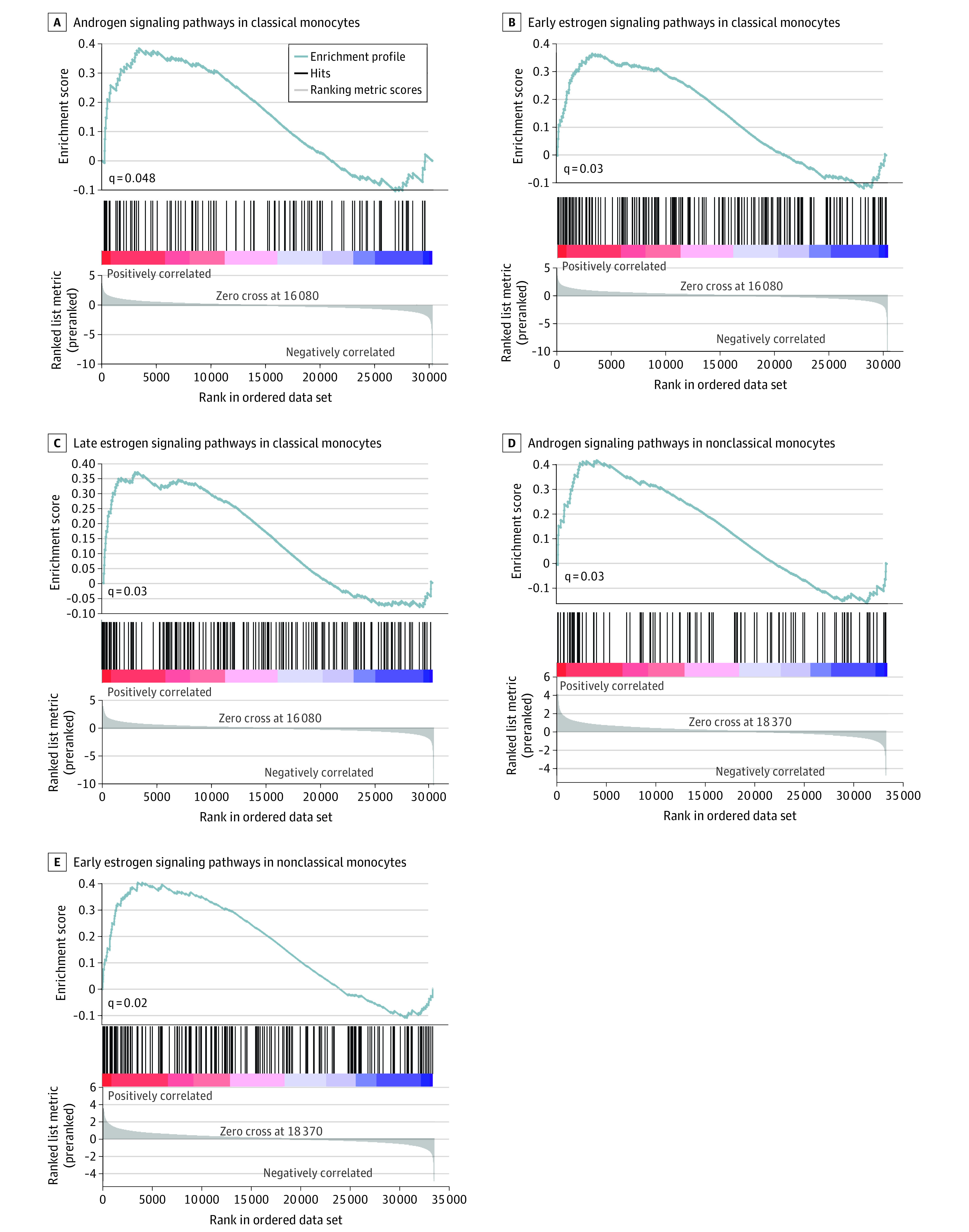
Among 152 patients (90 [59.2%] men; 62 [40.8%] women; mean [SD] age, 63 [16] years), 143 patients (94.1%) were hospitalized. Among 66 men with severe COVID-19, median [interquartile range] testosterone concentrations were lower at day 0 (53 [18 to 114] ng/dL vs 151 [95 to 217] ng/dL; P = .01) and day 3 (19 [6 to 68] ng/dL vs 111 [49 to 274] ng/dL; P = .006) compared with 24 men with milder disease. Testosterone concentrations were inversely associated with concentrations of interleukin 6 (β = -0.43; 95% CI, -0.52 to -0.17; P < .001), C-reactive protein (β = -0.38; 95% CI, -0.78 to -0.16; P = .004), interleukin 1 receptor antagonist (β = -0.29; 95% CI, -0.64 to -0.06; P = .02), hepatocyte growth factor (β = -0.46; 95% CI, -0.69 to -0.25; P < .001), and interferon γ-inducible protein 10 (β = -0.32; 95% CI, -0.62 to -0.10; P = .007). Estradiol and IGF-1 concentrations were not associated with COVID-19 severity in men. Testosterone, estradiol, and IGF-1 concentrations were similar in women with and without severe COVID-19. Gene set enrichment analysis revealed upregulated hormone signaling pathways in CD14+CD16- (ie, classical) monocytes and CD14-CD16+ (ie, nonclassical) monocytes in male patients with COVID-19 who needed intensive care unit treatment vs those who did not.
In this single-center cohort study of patients with COVID-19, lower testosterone concentrations during hospitalization were associated with increased disease severity and inflammation in men. Hormone signaling pathways in monocytes did not parallel serum hormone concentrations, and further investigation is required to understand their pathophysiologic association with COVID-19.
重要提示:男性是患严重 COVID-19 疾病的风险因素。目前尚不清楚性激素是否会导致这种倾向。
目的:研究血清睾酮、雌二醇和胰岛素样生长因子 1(IGF-1)的浓度与 COVID-19 严重程度的关联,这些浓度受性激素信号的调节。
设计、地点和参与者:本前瞻性队列研究使用连续从密苏里州圣路易斯市巴恩斯犹太医院因 COVID-19 就诊的患者的血清样本进行(通过鼻咽拭子诊断)。
暴露:在入院时(如果患者仍住院)以及入院后第 3、7、14 和 28 天测量睾酮、雌二醇和 IGF-1 浓度。
主要结果和测量:比较了患有严重 COVID-19 与患有轻度 COVID-19 疾病的患者的基线激素浓度。对循环单核细胞进行 RNA 测序,以了解循环激素浓度改变与细胞信号通路的机制关联。
结果:在 152 名患者(90 名[59.2%]男性;62 名[40.8%]女性;平均[标准差]年龄,63[16]岁)中,143 名(94.1%)住院。在 66 名患有严重 COVID-19 的男性中,睾酮浓度中位数[四分位距]在入院第 0 天(53[18 至 114]ng/dL 与 151[95 至 217]ng/dL;P=0.01)和第 3 天(19[6 至 68]ng/dL 与 111[49 至 274]ng/dL;P=0.006)较低,与 24 名病情较轻的男性相比。睾酮浓度与白细胞介素 6(β=-0.43;95%CI,-0.52 至 -0.17;P<0.001)、C 反应蛋白(β=-0.38;95%CI,-0.78 至 -0.16;P=0.004)、白细胞介素 1 受体拮抗剂(β=-0.29;95%CI,-0.64 至 -0.06;P=0.02)、肝细胞生长因子(β=-0.46;95%CI,-0.69 至 -0.25;P<0.001)和干扰素 γ 诱导蛋白 10(β=-0.32;95%CI,-0.62 至 -0.10;P=0.007)呈负相关。在男性中,雌二醇和 IGF-1 浓度与 COVID-19 严重程度无关。患有和不患有严重 COVID-19 的女性的睾酮、雌二醇和 IGF-1 浓度相似。基因集富集分析显示,与未入住重症监护病房的男性 COVID-19 患者相比,需要入住重症监护病房的男性患者中 CD14+CD16-(即经典)单核细胞和 CD14-CD16+(即非经典)单核细胞中激素信号通路上调。
结论和相关性:在这项针对 COVID-19 患者的单中心队列研究中,住院期间睾酮浓度降低与男性疾病严重程度和炎症增加相关。单核细胞中的激素信号通路与血清激素浓度不一致,需要进一步研究以了解其与 COVID-19 的病理生理关联。