Liang Lixin, Liang Yingru, Li Ke, Qin Pengzhe, Lin Guozhen, Li Yan, Xu Huan, Wang Suixiang, Jing Qinlong, Liang Boheng, Xu Lin
Department of Epidemiology, School of Public Health, Sun Yat-sen University, Guangzhou, Guangdong, P. R. China.
Department of Chronic Noncommunicable Disease Prevention and Control, Guangzhou Center for Disease Control and Prevention, Guangzhou, Guangdong, P. R. China.
Gastroenterol Rep (Oxf). 2022 Feb 9;10(1):goac002. doi: 10.1093/gastro/goac002. eCollection 2022 Feb.
The uptake of colonoscopy is low in individuals at risk of colorectal cancer (CRC). We constructed a risk-prediction score (RPS) in a large community-based sample at high risk of CRC to enable more accurate risk stratification and to motivate and increase the uptake rate of colonoscopy.
A total of 12,628 participants classified as high-risk according to positivity of immunochemical fecal occult blood tests or High-Risk Factor Questionnaire underwent colonoscopy. Logistic regression was used to derive a RPS and analysed the associations of the RPS with colorectal lesions, giving odds ratios (ORs) and 95% confidence intervals (CIs).
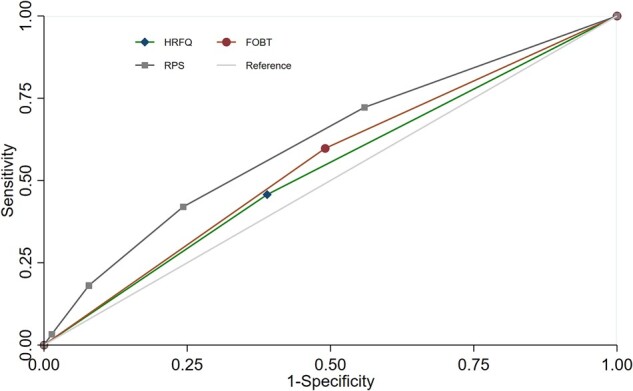
Of the participants, men (OR = 1.73, 95% CI = 1.58-1.90), older age (≥65 years; 1.41, 1.31-1.53), higher body mass index (≥28 kg/m; 1.22, 1.07-1.39), ever smoking (1.47, 1.31-1.65), and weekly alcohol use (1.28, 1.09-1.52) were associated with a higher risk of colorectal lesions. We assigned 1 point to each of the above five risk factors and derived a RPS ranging from 0 to 5, with a higher score indicating a higher risk. Compared with a RPS of 0, a RPS of 1, 2, 3, and 4-5 showed a higher risk of colorectal lesions, with the OR (95% CI) being 1.50 (1.37-1.63), 2.34 (2.12-2.59), 3.58 (3.13-4.10), and 3.91 (3.00-5.10), respectively. The area under the receiver-operating characteristic curve of RPS in predicting colorectal lesions was 0.62.
Participants with an increase in the RPS of ≥1 point had a significantly higher risk of colorectal lesions, suggesting the urgency for measuring colonoscopy in this very high-risk group. High-risk strategies incorporating RPS may be employed to achieve a higher colonoscopy-uptake rate.
在结直肠癌(CRC)风险个体中,结肠镜检查的接受率较低。我们在一个基于社区的、CRC高风险大样本中构建了一个风险预测评分(RPS),以实现更准确的风险分层,并激励和提高结肠镜检查的接受率。
共有12628名根据免疫化学粪便潜血试验阳性或高危因素问卷被分类为高危的参与者接受了结肠镜检查。采用逻辑回归得出RPS,并分析RPS与结直肠病变的关联,给出比值比(OR)和95%置信区间(CI)。
在参与者中,男性(OR = 1.73,95% CI = 1.58 - 1.90)、年龄较大(≥65岁;1.41,1.31 - 1.53)、体重指数较高(≥28 kg/m;1.22,1.07 - 1.39)、曾经吸烟(1.47,1.31 - 1.65)以及每周饮酒(1.28,1.09 - 1.52)与结直肠病变风险较高相关。我们为上述五个风险因素各赋予1分,得出RPS范围为0至5分,分数越高表明风险越高。与RPS为0相比,RPS为1、2、3以及4 - 5分者结直肠病变风险更高,OR(95% CI)分别为1.50(1.37 - 1.63)、2.34(2.12 - 2.59)、3.58(3.13 - 4.10)以及3.91(3.00 - 5.10)。RPS预测结直肠病变的受试者工作特征曲线下面积为0.62。
RPS增加≥1分的参与者结直肠病变风险显著更高,这表明在这个极高风险组中进行结肠镜检查的紧迫性。可采用纳入RPS的高危策略来实现更高的结肠镜检查接受率。