Ardon Orly, Reuter Victor E, Hameed Meera, Corsale Lorraine, Manzo Allyne, Sirintrapun Sahussapont J, Ntiamoah Peter, Stamelos Evangelos, Schueffler Peter J, England Christine, Klimstra David S, Hanna Matthew G
Department of Pathology, Memorial Sloan Kettering Cancer Center, New York, NY, USA.
The Warren Alpert Center for Digital and Computational Pathology, Memorial Sloan Kettering Cancer Center, New York, NY, USA.
Acad Pathol. 2021 Apr 28;8:23742895211010276. doi: 10.1177/23742895211010276. eCollection 2021 Jan-Dec.
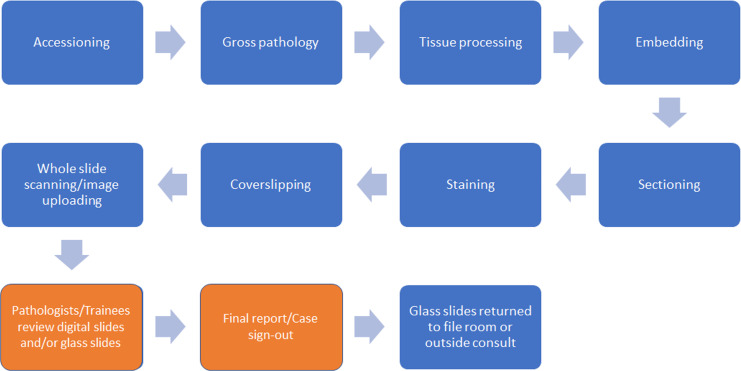
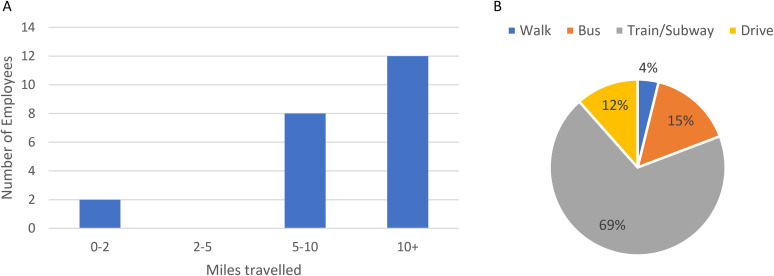
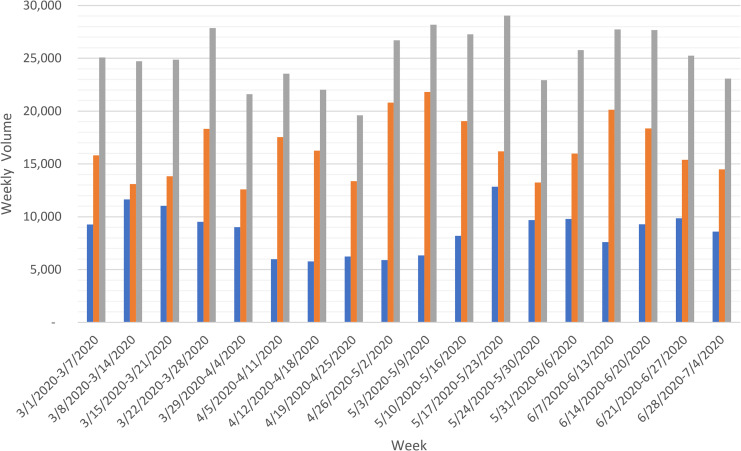
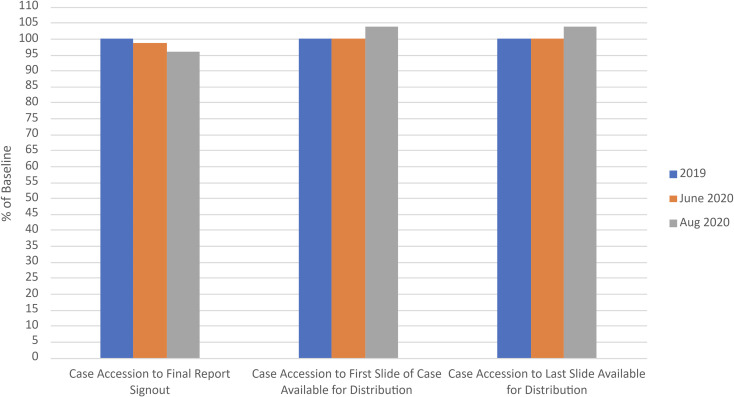
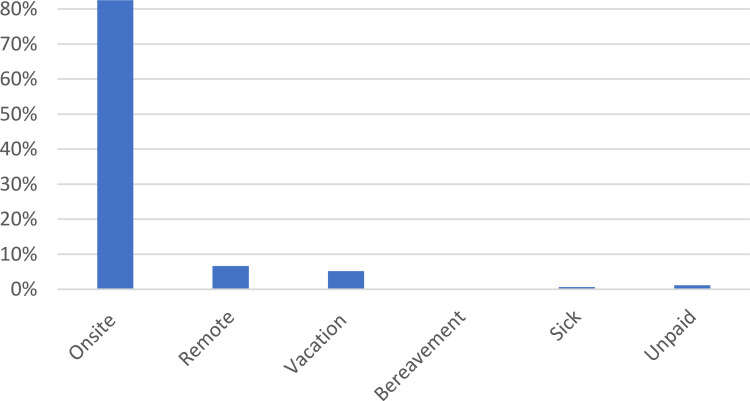
Implementation of an infrastructure to support digital pathology began in 2006 at Memorial Sloan Kettering Cancer Center. The public health emergency and COVID-19 pandemic regulations in New York City required a novel workflow to sustain existing operations. While regulatory enforcement discretions offered faculty workspace flexibility, a substantial portion of laboratory and digital pathology workflows require on-site presence of staff. Maintaining social distancing and offering staggered work schedules. Due to a decrease in patients seeking health care at the onset of the pandemic, a temporary decrease in patient specimens was observed. Hospital and travel regulations impacted onsite vendor technical support. Digital glass slide scanning activities onsite proceeded without interruption throughout the pandemic, with challenges including staff who required quarantine due to virus exposure, unrelated illness, family support, or lack of public transportation. During the public health emergency, we validated digital pathology systems for a remote pathology operation. Since March 2020, the departmental digital pathology staff were able to maintain scanning volumes of over 100 000 slides per month. The digital scanning team reprioritized archival slide scanning and participated in a remote sign-out validation and successful submission of New York State approval for a laboratory developed test. Digital pathology offers a health care delivery model where pathologists can perform their sign out duties at remote location and prevent disruptions to critical pathology services for patients seeking care at our institution during emergencies. Development of standard operating procedures to support digital workflows will maintain turnaround times and enable clinical operations during emergency or otherwise unanticipated events.
2006年,纪念斯隆凯特琳癌症中心开始实施支持数字病理学的基础设施建设。纽约市的公共卫生紧急情况和新冠疫情相关规定要求采用全新的工作流程来维持现有业务。虽然监管执法的自由裁量权为教职员工提供了工作空间的灵活性,但实验室和数字病理学工作流程的很大一部分需要工作人员现场办公。要保持社交距离并提供错开的工作时间表。由于疫情初期寻求医疗保健的患者减少,观察到患者标本暂时减少。医院和旅行规定影响了现场供应商的技术支持。在整个疫情期间,现场的数字玻片扫描活动持续进行,面临的挑战包括因接触病毒、患无关疾病、家庭支持需求或缺乏公共交通而需要隔离的工作人员。在公共卫生紧急情况期间,我们验证了用于远程病理学操作的数字病理学系统。自2020年3月以来,部门数字病理学工作人员每月能够保持超过10万张玻片的扫描量。数字扫描团队重新调整了存档玻片扫描的优先级,并参与了远程签出验证以及成功提交纽约州对一项实验室自建检测的批准。数字病理学提供了一种医疗服务模式,病理学家可以在远程履行签出职责,并在紧急情况下防止对在我们机构寻求治疗的患者的关键病理学服务造成中断。制定支持数字工作流程的标准操作程序将维持周转时间,并在紧急情况或其他意外事件期间确保临床业务的开展。