Huang Chien-Chia, Wu Pei-Wen, Lee Cheng-Chi, Chang Po-Hung, Huang Chi-Che, Lee Ta-Jen
Division of Rhinology, Department of Otolaryngology Chang Gung Memorial Hospital and Chang Gung University Taoyuan Taiwan.
Graduate Institute of Clinical Medical Sciences, College of Medicine, Chang Gung University Taoyuan Taiwan.
Laryngoscope Investig Otolaryngol. 2022 Jan 19;7(1):22-28. doi: 10.1002/lio2.730. eCollection 2022 Feb.
Patients with empty nose syndrome (ENS) suffer from paradoxical nasal obstruction with a patent objective nasal airway. ENS may result from the excessive surgical reduction of the turbinate tissue. ENS patients also experience significant psychological symptoms such as anxiety and depression. In this study, we aimed to evaluate the prevalence of suicidal thoughts in ENS patients and to characterize these patients for early identification.
Prospective case series.
Patients with ENS were prospectively recruited for this study. The Sino-Nasal Outcome Test-25 (SNOT-25), Empty Nose Syndrome 6-item Questionnaire (ENS6Q), Beck Anxiety Inventory (BAI), and Beck Depression Inventory-II (BDI-II) were used to assess ENS patients before and 6 months after nasal reconstruction surgery.
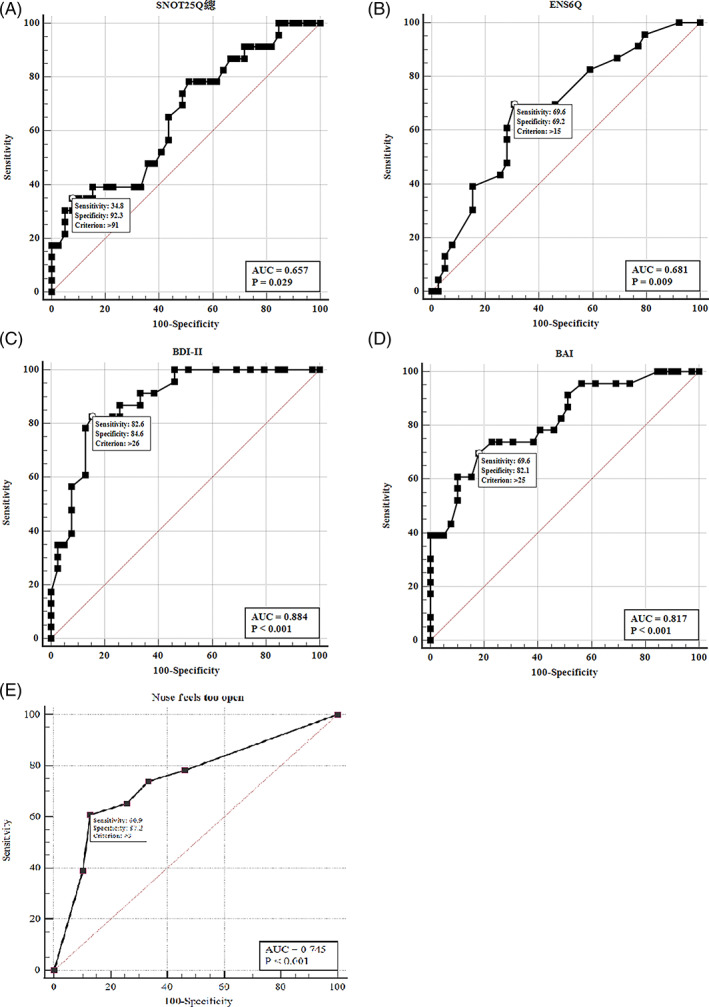
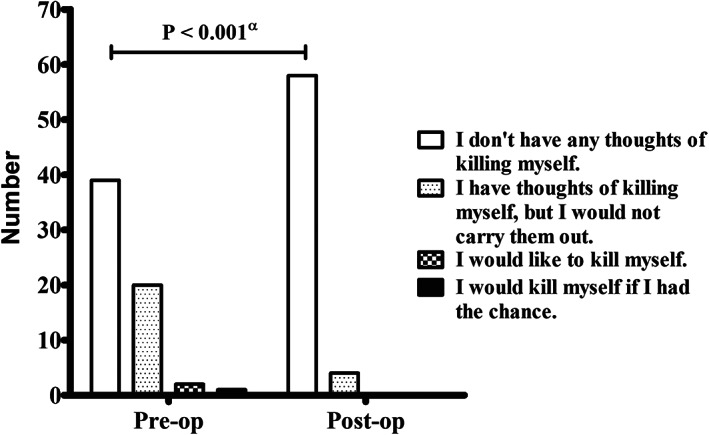
Sixty-two patients with ENS were enrolled. Suicidal thoughts were identified in 23 ENS patients preoperatively and in four patients postoperatively. ENS patients with suicidal thoughts rated significantly higher in the SNOT-25, ENS6Q, BDI-II, and BAI total scores than those without suicidal thoughts (all < .05). "Nose feels too open" was the item in ENS6Q that was significantly more severe in ENS patients with suicidal thoughts than those without suicidal thoughts ( < .001).
Suicidal thoughts are frequently identified in patients with ENS. ENS patients with suicidal thoughts experienced significantly more severe symptoms, impaired quality of life, and psychological burden than those without suicidal thoughts. Recognizing individuals who may carry suicidal thoughts and provide appropriate psychological interventions is critical to prevent tragedy.
空鼻综合征(ENS)患者存在矛盾性鼻阻塞,客观上鼻腔气道通畅。ENS可能源于鼻甲组织过度手术切除。ENS患者还会出现焦虑和抑郁等明显的心理症状。在本研究中,我们旨在评估ENS患者自杀念头的发生率,并对这些患者进行特征分析以便早期识别。
前瞻性病例系列研究。
前瞻性招募ENS患者进行本研究。使用鼻-鼻窦结局测试-25(SNOT-25)、空鼻综合征6项问卷(ENS6Q)、贝克焦虑量表(BAI)和贝克抑郁量表第二版(BDI-II)在鼻重建手术前和术后6个月评估ENS患者。
纳入62例ENS患者。术前23例ENS患者被识别出自杀念头,术后有4例。有自杀念头的ENS患者在SNOT-25、ENS6Q、BDI-II和BAI总分上的评分显著高于无自杀念头的患者(均P<0.05)。“鼻子感觉过于通畅”是ENS6Q中,有自杀念头的ENS患者比无自杀念头的患者严重得多的项目(P<0.001)。
ENS患者中经常发现有自杀念头。有自杀念头的ENS患者比无自杀念头的患者经历的症状更严重、生活质量受损和心理负担更重。识别可能有自杀念头的个体并提供适当的心理干预对于预防悲剧至关重要。
4级。