Esnault Clara, Schrama David, Houben Roland, Guyétant Serge, Desgranges Audrey, Martin Camille, Berthon Patricia, Viaud-Massuard Marie-Claude, Touzé Antoine, Kervarrec Thibault, Samimi Mahtab
Team "Biologie des Infections à Polyomavirus", UMR INRAE ISP 1282, Université de Tours, 31 Avenue Monge, 37200 Tours, France.
Department of Dermatology, Venereology and Allergology, University Hospital Würzburg, Josef-Schneider-Straße 2, 97080 Würzburg, Germany.
Cancers (Basel). 2022 Feb 2;14(3):778. doi: 10.3390/cancers14030778.
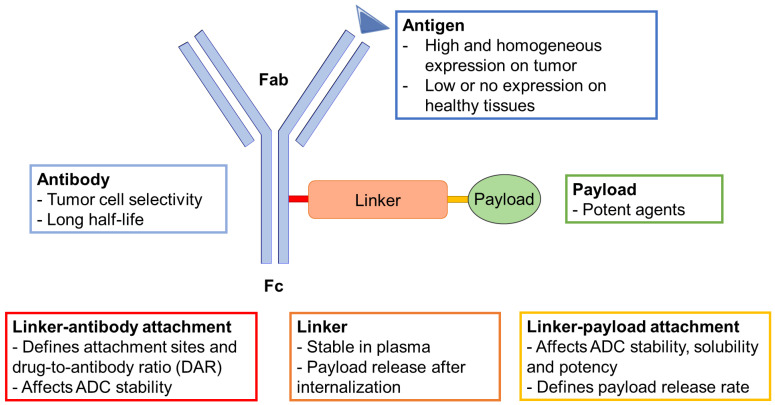
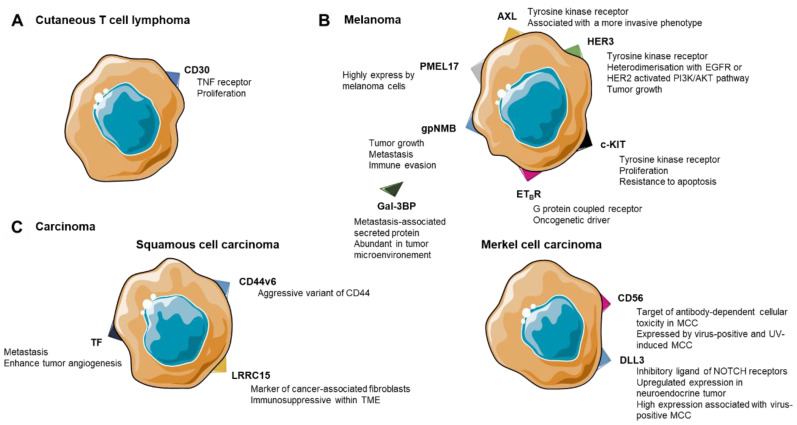
Antibody-drug conjugates (ADCs) are an emerging class of therapeutics, with twelve FDA- and EMA-approved drugs for hematological and solid cancers. Such drugs consist in a monoclonal antibody linked to a cytotoxic agent, allowing a specific cytotoxicity to tumor cells. In recent years, tremendous progress has been observed in therapeutic approaches for advanced skin cancer patients. In this regard, targeted therapies (e.g., kinase inhibitors) or immune checkpoint-blocking antibodies outperformed conventional chemotherapy, with proven benefit to survival. Nevertheless, primary and acquired resistances as well as adverse events remain limitations of these therapies. Therefore, ADCs appear as an emerging therapeutic option in oncodermatology. After providing an overview of ADC design and development, the goal of this article is to review the potential ADC indications in the field of oncodermatology.
抗体药物偶联物(ADCs)是一类新兴的治疗药物,有12种已获美国食品药品监督管理局(FDA)和欧洲药品管理局(EMA)批准用于治疗血液系统癌症和实体癌的药物。这类药物由与细胞毒性药物相连的单克隆抗体组成,可对肿瘤细胞产生特异性细胞毒性。近年来,晚期皮肤癌患者的治疗方法取得了巨大进展。在这方面,靶向疗法(如激酶抑制剂)或免疫检查点阻断抗体的疗效优于传统化疗,已证实对生存期有益。然而,原发性和获得性耐药以及不良事件仍然是这些疗法的局限性。因此,抗体药物偶联物在肿瘤皮肤病学领域似乎是一种新兴的治疗选择。在概述抗体药物偶联物的设计与开发之后,本文的目的是综述抗体药物偶联物在肿瘤皮肤病学领域的潜在适应证。