Dermatology Clinic, University Medical Center of the Johannes Gutenberg-University Mainz, Langenbeckstraße 1, 55131 Mainz, Germany.
Max Planck Institute for Polymer Research, Ackermannweg 10, 55128 Mainz, Germany.
Cells. 2022 Jan 19;11(3):328. doi: 10.3390/cells11030328.
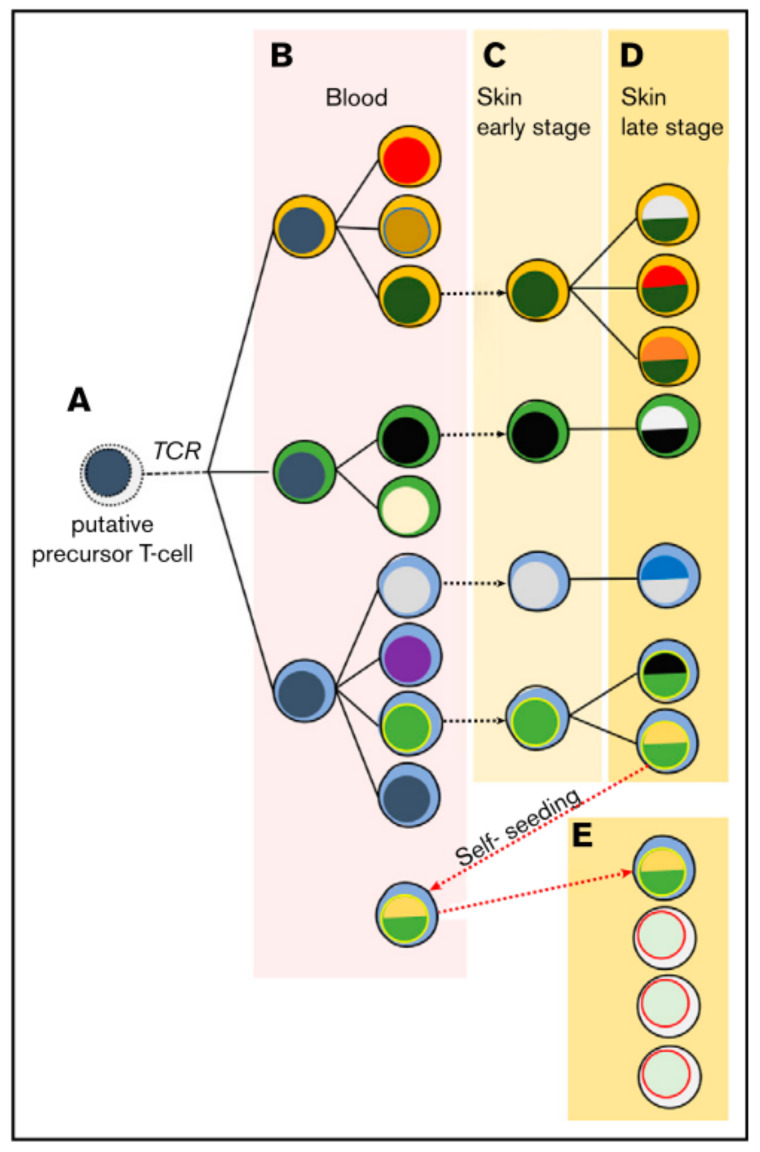
Cutaneous T-Cell Lymphomas (CTCL) presents with substantial clinical variability and transcriptional heterogeneity. In the recent years, several studies paved the way to elucidate aetiology and pathogenesis of CTCL using sequencing methods. Several T-cell subtypes were suggested as the source of disease thereby explaining clinical and transcriptional heterogeneity of CTCL entities. Several differentially expressed pathways could explain disease progression. However, exogenous triggers in the skin microenvironment also seem to affect CTCL status. Especially was shown to contribute to disease progression. Only little is known about the complex microbiome patterns involved in CTCL and how microbial shifts might impact this malignancy. Nevertheless, first hints indicate that the microbiome might at least in part explain transcriptional heterogeneity and that microbial approaches could serve in diagnosis and prognosis. Shaping the microbiome could be a treatment option to maintain stable disease. Here, we review current knowledge of transcriptional heterogeneity of and microbial influences on CTCL. We discuss potential benefits of microbial applications and microbial directed therapies to aid patients with CTCL burden.
皮肤 T 细胞淋巴瘤(CTCL)表现出显著的临床变异性和转录异质性。近年来,多项研究使用测序方法为阐明 CTCL 的病因和发病机制奠定了基础。几种 T 细胞亚型被认为是疾病的来源,从而解释了 CTCL 实体的临床和转录异质性。几种差异表达的途径可以解释疾病的进展。然而,皮肤微环境中的外源性触发因素似乎也会影响 CTCL 的状态。特别是 被证明有助于疾病的进展。目前对涉及 CTCL 的复杂微生物组模式以及微生物变化如何影响这种恶性肿瘤知之甚少。尽管如此,初步迹象表明,微生物组至少可以部分解释转录异质性,微生物方法可以用于诊断和预后。塑造微生物组可能是维持疾病稳定的一种治疗选择。在这里,我们回顾了 CTCL 的转录异质性和微生物影响的现有知识。我们讨论了微生物应用和微生物定向治疗的潜在益处,以帮助 CTCL 患者减轻负担。