Department of Medicine and Surgery, University of Parma, 43126 Parma, Italy.
Medical Oncology Unit, University Hospital of Parma, 43126 Parma, Italy.
Cells. 2022 Jan 25;11(3):413. doi: 10.3390/cells11030413.
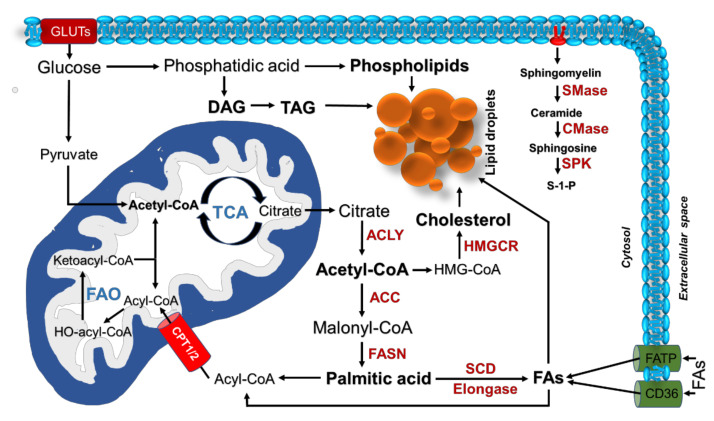
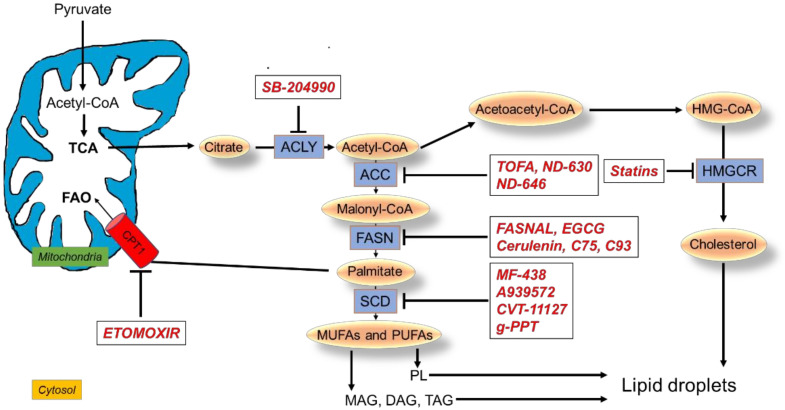
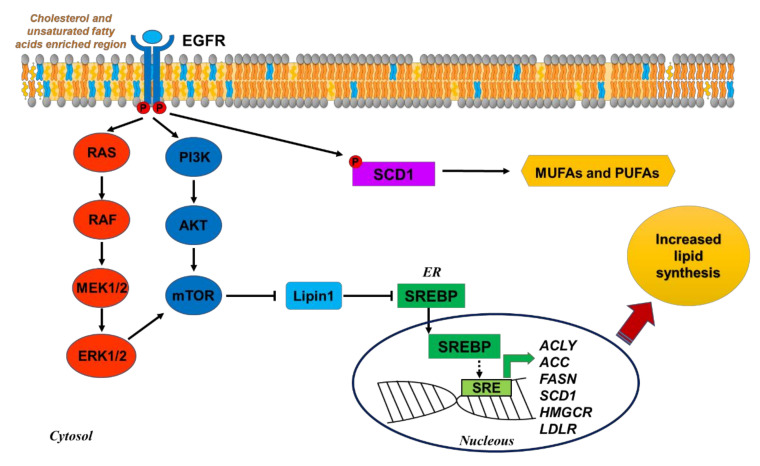
Lung cancer is the leading cause of cancer deaths worldwide. Most of lung cancer cases are classified as non-small cell lung cancers (NSCLC). EGFR has become an important therapeutic target for the treatment of NSCLC patients, and inhibitors targeting the kinase domain of EGFR are currently used in clinical settings. Recently, an increasing interest has emerged toward understanding the mechanisms and biological consequences associated with lipid reprogramming in cancer. Increased uptake, synthesis, oxidation, or storage of lipids has been demonstrated to contribute to the growth of many types of cancer, including lung cancer. In this review, we provide an overview of metabolism in cancer and then explore in more detail the role of lipid metabolic reprogramming in lung cancer development and progression and in resistance to therapies, emphasizing its connection with EGFR signaling. In addition, we summarize the potential therapeutic approaches targeting lipid metabolism for lung cancer treatment.
肺癌是全球癌症死亡的主要原因。大多数肺癌病例被归类为非小细胞肺癌(NSCLC)。EGFR 已成为治疗 NSCLC 患者的重要治疗靶点,目前在临床环境中使用针对 EGFR 激酶结构域的抑制剂。最近,人们越来越关注了解与癌症中脂质重编程相关的机制和生物学后果。已经证明,脂质摄取、合成、氧化或储存的增加有助于包括肺癌在内的许多类型癌症的生长。在这篇综述中,我们提供了癌症代谢的概述,然后更详细地探讨了脂质代谢重编程在肺癌发生和发展以及对治疗的抵抗中的作用,强调了它与 EGFR 信号的联系。此外,我们总结了针对肺癌治疗的靶向脂质代谢的潜在治疗方法。