Unit of Basic and Applied Sciences, Faculty of Biosciences and Agro-Food and Environmental Technologies, University of Teramo, 64100 Teramo, Italy.
National Research Council (CNR), Campus International Development (EMMA-INFRAFRONTIER-IMPC), Institute of Biochemistry and Cellular Biology (IBBC), 00015 Monterotondo Scalo, Italy.
Cells. 2022 Jan 27;11(3):434. doi: 10.3390/cells11030434.
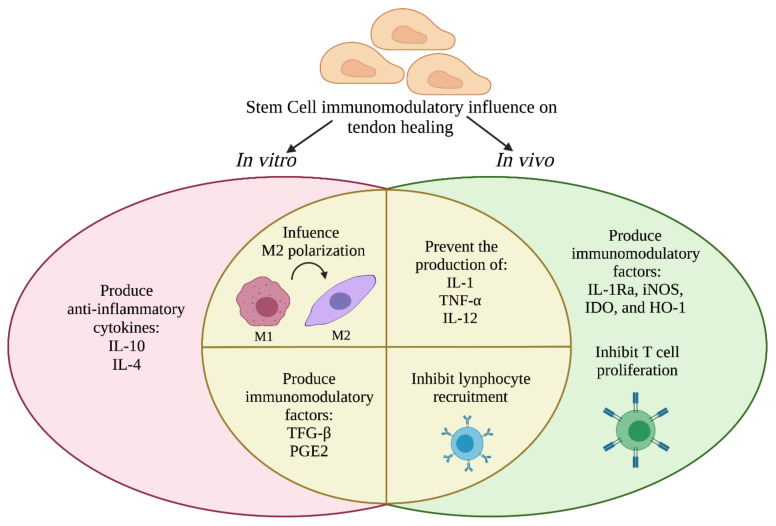
Tendon disorders represent a very common pathology in today's population, and tendinopathies that account 30% of tendon-related injuries, affect yearly millions of people which in turn cause huge socioeconomic and health repercussions worldwide. Inflammation plays a prominent role in the development of tendon pathologies, and advances in understanding the underlying mechanisms during the inflammatory state have provided additional insights into its potential role in tendon disorders. Different cell compartments, in combination with secreted immune modulators, have shown to control and modulate the inflammatory response during tendinopathies. Stromal compartment represented by tenocytes has shown to display an important role in orchestrating the inflammatory response during tendon injuries due to the interplay they exhibit with the immune-sensing and infiltrating compartments, which belong to resident and recruited immune cells. The use of stem cells or their derived secretomes within the regenerative medicine field might represent synergic new therapeutical approaches that can be used to tune the reaction of immune cells within the damaged tissues. To this end, promising opportunities are headed to the stimulation of macrophages polarization towards anti-inflammatory phenotype together with the recruitment of stem cells, that possess immunomodulatory properties, able to infiltrate within the damaged tissues and improve tendinopathies resolution. Indeed, the comprehension of the interactions between tenocytes or stem cells with the immune cells might considerably modulate the immune reaction solving hence the inflammatory response and preventing fibrotic tissue formation. The purpose of this review is to compare the roles of distinct cell compartments during tendon homeostasis and injury. Furthermore, the role of immune cells in this field, as well as their interactions with stem cells and tenocytes during tendon regeneration, will be discussed to gain insights into new ways for dealing with tendinopathies.
肌腱疾病是当今人群中非常常见的一种病理学,其中占 30%的肌腱相关损伤的肌腱病影响着每年数以百万计的人,这反过来又在全球范围内造成了巨大的社会经济和健康影响。炎症在肌腱病的发展中起着重要作用,对炎症状态下潜在机制的深入了解为其在肌腱疾病中的潜在作用提供了更多的认识。不同的细胞区室,结合分泌的免疫调节剂,已被证明可以控制和调节肌腱病中的炎症反应。由肌腱细胞组成的基质区室已被证明在肌腱损伤过程中,由于它们与免疫感应和浸润区室(属于固有和募集的免疫细胞)之间的相互作用,在协调炎症反应方面发挥着重要作用。在再生医学领域中使用干细胞或其衍生的分泌组可能代表协同的新治疗方法,可以用于调节受损组织内免疫细胞的反应。为此,有希望的机会是刺激巨噬细胞向抗炎表型极化,并招募具有免疫调节特性的干细胞,能够浸润受损组织并改善肌腱病的愈合。事实上,理解肌腱细胞或干细胞与免疫细胞之间的相互作用可以极大地调节免疫反应,从而解决炎症反应并防止纤维组织形成。本综述的目的是比较不同细胞区室在肌腱稳态和损伤中的作用。此外,还将讨论免疫细胞在该领域的作用,以及它们在肌腱再生过程中与干细胞和肌腱细胞的相互作用,以深入了解处理肌腱病的新方法。