Grootjen Lionne N, Uyl Nathalie E M, van Beijsterveldt Inge A L P, Damen Layla, Kerkhof Gerthe F, Hokken-Koelega Anita C S
Dutch Reference Center for Prader-Willi Syndrome Westzeedijk 106, 3016 AH Rotterdam, The Netherlands.
Department of Pediatrics, Subdivision of Endocrinology, Erasmus University Medical Center-Sophia Children's Hospital, 3015 CN Rotterdam, The Netherlands.
J Clin Med. 2022 Jan 28;11(3):679. doi: 10.3390/jcm11030679.
Prader-Willi syndrome (PWS) is a rare genetic syndrome with a wide spectrum of clinical features in early life. Late diagnoses are still present. We characterized the perinatal and neonatal features of PWS, compared them with those of healthy newborns and assessed the prenatal and neonatal differences between the genetic subtypes.
A cohort study in children with PWS. The prevalence of variables was compared with healthy infants (PLUTO cohort) and to population statistics from literature.
244 infants with PWS and 365 healthy infants.
Data on prenatal and neonatal variables in both cohorts. Population statistics were collected through an extensive literature search.
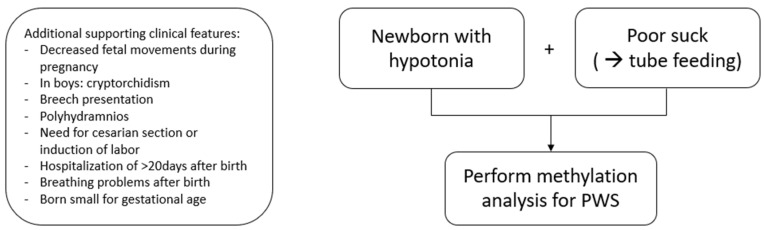
A higher prevalence of maternal age >35 years was found in PWS compared to healthy infants and population statistics, and the highest maternal age was found in the mUPD group. Higher prevalence of polyhydramnios, caesarean section, labour induction and breech presentation, and lower birth weight SDS was found in PWS compared to healthy infants. High prevalences of decreased fetal movements (78.5%), hypotonia (100%), cryptorchism (95.9%) and poor sucking/tube feeding (93.9%) were found in PWS.
This study presents an overview of prenatal and neonatal variables in infants with PWS compared to healthy infants. Our findings may increase clinical awareness of the early perinatal signs of PWS by obstetricians, neonatologists and all those involved in infant care, enabling early diagnosis and start of multidisciplinary treatment.
普拉德-威利综合征(PWS)是一种罕见的遗传综合征,在生命早期具有广泛的临床特征。目前仍存在诊断延迟的情况。我们对PWS的围产期和新生儿特征进行了描述,将其与健康新生儿的特征进行比较,并评估了各遗传亚型之间的产前和新生儿差异。
一项针对PWS患儿的队列研究。将变量的患病率与健康婴儿(PLUTO队列)以及文献中的人群统计数据进行比较。
244例PWS婴儿和365例健康婴儿。
两个队列中关于产前和新生儿变量的数据。通过广泛的文献检索收集人群统计数据。
与健康婴儿和人群统计数据相比,PWS患儿中母亲年龄>35岁的患病率更高,且在母源单亲二倍体(mUPD)组中母亲年龄最高。与健康婴儿相比,PWS患儿羊水过多、剖宫产、引产和臀位分娩的患病率更高,出生体重标准差评分更低。PWS患儿中胎动减少(78.5%)、肌张力低下(100%)、隐睾(95.9%)和吸吮/管饲不良(93.9%)的患病率较高。
本研究概述了PWS婴儿与健康婴儿相比的产前和新生儿变量。我们的研究结果可能会提高产科医生、新生儿科医生以及所有参与婴儿护理的人员对PWS早期围产期体征的临床认识,从而实现早期诊断并开始多学科治疗。