Henderson V J, Cohen R G, Mitchell R S, Kosek J C, Miller D C
Ann Surg. 1986 Apr;203(4):339-45. doi: 10.1097/00000658-198604000-00001.
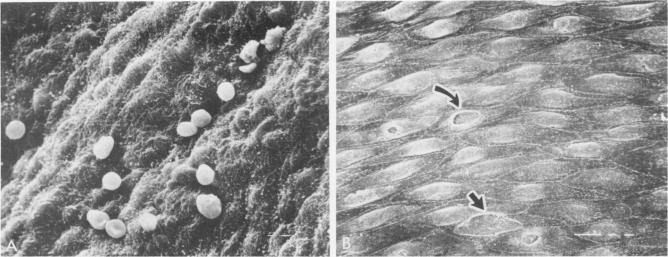
Canine venous autografts and allografts were interposed in the femoral and carotid arterial positions in 29 dogs; grafts were harvested at three postoperative intervals (1-2 weeks, 4-6 weeks, and 8-10 weeks) for light and scanning electron (SEM) microscopy and lumenal surface prostacyclin (PGI2) production. Normal veins and arteries were used as controls. Radioimmunoassay for tritiated 6-k-PGF1 alpha, the stable metabolite of PGI2, was performed using a flow surface template incubation chamber during basal and arachidonic acid stimulated conditions. Using SEM, the autografts revealed normal endothelial cell (EC) surfaces at all time intervals; conversely, allografts exhibited extensive EC loss at 1-2 weeks with gradual reparation by 10-12 weeks (such that the EC surface was virtually indistinguishable from that of control veins or autografts). PGI2 production was significantly greater in control arteries than veins (p = 0.0001). At 1-2 weeks and 4-6 weeks, lumenal production of PGI2 in both the autografts and allografts was not significantly different from control vein; however, PGI2 production after 10-12 weeks was identical to normal arterial levels (and significantly [p less than 0.0044] higher than venous levels) in both basal and stimulated conditions. Although the mechanisms responsible for this functional (biochemical) "arterialization" process remain conjectural, increased biosynthesis and/or release of PGI2 by endothelial cells, acute phase inflammatory cells (allografts) mediated by interleukin-1 or myointimal cells seems most likely. Further elucidation of these sources of PGI2 is necessary, but these data demonstrate for the first time that venous grafts placed in the arterial circulation undergo complete functional adaptation (in addition to the well known morphological changes).
在29只犬的股动脉和颈动脉位置植入犬自体静脉移植物和同种异体静脉移植物;在术后三个时间间隔(1 - 2周、4 - 6周和8 - 10周)采集移植物,用于光镜和扫描电子显微镜(SEM)检查以及管腔表面前列环素(PGI2)生成检测。正常静脉和动脉用作对照。在基础状态和花生四烯酸刺激条件下,使用流动表面模板孵育室对PGI2的稳定代谢产物氚标记的6 - k - PGF1α进行放射免疫测定。使用SEM观察发现,自体静脉移植物在所有时间间隔内皮细胞(EC)表面均正常;相反,同种异体静脉移植物在1 - 2周时出现广泛的EC丢失,到10 - 12周时逐渐修复(以至于EC表面与对照静脉或自体静脉移植物几乎无法区分)。对照动脉中PGI2的生成显著高于静脉(p = 0.0001)。在1 - 2周和4 - 6周时,自体静脉移植物和同种异体静脉移植物管腔内PGI2的生成与对照静脉无显著差异;然而,在基础状态和刺激条件下,10 - 12周后PGI2的生成与正常动脉水平相同(且显著高于静脉水平,p < 0.0044)。尽管导致这种功能性(生化)“动脉化”过程的机制仍属推测,但内皮细胞、由白细胞介素 - 1介导的急性期炎症细胞(同种异体移植物)或肌内膜细胞增加PGI2的生物合成和/或释放似乎最有可能。虽然有必要进一步阐明这些PGI2的来源,但这些数据首次证明,置于动脉循环中的静脉移植物会发生完全的功能适应(除了众所周知的形态学变化)。