Zhang Yan, Liu Lvzhou, Chen Xiang, Li Jincai
College of Agriculture, Anhui Agricultural University, Hefei 230036, China.
Jiangsu Collaborative Innovation Centre for Modern Crop Production, Nanjing 210093, China.
Plants (Basel). 2022 Jan 30;11(3):389. doi: 10.3390/plants11030389.
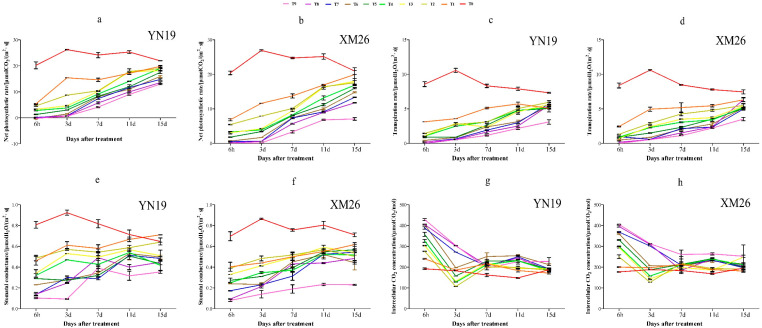
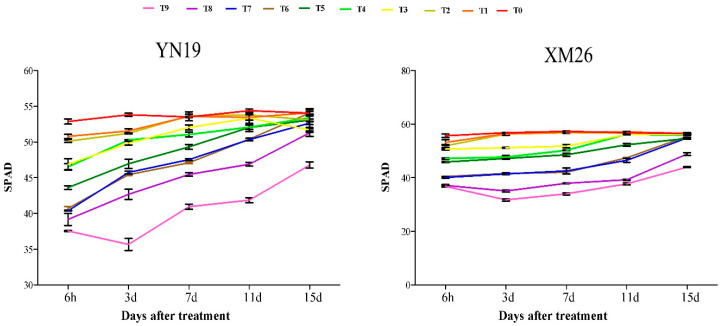
Climate change has caused frequent extreme low-temperature events to threaten global food security. Spring low-temperature stress is one of the major limiting factors for high and stable yields of wheat. We used two wheat varieties differing in spring cold-sensitivity (cold-tolerant variety Yannong 19 and cold-sensitive variety Xinmai 26) to examine the effects of low-temperature stress during the anther differentiation period on wheat photosynthetic performance and spike-setting characteristics. Low-temperature stress was simulated in a climate box at -2 °C, 0 °C or 2 °C (night) and 15 °C (day) for 24 h, 48 h or 72 h. With the extension of the treatment time and the decrease of temperature, the photosynthetic rate, stomatal conductance and transpiration rate of wheat leaves gradually decreased. All treatments except -2 °C for 72 h recovered slowly within 7-15 days after treatment. Low-temperature stress greatly reduced grains per spikelet, 1000-grain weight and yield per plant. By analyzing the spikelets in different stalk locations (upper, middle and lower), we found that the number of upper spikelets was significantly less than lower and middle spikelets after low-temperature stress. The sterile grain of upper spikelets (Xinmai 26, for example) can reach 100% at -2 °C for 48 h and 72 h, and the yield loss rate was 90.52% at 2 °C for 24 h, which was much higher than for the lower spikelets (60.73%) and middle spikelets (50.94%). Overall, these findings suggest that low-temperature stress during the anther differentiation period alters the photosynthetic activity involved in the accumulation of dry matter in wheat, which leads to delaying young spike growth, especially for upper spikelets, and ultimately in a decrease in yield.
气候变化导致频繁的极端低温事件,威胁着全球粮食安全。春季低温胁迫是小麦高产稳产的主要限制因素之一。我们使用了两个对春季低温敏感性不同的小麦品种(耐冷品种烟农19和冷敏感品种新麦26),来研究花药分化期的低温胁迫对小麦光合性能和结实特性的影响。在气候箱中模拟低温胁迫,设置夜间温度为-2℃、0℃或2℃,白天温度为15℃,处理24小时、48小时或72小时。随着处理时间的延长和温度的降低,小麦叶片的光合速率、气孔导度和蒸腾速率逐渐下降。除了-2℃处理72小时外,所有处理在处理后7至15天内恢复缓慢。低温胁迫显著降低了每小穗粒数、千粒重和单株产量。通过分析不同茎节位置(上部、中部和下部)的小穗,我们发现低温胁迫后上部小穗的数量显著少于下部和中部小穗。例如,在-2℃处理48小时和72小时后,上部小穗(如新麦26)的不育粒率可达100%,在2℃处理24小时时产量损失率为90.52%,远高于下部小穗(60.73%)和中部小穗(50.94%)。总体而言,这些研究结果表明,花药分化期的低温胁迫改变了小麦干物质积累过程中的光合活性,导致幼穗生长延迟,尤其是上部小穗,最终导致产量下降。