Zeng Yanhua, Zhang Yuping, Xiang Jing, Uphoff Norman T, Pan Xiaohua, Zhu Defeng
Key Laboratory of Crop Physiology, Ecology and Genetic Breeding, Jiangxi Agricultural UniversityNanchang, China.
State Key Laboratory of Rice Biology, China National Rice Research Institute (CAAS)Hangzhou, China.
Front Plant Sci. 2017 Aug 8;8:1350. doi: 10.3389/fpls.2017.01350. eCollection 2017.
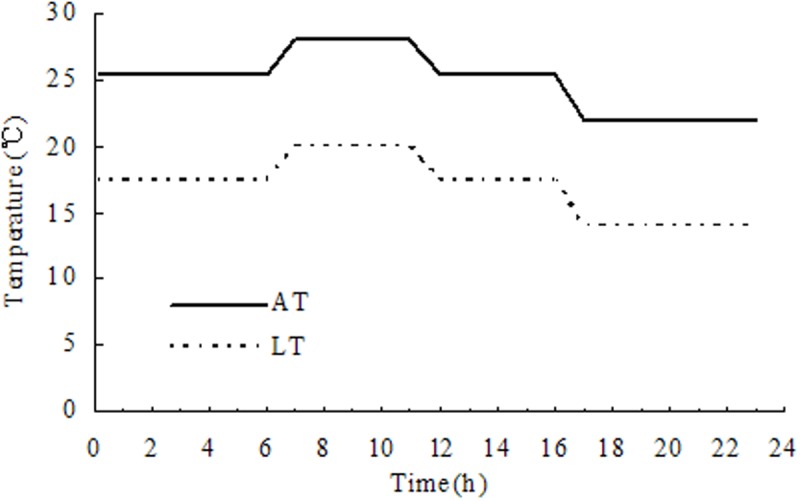
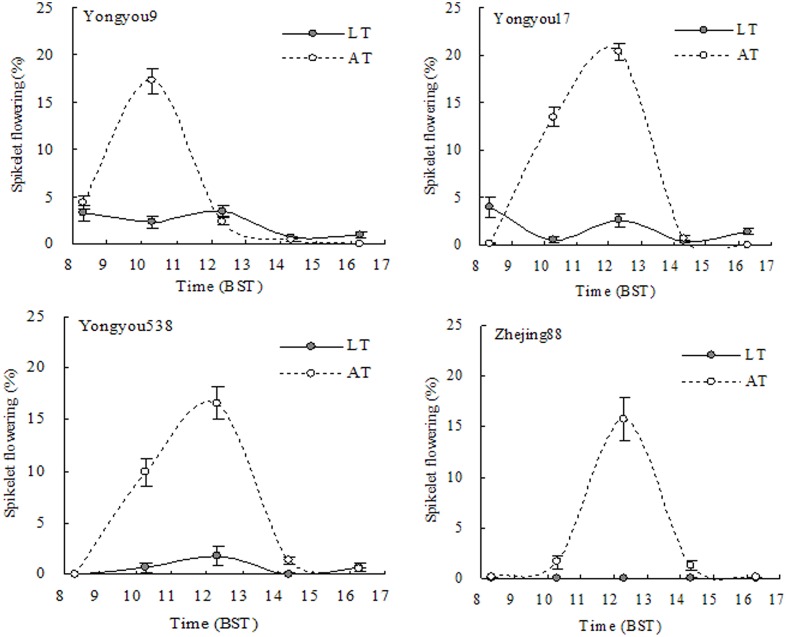
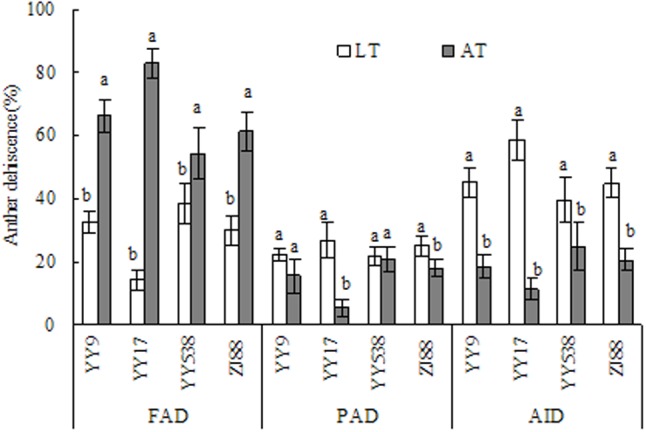
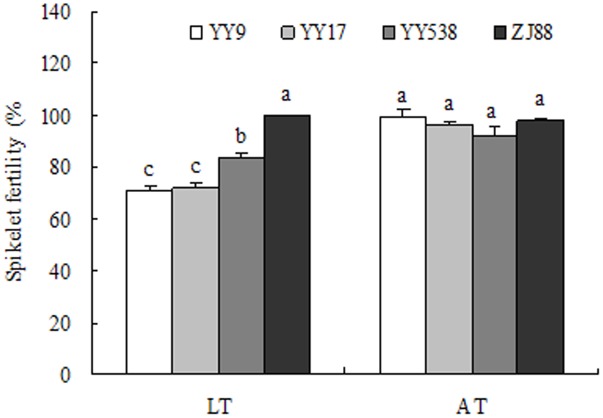
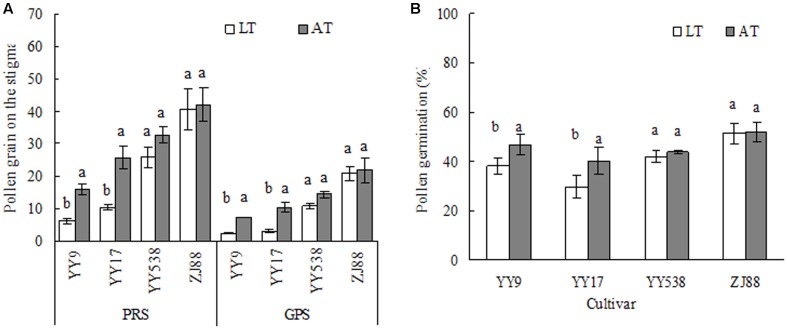
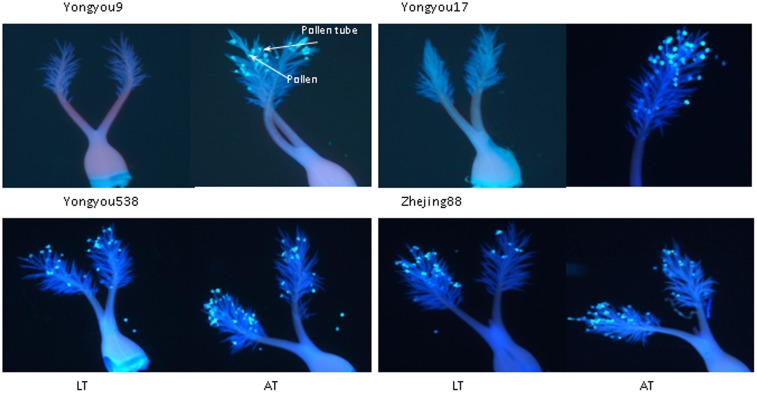
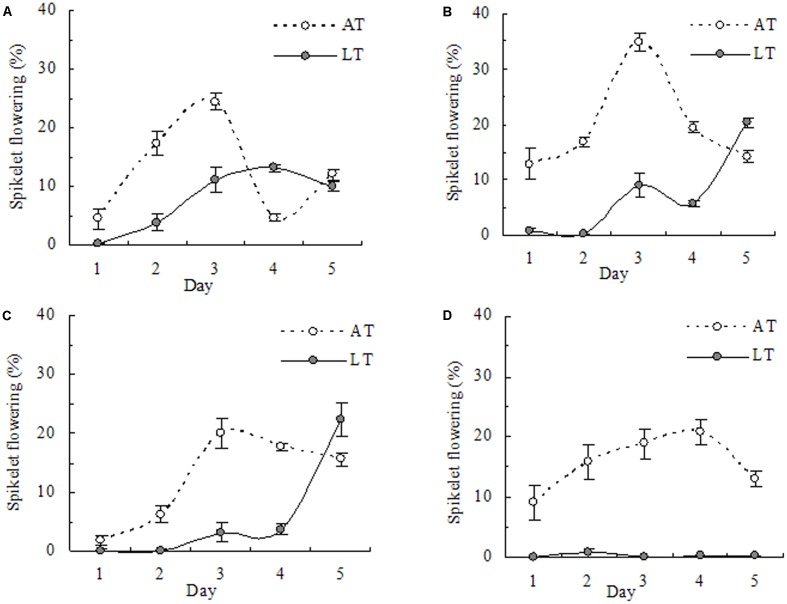
Poor spikelet fertility under low temperature (LT) stress during anthesis limits the possibility of high yield potential in hybrid rice, leading to reduced stability of grain yield. However, the cause for it is still unclear. In this study, three hybrid rice cultivars, Yongyou9, Yongyou17 (both cold sensitive), and Yongyou538, and one inbred rice cultivar, Zhejing88 (cold tolerant), were grown under LT (17°C) and ambient temperature (AT) (25°C) during anthesis to test for their response with respect to spikelet fertility, pollen germination, and spikelet flowering. The results indicated that LT resulted in lower spikelet fertility in cold-sensitive cultivars than in cold-tolerant cultivars. Spikelet fertility was highly correlated with pollen germination on the stigma. The number of pollen grains and germinated pollen were higher in cold-tolerant cultivars than in cold-sensitive cultivars. Pollen fertility and pollen diameter were also higher in cold-tolerant cultivars, although the latter could achieve a high number of spikelets at anthesis in flowering patterns throughout the duration of LT stress. There were significant differences in anther width and volume between genotypes and treatments according to microscopic analyses, but no differences were observed in anther dehiscence. Moreover, variation in the number of pollen grains on stigmas and in spikelet fertility was not related to either the number of spikelets reaching anthesis or anther dehiscence. Overall, improved anther size, better pollen function, and higher spikelet fertility under LT stress were observed in cold-tolerant cultivars than in cold-sensitive cultivars. The results suggest that the increase in spikelet fertility is due to enhanced pollen germination rather than the number of spikelets reaching anthesis.
在水稻扬花期,低温胁迫下小穗育性不佳限制了杂交水稻高产潜力的实现,导致粮食产量稳定性降低。然而,其原因尚不清楚。本研究选取了3个杂交水稻品种,即甬优9号、甬优17号(均对低温敏感)和甬优538,以及1个常规水稻品种浙粳88(耐低温),在扬花期分别置于低温(17°C)和环境温度(25°C)条件下,以测试它们在小穗育性、花粉萌发和小穗开花方面的响应。结果表明,低温导致对低温敏感的品种小穗育性低于耐低温品种。小穗育性与柱头上的花粉萌发高度相关。耐低温品种的花粉粒数量和萌发花粉数量均高于对低温敏感的品种。尽管在整个低温胁迫期间,对低温敏感的品种在开花模式上能在扬花期达到较高的小穗数量,但耐低温品种的花粉育性和花粉直径也更高。根据显微镜分析,不同基因型和处理之间花药宽度和体积存在显著差异,但花药开裂情况未观察到差异。此外,柱头上花粉粒数量和小穗育性的变化与达到扬花期的小穗数量或花药开裂均无关。总体而言,与对低温敏感的品种相比,耐低温品种在低温胁迫下花药大小更佳、花粉功能更好、小穗育性更高。结果表明,小穗育性的提高是由于花粉萌发增强,而非达到扬花期的小穗数量增加。