• 文献检索
  • 文档翻译
  • 深度研究
  • 学术资讯
  • Suppr Zotero 插件Zotero 插件
  • 邀请有礼
  • 套餐&价格
  • 历史记录
应用&插件
Suppr Zotero 插件Zotero 插件浏览器插件Mac 客户端Windows 客户端微信小程序
定价
高级版会员购买积分包购买API积分包
服务
文献检索文档翻译深度研究API 文档MCP 服务
关于我们
关于 Suppr公司介绍联系我们用户协议隐私条款
关注我们

Suppr 超能文献

核心技术专利:CN118964589B侵权必究
粤ICP备2023148730 号-1Suppr @ 2026

文献检索

告别复杂PubMed语法,用中文像聊天一样搜索,搜遍4000万医学文献。AI智能推荐,让科研检索更轻松。

立即免费搜索

文件翻译

保留排版,准确专业,支持PDF/Word/PPT等文件格式,支持 12+语言互译。

免费翻译文档

深度研究

AI帮你快速写综述,25分钟生成高质量综述,智能提取关键信息,辅助科研写作。

立即免费体验

单产趋势不足以在2050年前使全球作物产量翻番。

Yield Trends Are Insufficient to Double Global Crop Production by 2050.

作者信息

Ray Deepak K, Mueller Nathaniel D, West Paul C, Foley Jonathan A

机构信息

Institute on the Environment (IonE), University of Minnesota, Saint Paul, Minnesota, United States of America.

出版信息

PLoS One. 2013 Jun 19;8(6):e66428. doi: 10.1371/journal.pone.0066428. Print 2013.

DOI:10.1371/journal.pone.0066428
PMID:23840465
原文链接:https://pmc.ncbi.nlm.nih.gov/articles/PMC3686737/
Abstract

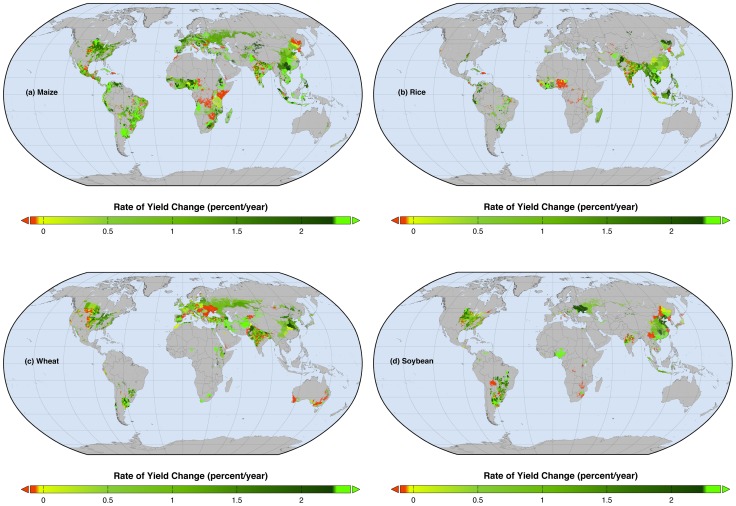
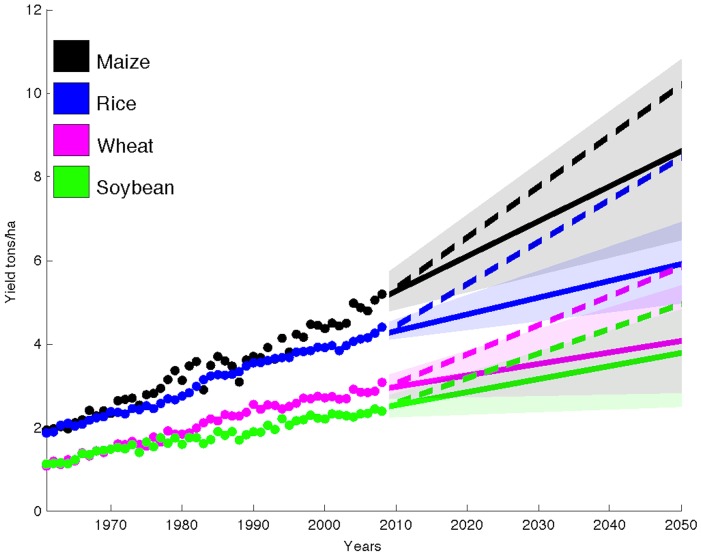
Several studies have shown that global crop production needs to double by 2050 to meet the projected demands from rising population, diet shifts, and increasing biofuels consumption. Boosting crop yields to meet these rising demands, rather than clearing more land for agriculture has been highlighted as a preferred solution to meet this goal. However, we first need to understand how crop yields are changing globally, and whether we are on track to double production by 2050. Using ∼2.5 million agricultural statistics, collected for ∼13,500 political units across the world, we track four key global crops-maize, rice, wheat, and soybean-that currently produce nearly two-thirds of global agricultural calories. We find that yields in these top four crops are increasing at 1.6%, 1.0%, 0.9%, and 1.3% per year, non-compounding rates, respectively, which is less than the 2.4% per year rate required to double global production by 2050. At these rates global production in these crops would increase by ∼67%, ∼42%, ∼38%, and ∼55%, respectively, which is far below what is needed to meet projected demands in 2050. We present detailed maps to identify where rates must be increased to boost crop production and meet rising demands.

摘要

多项研究表明,到2050年全球作物产量需要翻番,才能满足预计因人口增长、饮食结构变化和生物燃料消耗增加而产生的需求。提高作物产量以满足这些不断增长的需求,而非开垦更多土地用于农业生产,已被视为实现这一目标的首选解决方案。然而,我们首先需要了解全球作物产量是如何变化的,以及到2050年我们是否有望实现产量翻番。利用收集自全球约13500个政治单位的约250万条农业统计数据,我们追踪了四种主要的全球作物——玉米、水稻、小麦和大豆,它们目前提供了全球近三分之二的农业热量。我们发现,这四种主要作物的产量年增长率分别为1.6%、1.0%、0.9%和1.3%(非复利增长率),低于到2050年使全球产量翻番所需的每年2.4%的增长率。按照这些增长率,这些作物的全球产量将分别增长约67%、42%、38%和55%,远低于满足2050年预计需求所需的增幅。我们展示了详细的地图,以确定哪些地区必须提高产量增长率,以促进作物生产并满足不断增长的需求。
https://cdn.ncbi.nlm.nih.gov/pmc/blobs/bce2/3686737/ad9f76c2467d/pone.0066428.g002.jpg
https://cdn.ncbi.nlm.nih.gov/pmc/blobs/bce2/3686737/9047a239d466/pone.0066428.g001.jpg
https://cdn.ncbi.nlm.nih.gov/pmc/blobs/bce2/3686737/ad9f76c2467d/pone.0066428.g002.jpg
https://cdn.ncbi.nlm.nih.gov/pmc/blobs/bce2/3686737/9047a239d466/pone.0066428.g001.jpg
https://cdn.ncbi.nlm.nih.gov/pmc/blobs/bce2/3686737/ad9f76c2467d/pone.0066428.g002.jpg

相似文献

1
Yield Trends Are Insufficient to Double Global Crop Production by 2050.单产趋势不足以在2050年前使全球作物产量翻番。
PLoS One. 2013 Jun 19;8(6):e66428. doi: 10.1371/journal.pone.0066428. Print 2013.
2
Uncertainties of potentials and recent changes in global yields of major crops resulting from census- and satellite-based yield datasets at multiple resolutions.基于多分辨率普查和卫星产量数据集的主要作物全球产量的潜力不确定性和近期变化。
PLoS One. 2018 Sep 20;13(9):e0203809. doi: 10.1371/journal.pone.0203809. eCollection 2018.
3
Closing Yield Gaps: How Sustainable Can We Be?缩小产量差距:我们能有多可持续?
PLoS One. 2015 Jun 17;10(6):e0129487. doi: 10.1371/journal.pone.0129487. eCollection 2015.
4
Recent patterns of crop yield growth and stagnation.近年来作物产量的增长和停滞模式。
Nat Commun. 2012;3:1293. doi: 10.1038/ncomms2296.
5
Climate change has likely already affected global food production.气候变化可能已经影响到了全球粮食生产。
PLoS One. 2019 May 31;14(5):e0217148. doi: 10.1371/journal.pone.0217148. eCollection 2019.
6
When too much isn't enough: Does current food production meet global nutritional needs?物极必反:当前的粮食生产能否满足全球营养需求?
PLoS One. 2018 Oct 23;13(10):e0205683. doi: 10.1371/journal.pone.0205683. eCollection 2018.
7
Patterns of Cereal Yield Growth across China from 1980 to 2010 and Their Implications for Food Production and Food Security.1980年至2010年中国谷物产量增长模式及其对粮食生产和粮食安全的影响。
PLoS One. 2016 Jul 12;11(7):e0159061. doi: 10.1371/journal.pone.0159061. eCollection 2016.
8
Synchronized failure of global crop production.全球作物生产同步失败。
Nat Ecol Evol. 2019 May;3(5):780-786. doi: 10.1038/s41559-019-0862-x. Epub 2019 Apr 15.
9
Q&A: modern crop breeding for future food security.问答:为未来粮食安全进行现代作物育种
BMC Biol. 2019 Feb 25;17(1):18. doi: 10.1186/s12915-019-0638-4.
10
Is the boom in staple crop production attributed to expanded cropland or improved yield? A comparative analysis between China and India.粮食作物产量的增长是源于耕地面积的扩大还是单产的提高?中国和印度的比较分析。
Sci Total Environ. 2024 Jul 10;933:173151. doi: 10.1016/j.scitotenv.2024.173151. Epub 2024 May 10.

引用本文的文献

1
Research Advances in AP2/ERF Transcription Factors in Rice Growth and Development.水稻生长发育过程中AP2/ERF转录因子的研究进展
Plants (Basel). 2025 Aug 27;14(17):2673. doi: 10.3390/plants14172673.
2
The beneficial impact of silicon on wheat drought resilience is dependent on cultivar and stress intensity.硅对小麦抗旱性的有益影响取决于品种和胁迫强度。
Front Plant Sci. 2025 Aug 21;16:1661405. doi: 10.3389/fpls.2025.1661405. eCollection 2025.
3
Advances in Functional Genomics for Exploring Abiotic Stress Tolerance Mechanisms in Cereals.

本文引用的文献

1
Conserving the birds of Uganda's banana-coffee arc: land sparing and land sharing compared.保护乌干达香蕉-咖啡弧的鸟类:土地节约与土地共享的比较。
PLoS One. 2013;8(2):e54597. doi: 10.1371/journal.pone.0054597. Epub 2013 Feb 4.
2
Watershed sediment losses to lakes accelerating despite agricultural soil conservation efforts.尽管采取了农业土壤保持措施,流域泥沙仍加速向湖泊输送。
PLoS One. 2013;8(1):e53554. doi: 10.1371/journal.pone.0053554. Epub 2013 Jan 9.
3
WHO, World Food Programme, and International Fund for Agricultural Development. 2012. The State of Food Insecurity in the World 2012. Economic growth is necessary but not sufficient to accelerate reduction of hunger and malnutrition. Rome, FAO.
探索谷物非生物胁迫耐受机制的功能基因组学进展
Plants (Basel). 2025 Aug 8;14(16):2459. doi: 10.3390/plants14162459.
4
Harnessing big data for enhanced genome-wide prediction in winter wheat breeding.利用大数据增强冬小麦育种中的全基因组预测
Theor Appl Genet. 2025 Aug 22;138(9):224. doi: 10.1007/s00122-025-05007-6.
5
Positive impact of hydroponics and artificial light on yield and quality of wheat.水培和人工光照对小麦产量和品质的积极影响。
Sci Rep. 2025 Aug 21;15(1):30768. doi: 10.1038/s41598-025-16204-0.
6
Identification of quantitative trait loci and candidate genes underlying kernel traits of wheat (Triticum aestivum L.) in response to drought stress.干旱胁迫下小麦(Triticum aestivum L.)籽粒性状相关数量性状位点及候选基因的鉴定
Theor Appl Genet. 2025 Aug 19;138(9):216. doi: 10.1007/s00122-025-05001-y.
7
From spectrum to yield: advances in crop photosynthesis with hyperspectral imaging.从光谱到产量:利用高光谱成像技术实现作物光合作用的进展
Photosynthetica. 2025 Jul 8;63(2):196-233. doi: 10.32615/ps.2025.012. eCollection 2025.
8
Large-scale identification and association analysis of wheat grain weight genes using rice orthologs.利用水稻直系同源基因对小麦粒重基因进行大规模鉴定与关联分析。
Theor Appl Genet. 2025 Aug 5;138(8):197. doi: 10.1007/s00122-025-04988-8.
9
Breeding Wheat ( L.) for Pre-Harvest Sprouting Tolerance in South Africa: Current Status and Future Prospects.南非培育抗穗发芽小麦(L.)的现状与未来前景
Plants (Basel). 2025 Jul 10;14(14):2134. doi: 10.3390/plants14142134.
10
Genetic mapping and haplotype analysis identify novel candidate genes for high night temperature tolerance in winter wheat.遗传图谱构建与单倍型分析鉴定出冬小麦耐高夜温的新候选基因。
Plant Genome. 2025 Sep;18(3):e70075. doi: 10.1002/tpg2.70075.
世界卫生组织、世界粮食计划署和国际农业发展基金。2012年。《2012年世界粮食不安全状况》。经济增长对于加快减少饥饿和营养不良现象是必要的,但并不充分。罗马,粮农组织。
Adv Nutr. 2013 Jan 1;4(1):126-7. doi: 10.3945/an.112.003343.
4
Recent patterns of crop yield growth and stagnation.近年来作物产量的增长和停滞模式。
Nat Commun. 2012;3:1293. doi: 10.1038/ncomms2296.
5
Lost food, wasted resources: global food supply chain losses and their impacts on freshwater, cropland, and fertiliser use.损失的食物,浪费的资源:全球粮食供应链损失及其对淡水资源、耕地和化肥使用的影响。
Sci Total Environ. 2012 Nov 1;438:477-89. doi: 10.1016/j.scitotenv.2012.08.092. Epub 2012 Sep 29.
6
Closing yield gaps through nutrient and water management.通过养分和水分管理来缩小产量差距。
Nature. 2012 Oct 11;490(7419):254-7. doi: 10.1038/nature11420. Epub 2012 Aug 29.
7
Green revolution: impacts, limits, and the path ahead.绿色革命:影响、局限及未来之路。
Proc Natl Acad Sci U S A. 2012 Jul 31;109(31):12302-8. doi: 10.1073/pnas.0912953109. Epub 2012 Jul 23.
8
Global food demand and the sustainable intensification of agriculture.全球粮食需求与农业可持续集约化发展。
Proc Natl Acad Sci U S A. 2011 Dec 13;108(50):20260-4. doi: 10.1073/pnas.1116437108. Epub 2011 Nov 21.
9
Solutions for a cultivated planet.为培育的星球寻找解决方案。
Nature. 2011 Oct 12;478(7369):337-42. doi: 10.1038/nature10452.
10
Reconciling food production and biodiversity conservation: land sharing and land sparing compared.协调粮食生产与生物多样性保护:土地共享与土地分离的比较。
Science. 2011 Sep 2;333(6047):1289-91. doi: 10.1126/science.1208742.