School of Automation, Hangzhou Dianzi University, Hangzhou 310018, China.
Zhejiang Key Laboratory of Design and Intelligence and Digital Creativity, College of Computer Science and Technology, Zhejiang University, Hangzhou 310027, China.
Sensors (Basel). 2022 Feb 6;22(3):1227. doi: 10.3390/s22031227.
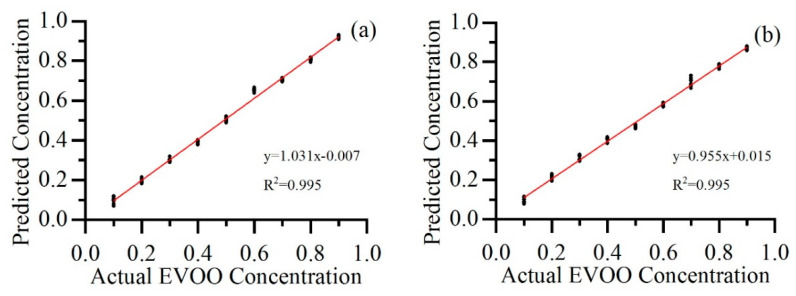
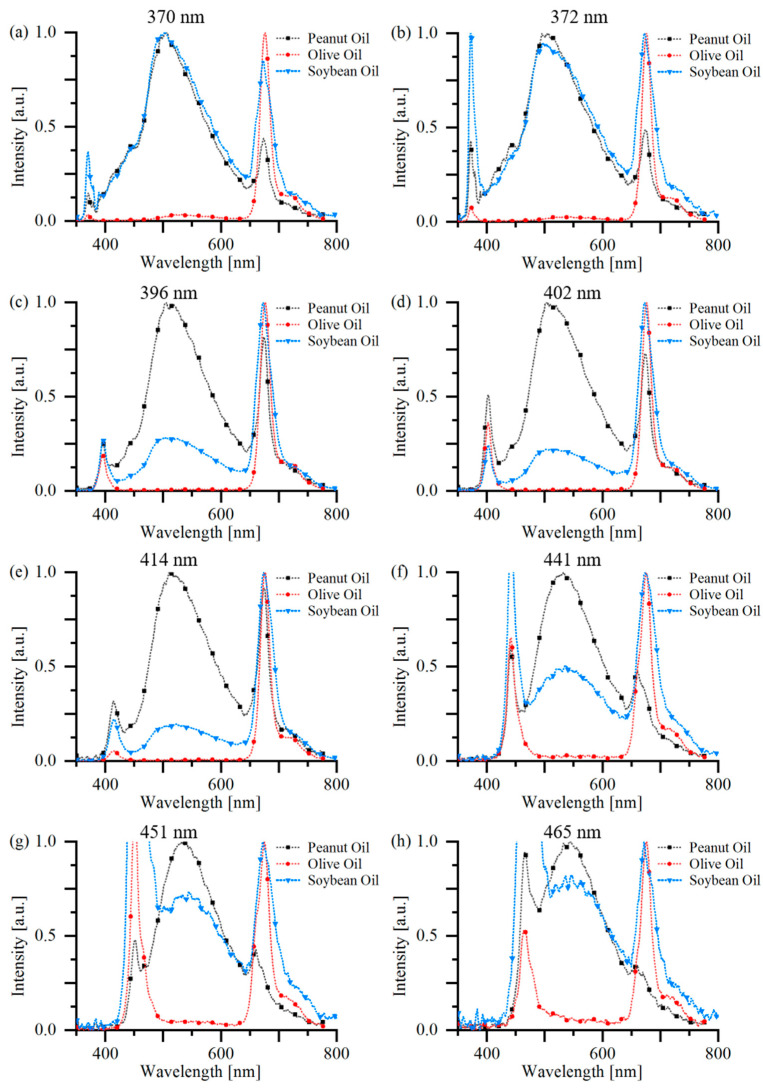
As it is high in value, extra virgin olive oil (EVOO) is frequently blended with inferior vegetable oils. This study presents an optical method for determining the adulteration level of EVOO with soybean oil as well as peanut oil using LED-induced fluorescence spectroscopy. Eight LEDs with central wavelengths from ultra-violet (UV) to blue are tested to induce the fluorescence spectra of EVOO, peanut oil, and soybean oil, and the UV LED of 372 nm is selected for further detection. Samples are prepared by mixing olive oil with different volume fractions of peanut or soybean oil, and their fluorescence spectra are collected. Different pre-processing and regression methods are utilized to build the prediction model, and good linearity is obtained between the predicted and actual adulteration concentration. This result, accompanied by the non-destruction and no pre-treatment characteristics, proves that it is feasible to use LED-induced fluorescence spectroscopy as a way to investigate the EVOO adulteration level, and paves the way for building a hand-hold device that can be applied to real market conditions in the future.
特级初榨橄榄油(EVOO)因其价值高,常与劣质植物油混合。本研究提出了一种使用 LED 诱导荧光光谱法检测 EVOO 掺大豆油和花生油的掺假水平的光学方法。测试了 8 个中心波长从紫外(UV)到蓝色的 LED 来诱导 EVOO、花生油和大豆油的荧光光谱,并选择 372nm 的 UV LED 进行进一步检测。通过将橄榄油与不同体积分数的花生油或大豆油混合来制备样品,并采集其荧光光谱。利用不同的预处理和回归方法来建立预测模型,在预测和实际掺假浓度之间得到了良好的线性关系。这一结果,加上非破坏性和无需预处理的特点,证明了使用 LED 诱导荧光光谱法来研究 EVOO 的掺假水平是可行的,并为未来构建可应用于实际市场条件的手持式设备铺平了道路。