Department of Human Development and Family Studies, National Taiwan Normal University, 162, Heping East Road, Section 1, Taipei 106, Taiwan.
Int J Environ Res Public Health. 2022 Feb 8;19(3):1891. doi: 10.3390/ijerph19031891.
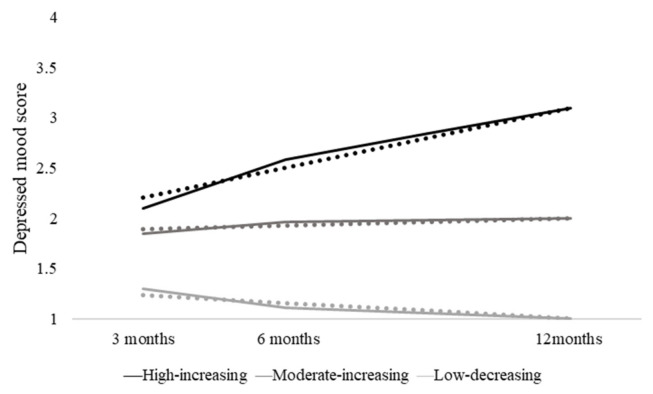
Parental psychological well-being is essential to the wellness of the family. However, longitudinal investigations into fathers' postpartum depressed mood are limited. This study aimed to identify the typologies of depressed mood trajectories over the first year postpartum among Taiwanese fathers and to examine the factors associated with such typologies. We retrieved data from a nationwide longitudinal study on child development and care in Taiwan. A total of 396 fathers, who completed at least one of the three interviews when their children were 3, 6, and 12 months old between 2016 and 2017, were included in this analysis. Conditional latent class growth analysis was conducted to identify the classifications of the fathers' depressed mood trajectories in the first year postpartum and to estimate the effects of covariates on individuals' membership of a trajectory class. Three classes of depressed mood trajectories were identified. The high increasing group consisted of 11% of the participants; the moderate increasing and the low decreasing groups consisted of 28% and 61% of the participants, respectively. Financial stress was associated with the fathers' likelihood of being in the high increasing group compared with their likelihood of being in the low decreasing group (OR = 2.28, CI = 1.16-4.47). The result may be related to the difference in gender roles and social expectations.
父母的心理健康对于家庭的健康至关重要。然而,关于父亲产后抑郁情绪的纵向研究有限。本研究旨在确定台湾地区父亲产后第一年抑郁情绪轨迹的类型,并探讨与这些类型相关的因素。我们从台湾地区一项关于儿童发展和护理的全国性纵向研究中提取数据。共有 396 名父亲在 2016 年至 2017 年间,当他们的孩子 3、6 和 12 个月大时,至少完成了三次访谈中的一次,他们被纳入了本分析。条件潜在类别增长分析用于确定父亲产后第一年抑郁情绪轨迹的分类,并估计协变量对个体轨迹类别的归属的影响。确定了三种抑郁情绪轨迹类型。高增长组占参与者的 11%;中增长组和低下降组分别占参与者的 28%和 61%。与低下降组相比,经济压力与父亲处于高增长组的可能性相关(OR=2.28,CI=1.16-4.47)。结果可能与性别角色和社会期望的差异有关。