Department of Biomedical Sciences, Hallym University College of Medicine, Chuncheon 24252, Korea.
Department of Allergy and Clinical Immunology, Ajou University School of Medicine, Suwon 16499, Korea.
Int J Mol Sci. 2022 Jan 30;23(3):1622. doi: 10.3390/ijms23031622.
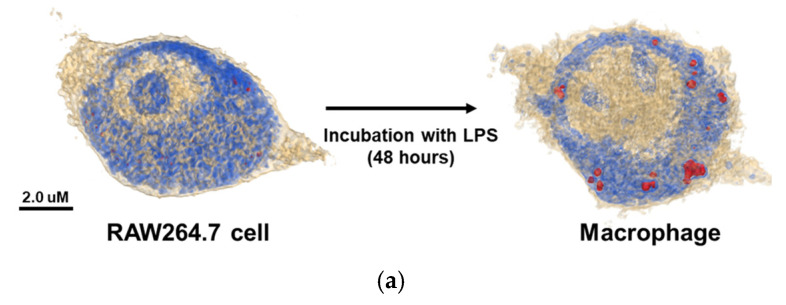
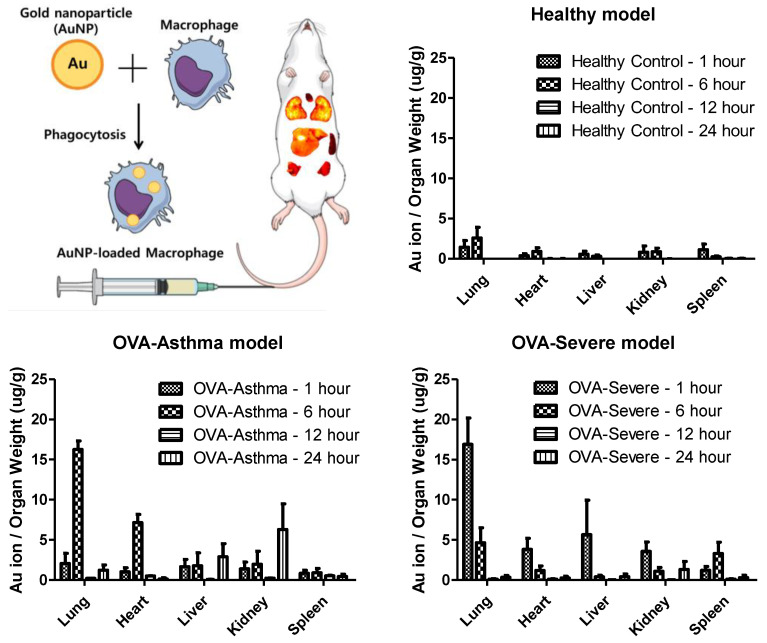
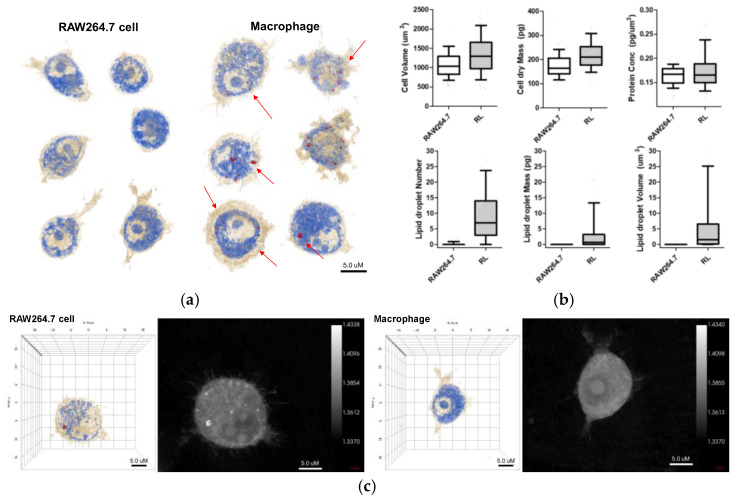
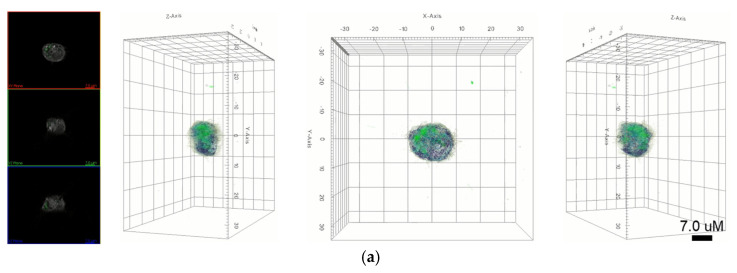
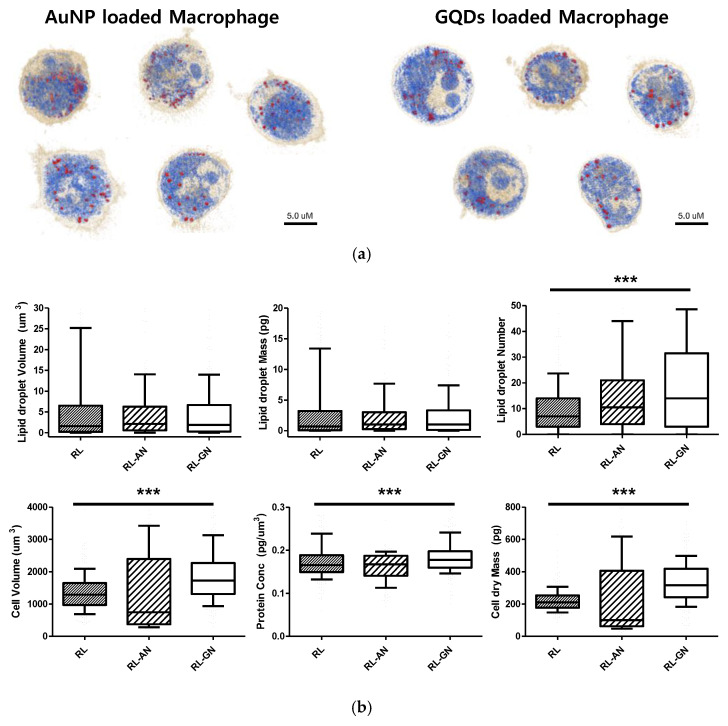
Understanding the interaction between nanoparticles and immune cells is essential for the evaluation of nanotoxicity and development of nanomedicines. However, to date, there is little data on the membrane microstructure and biochemical changes in nanoparticle-loaded immune cells. In this study, we observed the microstructure of nanoparticle-loaded macrophages and changes in lipid droplets using holotomography analysis. Quantitatively analyzing the refractive index distribution of nanoparticle-loaded macrophages, we identified the interactions between nanoparticles and macrophages. The results showed that, when nanoparticles were phagocytized by macrophages, the number of lipid droplets and cell volume increased. The volume and mass of the lipid droplets slightly increased, owing to the absorption of nanoparticles. Meanwhile, the number of lipid droplets increased more conspicuously than the other factors. Furthermore, alveolar macrophages are involved in the development and progression of asthma. Studies have shown that macrophages play an essential role in the maintenance of asthma-related inflammation and tissue damage, suggesting that macrophage cells may be applied to asthma target delivery strategies. Therefore, we investigated the target delivery efficiency of gold nanoparticle-loaded macrophages at the biodistribution level, using an ovalbumin-induced asthma mouse model. Normal and severe asthma models were selected to determine the difference in the level of inflammation in the lung. Consequently, macrophages had increased mobility in models of severe asthma, compared to those of normal asthma disease. In this regard, the detection of observable differences in nanoparticle-loaded macrophages may be of primary interest, as an essential endpoint analysis for investigating nanomedical applications and immunotheragnostic strategies.
了解纳米颗粒与免疫细胞的相互作用对于评估纳米毒性和开发纳米药物至关重要。然而,迄今为止,关于负载纳米颗粒的免疫细胞的膜微观结构和生化变化的数据很少。在这项研究中,我们使用全层析分析观察了负载纳米颗粒的巨噬细胞的微观结构和脂滴的变化。通过定量分析负载纳米颗粒的巨噬细胞的折射率分布,我们确定了纳米颗粒与巨噬细胞之间的相互作用。结果表明,当纳米颗粒被巨噬细胞吞噬时,脂滴的数量和细胞体积增加。由于吸收了纳米颗粒,脂滴的体积和质量略有增加。同时,脂滴的数量增加比其他因素更为明显。此外,肺泡巨噬细胞参与哮喘的发生和发展。研究表明,巨噬细胞在维持哮喘相关炎症和组织损伤方面发挥着重要作用,这表明巨噬细胞可能应用于哮喘的靶向递药策略。因此,我们在生物分布水平上研究了负载金纳米颗粒的巨噬细胞的靶向递药效率,使用卵清蛋白诱导的哮喘小鼠模型。选择正常和严重哮喘模型来确定肺部炎症水平的差异。结果表明,与正常哮喘疾病相比,严重哮喘模型中的巨噬细胞迁移能力增强。在这方面,对负载纳米颗粒的巨噬细胞的可观察差异的检测可能是主要的研究兴趣,作为研究纳米医学应用和免疫诊断策略的重要终点分析。