School of Nursing, Jinan University, Guangzhou, Guangdong, China.
School of Nursing, Sun Yat-sen University, 74 Zhongshan Road 2, Guangzhou, 510080, Guangdong, China.
BMC Geriatr. 2022 Feb 14;22(1):122. doi: 10.1186/s12877-022-02816-y.
The increased number of older adults living alone has created a substantial care need. However, the utilization rate of services and facilities to meet these needs are surprisingly low. Many of older adults experience difficulties accessing these services, although it remains unclear how these obstacles impede access to services. This study explored the obstacles and difficulties experienced by urban older adults in seeking community care.
A phenomenological study was carried out and participatory observation and in-depth interviews were employed to investigate the process of seeking care of older adults in urban communities. A total of 18 urban community-dwelling older adults aged 75 years and over were included. Data collected were analysed by content analysis.
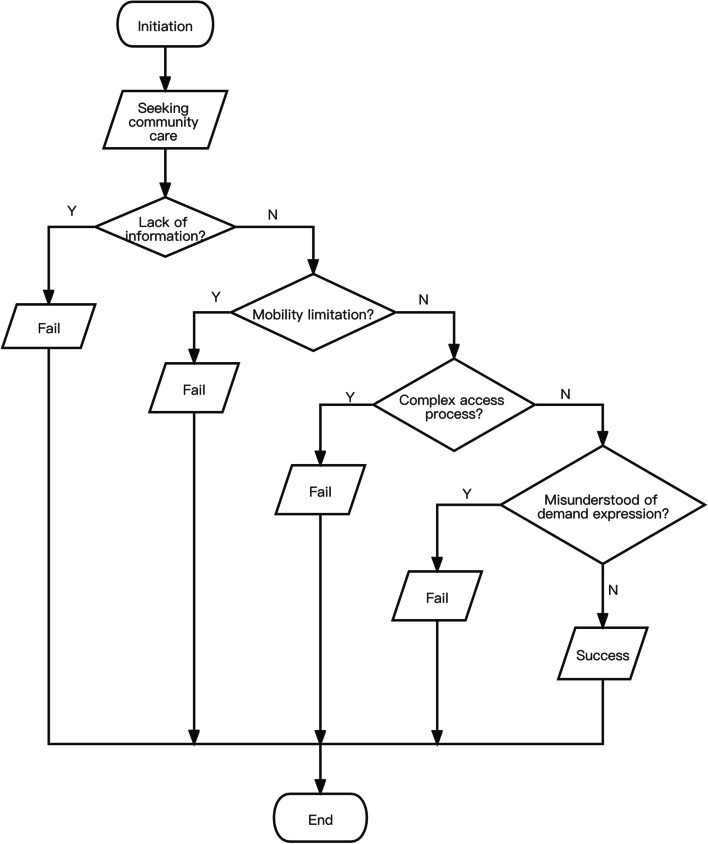
We identified the pathways by which senior-only households sought community care and encountered obstacles. (1) lack of community care information: older adults did not know where and how to get services, even though the care institutions scattered throughout the community; (2) limited mobility: older adults often suffered from various chronic diseases, which physically hindered their access to care resources; (3) complex process of achieving care: the functional fragmentation and geographical dispersion of care institutions made the care-seeking process challenging and confusing for older adults; (4) incomprehension of needs expression: limited interaction time and communication barriers between staff of institutions and the older adults were the final obstacle. Only by surmounting these obstacles one by one can older adults access the care resources effectively.
When older adults in the community initiated calls for help, they encountered several obstacles. Their physiological and social disadvantages limited their ability to seek care physically. Lack of integration and clear guidance in the process of providing community care exacerbated these difficulties. Reform of care services should focus on the visibility and accessibility of services for older adults.
独居的老年人数量增加,产生了大量的护理需求。然而,为满足这些需求而使用的服务和设施的利用率却低得惊人。许多老年人在获得这些服务时遇到困难,尽管尚不清楚这些障碍如何阻碍他们获得服务。本研究探讨了城市老年人在寻求社区护理时所经历的障碍和困难。
进行了一项现象学研究,采用参与式观察和深入访谈来调查城市社区老年人寻求护理的过程。共纳入 18 名 75 岁及以上的城市社区居住的老年人。通过内容分析对收集到的数据进行分析。
我们确定了独居家庭寻求社区护理并遇到障碍的途径。(1)缺乏社区护理信息:老年人不知道在哪里以及如何获得服务,尽管社区内到处都是护理机构;(2)行动不便:老年人经常患有各种慢性疾病,这在身体上阻碍了他们获得护理资源;(3)获得护理的过程复杂:护理机构的功能碎片化和地理分散化使得老年人在寻求护理资源时感到困难和困惑;(4)对需求表达的理解有限:机构工作人员与老年人之间的互动时间有限,沟通障碍是最后的障碍。只有一个一个地克服这些障碍,老年人才能有效地获得护理资源。
当社区中的老年人开始寻求帮助时,他们遇到了几个障碍。他们的生理和社会劣势限制了他们寻求护理的能力。提供社区护理过程中的缺乏整合和明确指导加剧了这些困难。护理服务的改革应侧重于为老年人提供服务的可见性和可及性。