Center for Retrovirus Research, Ohio State University, Columbus, OH 43210, USA.
Department of Veterinary Biosciences, Ohio State University, Columbus, OH 43210, USA.
Sci Transl Med. 2022 Mar 23;14(637):eabn8057. doi: 10.1126/scitranslmed.abn8057.
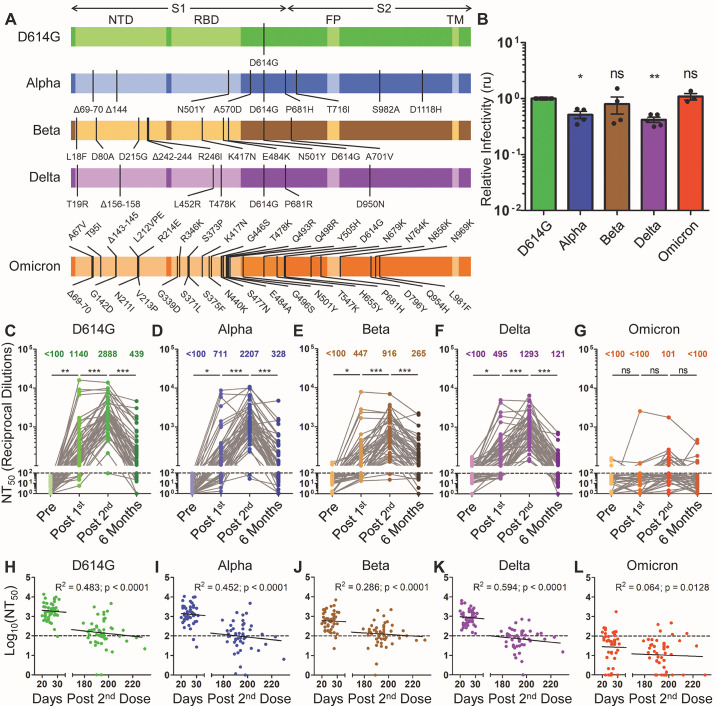
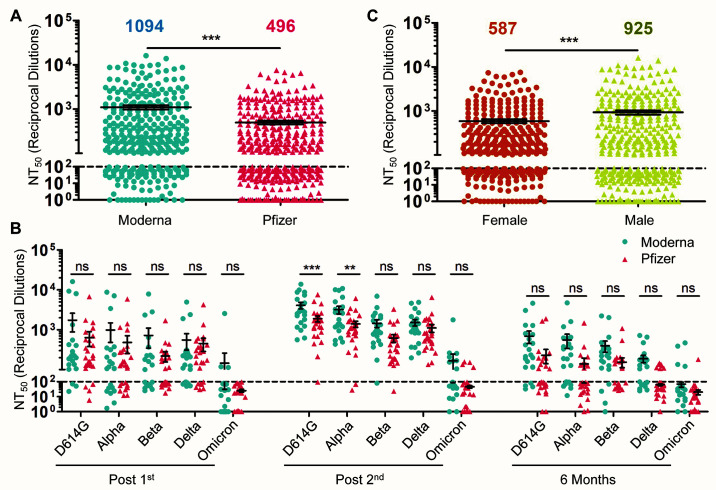
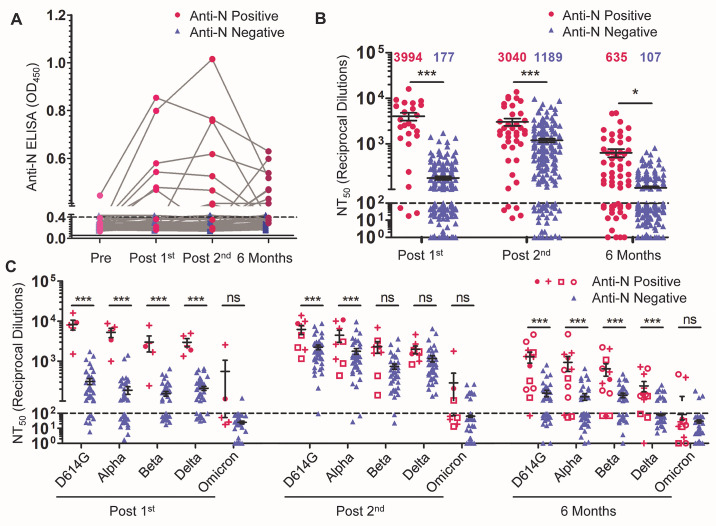
The waning efficacy of SARS-CoV-2 vaccines, combined with the continued emergence of variants resistant to vaccine-induced immunity, has reignited debate over the need for booster vaccine doses. To address this, we examined the neutralizing antibody response against the spike protein of five major SARS-CoV-2 variants, D614G, Alpha (B.1.1.7), Beta (B.1.351), Delta (B.1.617.2), and Omicron (B.1.1.529), in health care workers (HCWs) vaccinated with SARS-CoV-2 mRNA vaccines. Serum samples were collected before vaccination, 3 weeks after first vaccination, 1 month after second vaccination, and 6 months after second vaccination. Minimal neutralizing antibody titers were detected against Omicron pseudovirus at all four time points, including for most patients who had SARS-CoV-2 breakthrough infections. Neutralizing antibody titers against all other variant spike protein-bearing pseudoviruses declined markedly from 1 to 6 months after the second mRNA vaccine dose, although SARS-CoV-2 infection boosted vaccine responses. In addition, mRNA-1273-vaccinated HCWs exhibited about twofold higher neutralizing antibody titers than BNT162b2-vaccinated HCWs. Together, these results demonstrate possible waning of antibody-mediated protection against SARS-CoV-2 variants that is dependent on prior infection status and the mRNA vaccine received. They also show that the Omicron variant spike protein can almost completely escape from neutralizing antibodies elicited in recipients of only two mRNA vaccine doses.
SARS-CoV-2 疫苗效力逐渐减弱,加上不断出现对疫苗诱导免疫有抗性的变异株,再次引发了关于是否需要加强疫苗接种的争论。为了解决这个问题,我们研究了五种主要的 SARS-CoV-2 变异株(D614G、Alpha(B.1.1.7)、Beta(B.1.351)、Delta(B.1.617.2)和 Omicron(B.1.1.529))对接受 SARS-CoV-2 mRNA 疫苗接种的医护人员(HCWs)的 Spike 蛋白的中和抗体反应。在接种疫苗前、第一剂疫苗接种后 3 周、第二剂疫苗接种后 1 个月和第二剂疫苗接种后 6 个月采集血清样本。在所有四个时间点,包括大多数发生 SARS-CoV-2 突破性感染的患者,对 Omicron 假病毒的最小中和抗体滴度均被检测到。自第二剂 mRNA 疫苗接种后 1 至 6 个月,针对所有其他携带变异 Spike 蛋白的假病毒的中和抗体滴度显著下降,尽管 SARS-CoV-2 感染增强了疫苗反应。此外,与 BNT162b2 疫苗接种的 HCWs 相比,mRNA-1273 疫苗接种的 HCWs 表现出约两倍高的中和抗体滴度。总之,这些结果表明,针对 SARS-CoV-2 变异株的抗体介导的保护可能会减弱,这取决于先前的感染状况和所接种的 mRNA 疫苗。它们还表明,仅接受两剂 mRNA 疫苗接种的受种者的 Omicron 变异株 Spike 蛋白几乎可以完全逃避中和抗体的作用。