Department of Internal Medicine and.
Yale Diabetes Research Center, Yale School of Medicine, New Haven, Connecticut, USA.
JCI Insight. 2022 Apr 8;7(7):e157906. doi: 10.1172/jci.insight.157906.
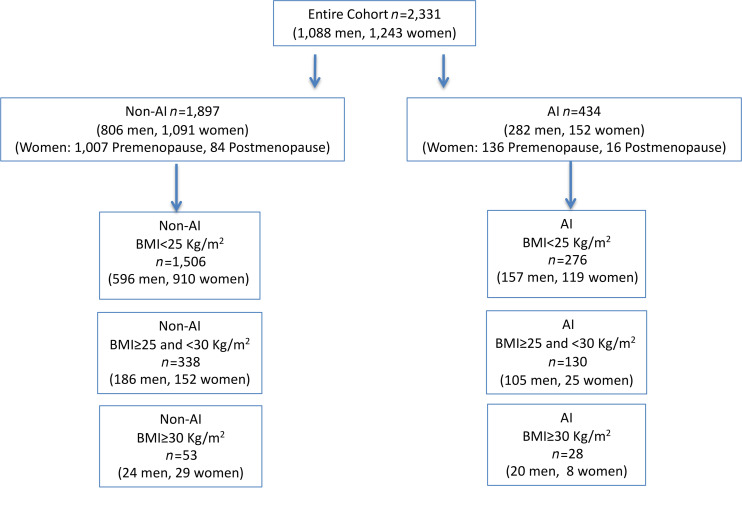
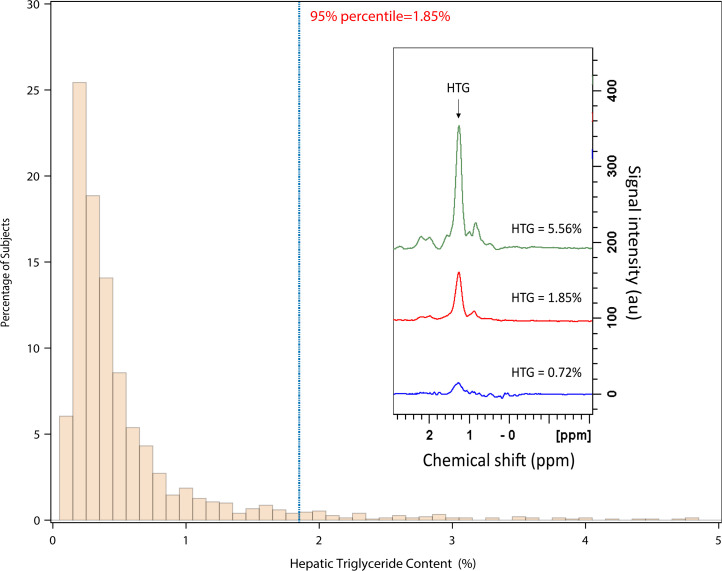
BackgroundNonalcoholic fatty liver affects 25% to 30% of the US and European populations; is associated with insulin resistance (IR), type 2 diabetes, and increased cardiovascular risk; and is defined by hepatic triglyceride (HTG) content greater than 5.56%. However, it is unknown whether HTG content less than 5.56% is associated with cardiometabolic risk factors and whether there are ethnic (Asian Indian, AI, versus non-AI) and/or sex differences in these parameters in lean individuals.MethodsWe prospectively recruited 2331 individuals and measured HTG, using 1H magnetic resonance spectroscopy, and plasma concentrations of triglycerides, total cholesterol, LDL-cholesterol, HDL-cholesterol, and uric acid. Insulin sensitivity was assessed using Homeostatic Model Assessment of Insulin Resistance and the Matsuda Insulin Sensitivity Index.ResultsThe 95th percentile for HTG in lean non-AI individuals was 1.85%. Plasma insulin, triglycerides, total cholesterol, LDL-cholesterol, and uric acid concentrations were increased and HDL-cholesterol was decreased in individuals with HTG content > 1.85% and ≤ 5.56% compared with those individuals with HTG content ≤ 1.85%, and these altered parameters were associated with increased IR. Mean HTG was lower in lean non-AI women compared with lean non-AI men, whereas lean AI men and women had a 40% to 100% increase in HTG when compared with non-AI men and women, which was associated with increased cardiometabolic risk factors.ConclusionWe found that the 95th percentile of HTG in lean non-AI individuals was 1.85% and that HTG concentrations above this threshold were associated with IR and cardiovascular risk factors. Premenopausal women were protected from these changes whereas young, lean AI men and women manifested increased HTG content and associated cardiometabolic risk factors.FundingGrants from the United States Department of Health and Human Resources (NIH/National Institute of Diabetes and Digestive and Kidney Diseases): R01 DK113984, P30 DK45735, U24 DK59635, and UL1 RR024139; and the Novo Nordisk Foundation (NNF18CC0034900).
非酒精性脂肪肝影响美国和欧洲人群的 25%至 30%;与胰岛素抵抗(IR)、2 型糖尿病和增加的心血管风险相关;并且由肝甘油三酯(HTG)含量大于 5.56%定义。然而,尚不清楚 HTG 含量小于 5.56%是否与心血管代谢危险因素相关,并且在瘦个体中是否存在种族(印度裔与非印度裔)和/或性别差异。
我们前瞻性招募了 2331 名个体,并使用 1H 磁共振波谱法测量 HTG,以及血浆甘油三酯、总胆固醇、LDL-胆固醇、HDL-胆固醇和尿酸浓度。使用稳态模型评估胰岛素抵抗和 Matsuda 胰岛素敏感性指数评估胰岛素敏感性。
瘦非印度裔个体中 HTG 的第 95 百分位数为 1.85%。与 HTG 含量≤1.85%的个体相比,HTG 含量>1.85%且≤5.56%的个体中血浆胰岛素、甘油三酯、总胆固醇、LDL-胆固醇和尿酸浓度升高,HDL-胆固醇降低,这些改变的参数与 IR 增加相关。与瘦非印度裔男性相比,瘦非印度裔女性的平均 HTG 较低,而与非印度裔男性和女性相比,瘦印度裔男性和女性的 HTG 增加了 40%至 100%,这与增加的心血管代谢危险因素相关。
我们发现瘦非印度裔个体中 HTG 的第 95 百分位数为 1.85%,并且该阈值以上的 HTG 浓度与 IR 和心血管危险因素相关。绝经前女性免受这些变化的影响,而年轻、瘦的印度裔男性和女性表现出增加的 HTG 含量和相关的心血管代谢危险因素。
美国卫生与公众服务部(美国国立卫生研究院/国家糖尿病、消化和肾脏疾病研究所)的拨款:R01 DK113984、P30 DK45735、U24 DK59635 和 UL1 RR024139;以及诺和诺德基金会(NNF18CC0034900)。